
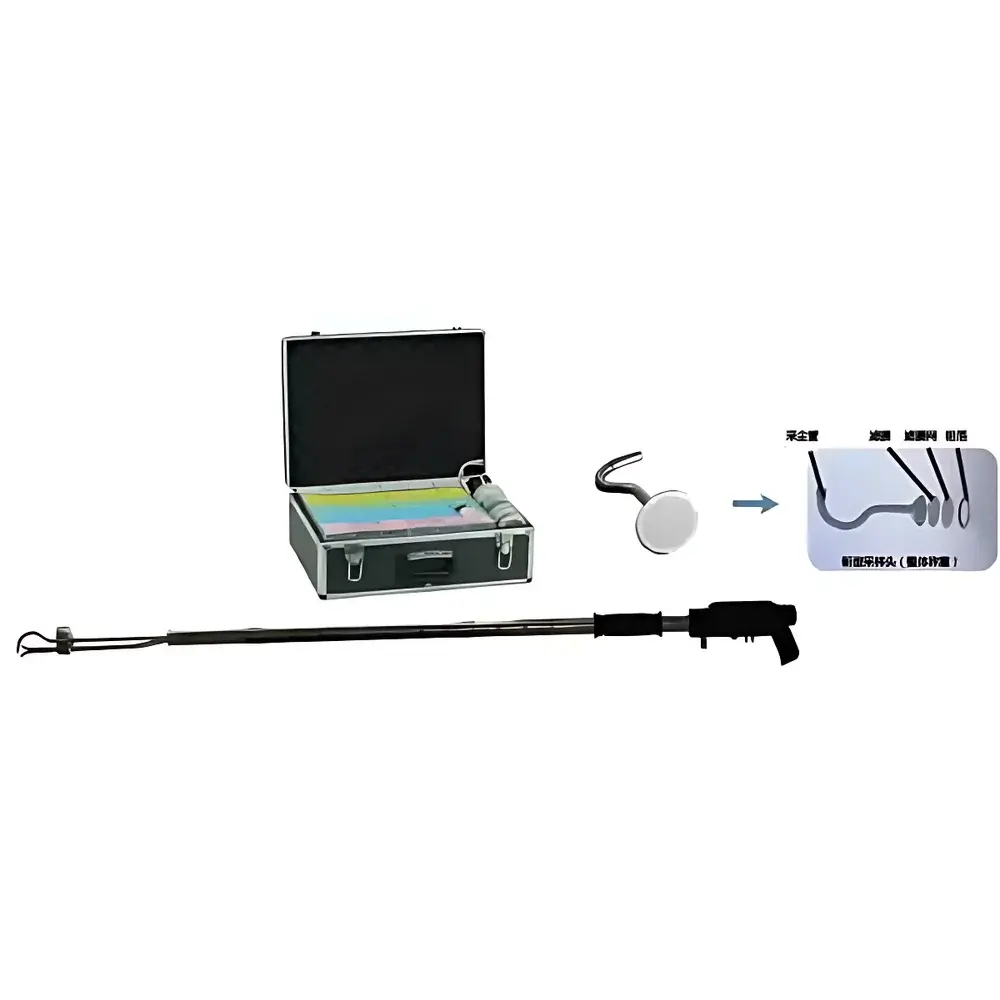
Tianhong TH-D47 Low-Concentration Particulate Sampling Probe
| Brand | Tianhong |
|---|---|
| Origin | Hubei, China |
| Manufacturer Type | Authorized Distributor |
| Country of Origin | China |
| Model | TH-D47 |
| Price Range | USD 1,400 – 2,800 |
| Application | Flue Gas Particulate Sampling at Concentrations < 50 mg/m³ |
| Operating Environment | High-Humidity Flue Gas Streams |
| Sampling Principle | Isokinetic Probe with Integrated Pre-Weighed Membrane Filter Cartridge |
| Weight of Probe Head | < 20 g |
| Gravimetric Compatibility | Compatible with 0.1 mg (100 µg) Analytical Balances |
| Available Nozzle Diameters | 4 mm, 6 mm, 8 mm, 10 mm |
| Filter Medium | PTFE or Quartz Fiber Membrane (Standard 47 mm Diameter) |
Overview
The Tianhong TH-D47 Low-Concentration Particulate Sampling Probe is an engineered solution for regulatory-grade gravimetric sampling of fine particulate matter (PM) in low-emission flue gas streams—specifically targeting concentrations below 50 mg/m³ under high-humidity conditions. Unlike conventional filter-tube-based methods governed by EPA Method 5 and GB/T 16157–1996, the TH-D47 implements an isokinetic sampling architecture with a fully integrated, pre-weighed membrane filter cartridge housed within a lightweight, thermally stable probe head. This design eliminates interfacial losses associated with traditional glass-fiber filter tubes—including static adhesion, condensate retention in bends, and mechanical rupture during transport—thereby improving measurement fidelity and reducing uncertainty in mass determination. The probe operates in tandem with certified stack sampling systems (e.g., portable or fixed-stack samplers compliant with ISO 9096 and HJ 836–2017), maintaining strict velocity matching across the nozzle to ensure representative particle capture without inertial bias.
Key Features
- Isokinetic sampling capability across variable flue gas velocities (5–30 m/s), enabled by interchangeable stainless-steel nozzles (4 mm, 6 mm, 8 mm, and 10 mm inner diameters)
- Monolithic probe head assembly weighing less than 20 g—designed for direct compatibility with Class I analytical balances (readability ≤ 0.1 mg) per ISO/IEC 17025 calibration requirements
- Integrated filter support structure that secures 47 mm diameter PTFE or quartz fiber membranes without edge folding or tension-induced deformation
- Nozzle-to-filter alignment optimized to minimize turbulent eddy formation and particle bounce, enhancing collection efficiency for sub-10 µm aerosols
- Corrosion-resistant 316L stainless-steel body with optional heated sheath (up to 180 °C) to suppress water vapor condensation in saturated stacks
- Traceable pre-weighing protocol: each probe head is individually calibrated and certified with balance log data, tare weight, and environmental metadata (temperature, RH, barometric pressure)
Sample Compatibility & Compliance
The TH-D47 is validated for use in compliance monitoring under Chinese national standards HJ 836–2017 (“Determination of Particulate Matter in Stationary Source Exhaust Gas—Low Concentration Gravimetric Method”) and aligned with international practices referenced in ISO 9096:2022 (“Air quality—Determination of mass concentration of dust in ducts—Gravimetric method”). It supports sampling of both organic and inorganic particulates—including fly ash, sulfate aerosols, and condensed heavy metals—in wet flue gas streams with relative humidity up to 95% RH and temperatures ranging from 60 °C to 200 °C. All components meet RoHS Directive 2011/65/EU material restrictions. Probe assemblies are supplied with full documentation packages—including Certificate of Conformance, NIST-traceable balance calibration records, and cleanroom handling logs—for GLP-compliant laboratory workflows.
Software & Data Management
While the TH-D47 is a hardware-only passive sampling device, it is fully interoperable with third-party stack emission data acquisition platforms supporting Modbus RTU, RS-485, or analog 4–20 mA inputs. When paired with Tianhong’s TH-900 series stack analyzers or compatible OEM controllers, real-time isokinetic flow correction algorithms automatically adjust pump speed based on measured stack velocity and temperature—ensuring continuous compliance with velocity tolerance thresholds (±10% per HJ 836). All gravimetric data generated using the TH-D47 may be imported into LIMS environments supporting ASTM E1447 or ISO/IEC 17025 audit trails, including electronic signatures, version-controlled worksheets, and chain-of-custody metadata.
Applications
- Regulatory stack testing for coal-fired, biomass, and waste-to-energy power plants operating under ultra-low emission standards (e.g., ≤10 mg/m³ PM)
- Performance verification of electrostatic precipitators (ESPs), fabric filters (FFs), and wet scrubbers in high-moisture exhaust ducts
- Source apportionment studies requiring high-precision PM mass loading data for receptor modeling (e.g., PMF, CMB)
- Validation of continuous emission monitoring systems (CEMS) for particulate matter via reference method correlation (per EN 14181)
- Research-grade sampling in pilot-scale carbon capture units where condensable organics and acid mists coexist with fine ash
FAQ
What filter media are compatible with the TH-D47 probe?
PTFE membrane filters (hydrophobic, 0.3–1.0 µm pore size) and quartz fiber filters (ash-free, 1.0 µm nominal retention) in standard 47 mm diameter format.
Does the probe require field calibration before use?
No—each unit is factory pre-weighed and certified; users perform only post-sampling re-weighing following standardized desiccation and equilibration per HJ 836 Section 7.3.
Can the TH-D47 be used for sampling above 200 °C?
Not without optional high-temperature modification; standard configuration is rated to 200 °C continuous duty; custom ceramic-insulated variants available upon request.
How is isokinetic sampling maintained during variable stack flow conditions?
By selecting the appropriate nozzle diameter and integrating with a feedback-controlled sampling pump system that dynamically adjusts volumetric flow rate based on real-time pitot tube velocity measurements.
Is the probe suitable for ISO 17025-accredited laboratories?
Yes—its design, documentation package, and traceable weighing protocol satisfy Clause 6.4 (Equipment) and Clause 7.7 (Sampling) of ISO/IEC 17025:2017 when operated within defined procedural limits.







