
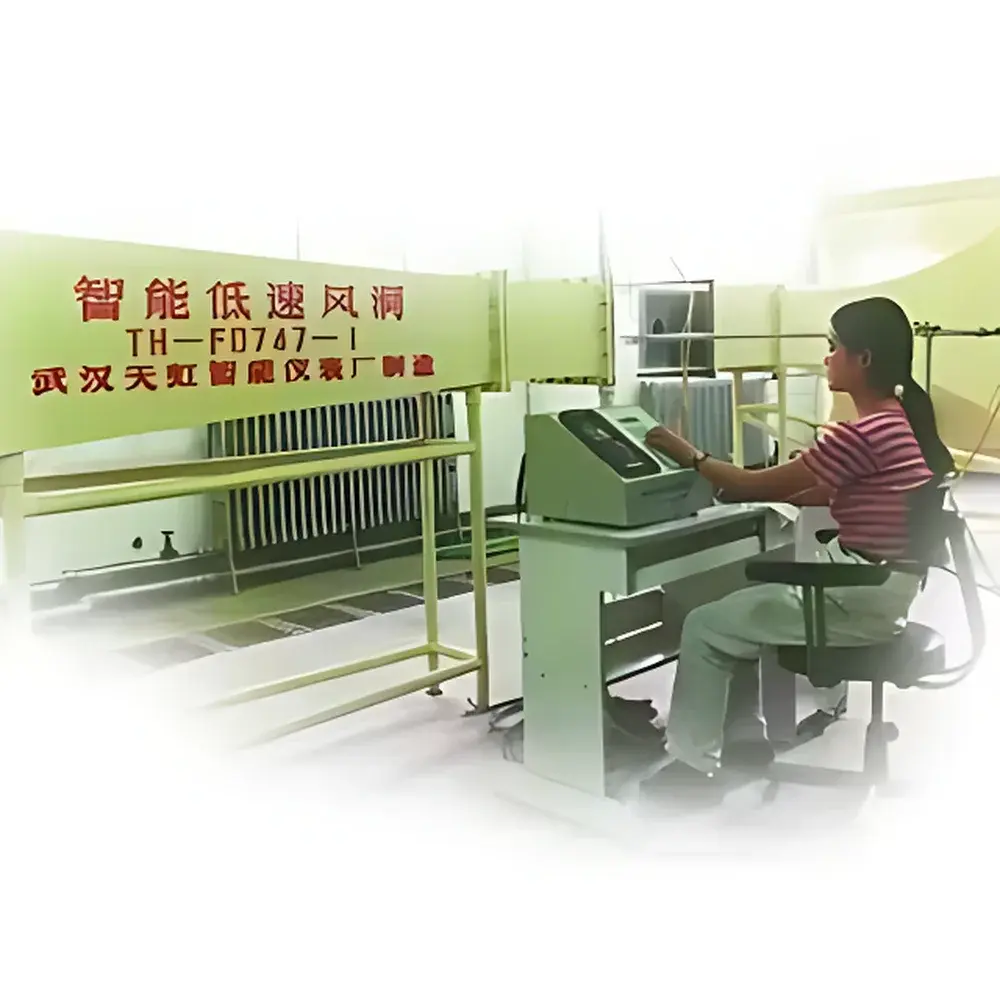
TH-FD747-1 Intelligent Low-Speed Wind Tunnel
| Origin | Hubei, China |
|---|---|
| Manufacturer Type | Authorized Distributor |
| Origin Category | Domestic (China) |
| Model | TH-FD747-1 |
| Pricing | Upon Request |
| Air Velocity Range | 0.5–30 m/s |
| Velocity Uniformity (Relative Standard Deviation) | ±1.2% |
| Flow Stability (Relative Standard Deviation) | ±0.5% |
| Sound Pressure Level | <85 dB(A) |
| Ambient Temperature Measurement Range | −20–100 °C (Accuracy: ±1 °C) |
| Dynamic Pressure Range | 0–1.0 kPa (Accuracy: ±1.5%) |
| Power Supply | 220 V AC, 50 Hz |
| Fan Supply | 380 V AC, 0–50 Hz Variable-Frequency Drive |
Overview
The TH-FD747-1 Intelligent Low-Speed Wind Tunnel is a precision-engineered calibration and validation platform designed for aerodynamic testing, instrument verification, and environmental flow characterization in controlled laboratory and industrial settings. Operating on the principle of forced-convection laminar-to-turbulent transition within a closed-loop or open-circuit configuration, the system generates stable, uniform, and reproducible airflow across a defined test section. Its core function is to serve as a primary reference standard for calibrating anemometers, pitot-static probes, differential pressure transducers, thermal mass flow meters, and other velocity- and pressure-sensitive instrumentation used in environmental monitoring, HVAC commissioning, occupational health & safety compliance, and academic fluid mechanics research. The wind tunnel integrates real-time feedback control with high-fidelity sensor fusion—enabling traceable, repeatable, and metrologically defensible airflow generation under ISO/IEC 17025-aligned operational conditions.
Key Features
- Microprocessor-based closed-loop velocity control system with automatic ramping, setpoint tracking, and real-time PID adjustment for airspeed stability.
- Variable-frequency drive (VFD) motor control (0–50 Hz) enabling precise, stepless regulation of centrifugal fan output from 0.5 to 30 m/s.
- Integrated sensor suite: high-accuracy differential pressure transducer (0–1.0 kPa, ±1.5% FS), calibrated thermistor-based temperature probe (−20–100 °C, ±1 °C), and certified standard pitot tube for velocity profile mapping.
- Acoustically optimized ductwork and fan housing achieving <85 dB(A) sound pressure level at operator position—compliant with OSHA and EU Directive 2003/10/EC noise exposure limits.
- Onboard thermal management ensuring stable operation across ambient conditions from −20 to +100 °C without performance drift.
- Embedded thermal printer for immediate hardcopy documentation of calibration reports, including timestamp, setpoint, measured values, deviations, and pass/fail status per user-defined tolerance bands.
Sample Compatibility & Compliance
The TH-FD747-1 accommodates a wide range of test objects—including handheld anemometers, fixed-mount air velocity sensors, multi-point traversing rakes, and compact flow straighteners—within its standardized working section. Its geometric design adheres to ASTM D5467-22 (Standard Test Method for Calibration of Anemometers) and ISO 16813:2021 (HVAC—Air velocity measurement—Calibration requirements). The system supports GLP-compliant workflows through audit-trail-capable data logging (optional USB export), and all critical measurements are traceable to national standards via NIST-traceable calibration certificates supplied with key sensors. It meets CE marking requirements for electromagnetic compatibility (EN 61326-1) and low-voltage directive (2014/35/EU), and its electrical architecture complies with IEC 61800-5-1 for adjustable speed drives.
Software & Data Management
While the TH-FD747-1 operates autonomously via its embedded microcontroller interface, optional PC connectivity (RS-232 or USB-to-serial) enables integration with third-party data acquisition platforms such as LabVIEW, MATLAB, or custom Python-based calibration management systems. All measurement records—including velocity profiles, dynamic pressure traces, temperature logs, and system diagnostics—are timestamped and stored in CSV format for post-processing. The firmware supports configurable reporting templates aligned with ISO/IEC 17025 Clause 7.8 (Reporting of Results), including uncertainty estimation fields and operator identification prompts. Audit trails record parameter changes, calibration events, and firmware updates—supporting FDA 21 CFR Part 11 readiness when deployed in regulated QA/QC environments.
Applications
- Primary calibration of vane anemometers, hot-wire anemometers, and ultrasonic air velocity sensors used in cleanroom monitoring and fume hood certification.
- Verification of differential pressure gauges and manometers employed in HVAC balancing, containment validation (e.g., ISO 14644-3), and pharmaceutical facility airflow qualification.
- Validation of wind speed sensors integrated into environmental monitoring networks (EMNs) for ambient air quality stations (per EPA 40 CFR Part 53).
- Undergraduate and graduate-level experimental fluid dynamics instruction—including boundary layer development, turbulence intensity measurement, and drag coefficient determination.
- Pre-commissioning functional testing of industrial ventilation systems, dust collection hoods, and local exhaust ventilation (LEV) units per HSE HSG258 guidelines.
FAQ
What is the recommended recalibration interval for the TH-FD747-1’s internal sensors?
Annual recalibration is advised for the differential pressure transducer and temperature probe; biannual verification is recommended for velocity uniformity and stability performance using NIST-traceable reference instruments.
Can the TH-FD747-1 be integrated into an automated calibration laboratory?
Yes—via RS-232 or optional Ethernet module (TH-FD747-1-ETH), it supports SCPI-like command sets for remote start/stop, setpoint change, and data polling in LIMS or MES environments.
Is the wind tunnel suitable for calibrating thermal mass flow meters?
It is appropriate for low-flow, low-velocity thermal sensors operating below 30 m/s, provided the test object does not significantly disrupt flow uniformity or introduce thermal plumes affecting upstream measurement integrity.
Does the system include uncertainty budget documentation?
A comprehensive uncertainty analysis report—covering contributions from sensor accuracy, velocity non-uniformity, temporal stability, and environmental influence factors—is provided upon request with factory calibration certificate.
What safety certifications does the TH-FD747-1 hold?
It carries CE marking (EMC Directive 2014/30/EU, LVD Directive 2014/35/EU), RoHS 2011/65/EU compliance, and conforms to IEC 61000-6-2/6-4 immunity and emission requirements.







