
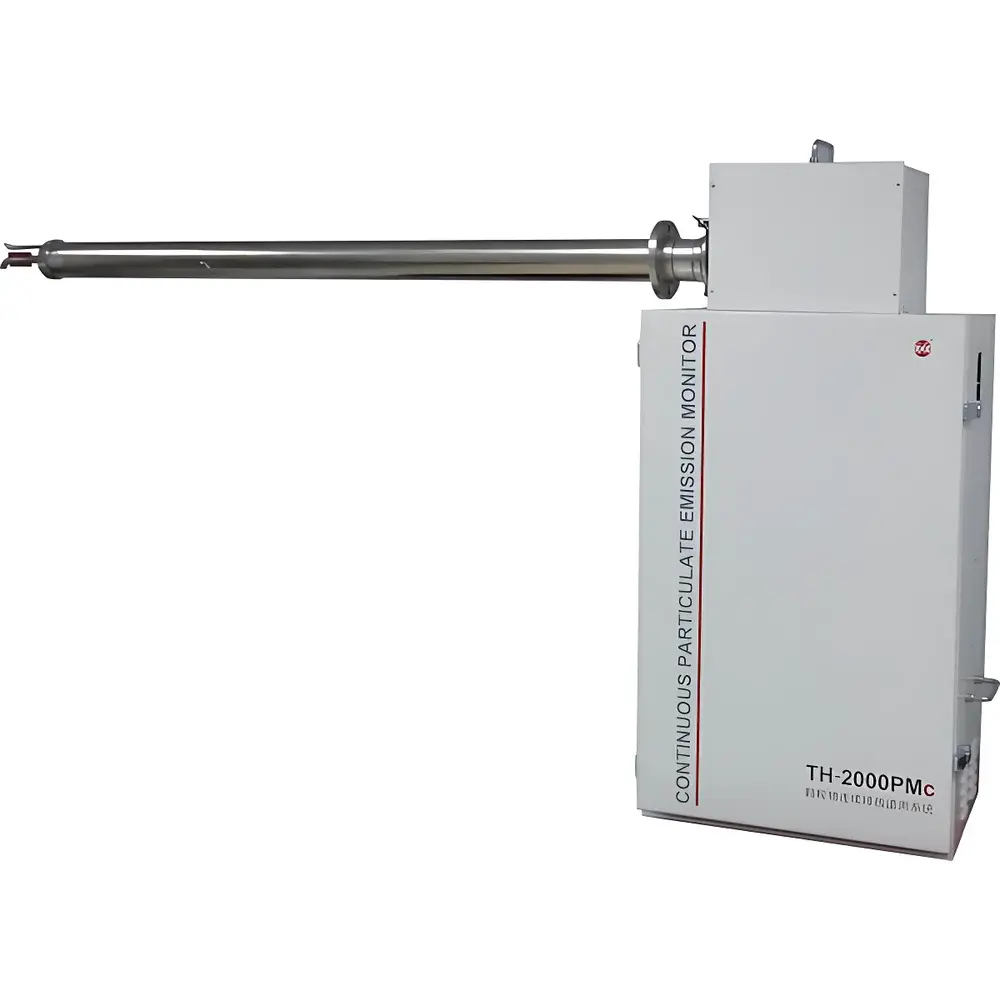
Tianhong TH-810β Beta-Ray Low-Concentration Particulate Matter Monitor
| Brand | Tianhong |
|---|---|
| Origin | Hubei, China |
| Manufacturer Type | Authorized Distributor |
| Model | TH-810β |
| Price Range | USD 35,000–56,000 (FOB) |
| Measurement Principle | Beta-ray Absorption Method |
| Measured Parameters | PM₁₀ and PM₂.₅ |
| Sampling Method | Isokinetic Tracking or Constant-Flow Sampling |
| Heating Temperature Range | Up to 130 °C (adjustable) |
| Display | 7-inch TFT Touchscreen |
| Data Interface | USB, RS232, RS485, LAN, GPRS |
| Environmental Rating | IP54 |
| Operating Temperature | −20 °C to +50 °C |
| Power Supply | AC 220 V ±10%, 50 Hz |
| Internal Data Storage | ≥12 months (1-min resolution) |
| Power Backup | Built-in UPS with >30 min hold-up time |
Overview
The Tianhong TH-810β is a certified continuous emission monitoring system (CEMS) engineered for regulatory-grade measurement of low-concentration particulate matter (PM) in flue gas streams—specifically targeting emissions below 50 mg/m³. It operates on the beta-ray absorption principle: a calibrated β-particle source (typically 14C or 85Kr) emits electrons through a filter tape that collects deposited particles; attenuation of the beam is quantified via a scintillation detector, enabling mass concentration calculation based on the Beer–Lambert law. Unlike optical scattering methods, beta-ray absorption provides direct, interference-resistant mass determination independent of particle refractive index, hygroscopicity, or morphology—critical for compliance with national and provincial emission standards in China (e.g., HJ 75–2017, HJ 76–2017) and aligned with international CEMS performance criteria (EN 13284-1, ISO 12141). The instrument is designed for permanent installation at stack outlets of thermal power plants, cement kilns, glass furnaces, and other high-temperature industrial processes where condensation risk, humidity fluctuations, and particulate loading variability demand robust thermal management and isokinetic sampling integrity.
Key Features
- Isokinetic sampling probe integrated with Pitot tube and thermocouple for real-time velocity and temperature profiling—ensuring representative sample extraction per ISO 9096 and EPA Method 5.
- Full-path heated sampling line (up to 130 °C), including probe, transfer line, and filter chamber, preventing water vapor condensation and volatile organic compound (VOC) adsorption that compromise PM mass accuracy.
- Dual-mode sampling control: programmable isokinetic tracking (with automatic flow adjustment via servo-controlled pump) or constant-flow operation (16.7 L/min nominal) for flexibility across varying stack velocities.
- Industrial-grade cooling system (embedded air conditioning unit) maintains internal electronics and detector stability under ambient temperatures up to +50 °C—enabling uninterrupted operation in unconditioned outdoor enclosures.
- 32-bit embedded microcontroller with deterministic real-time OS ensures precise timing of tape advancement, radiation counting intervals, zero/span calibration cycles, and environmental compensation algorithms.
- 7-inch capacitive touchscreen interface with multilingual UI (English/Chinese), intuitive menu navigation, and context-sensitive help—supporting field configuration without external PC.
- Built-in data logger with non-volatile flash memory stores ≥12 months of 1-minute averaged PM₁₀/PM₂.₅ values, auxiliary parameters (flow rate, temperature, pressure, humidity), and system diagnostics.
Sample Compatibility & Compliance
The TH-810β is validated for use with flue gases containing moisture content ≤30% v/v, temperature ≤200 °C (pre-heater inlet), and corrosive components typical of coal-fired, biomass, or waste incineration exhaust (SO₂ ≤2000 ppm, NOₓ ≤1000 ppm, HCl ≤500 ppm). Filter tapes are standard quartz-fiber or Teflon-coated glass fiber substrates compliant with EN 13284-1 Annex A. Instrument design meets IP54 ingress protection for outdoor cabinet mounting. Calibration traceability follows NIST-traceable beta sources and gravimetric reference filters. System-level validation supports GLP-compliant audit trails, including timestamped calibration logs, maintenance records, and alarm history—all exportable via USB or remote protocols. Fully compatible with China’s national CEMS data acquisition and transmission requirements (HJ 212–2017 communication protocol).
Software & Data Management
Data acquisition and reporting are managed via Tianhong’s proprietary CEMS-Link software suite (Windows-based), supporting automated data upload to provincial environmental monitoring platforms (e.g., China’s National Emission Monitoring Network). Local storage includes full metadata: raw counts, background subtraction, tape blank correction, flow-compensated mass loading, and uncertainty flags per measurement cycle. Remote access is enabled via secure TCP/IP (LAN/GPRS) with role-based authentication and encrypted data transmission. All critical events—including power loss, filter saturation, heater fault, or calibration deviation—are logged with millisecond timestamps and retained for ≥3 years. Audit trail functionality complies with basic 21 CFR Part 11 principles (electronic signatures optional via external PKI integration).
Applications
- Continuous monitoring of PM₁₀ and PM₂.₅ emissions from coal-, gas-, or biomass-fired power generation units—particularly subcritical and ultra-low-emission retrofitted boilers.
- Stack-side particulate verification in rotary kiln systems (cement clinker production), where alkali-rich dust and transient thermal shocks challenge sensor reliability.
- Real-time process feedback in flat-glass and container-glass melting furnaces, where refractory wear and batch composition shifts affect fine particulate generation.
- Compliance verification for municipal solid waste incinerators (MSWIs) and hazardous waste treatment facilities subject to stringent EU IED or China’s GB 18485–2014 limits.
- Research-grade source testing in EPA Method 17 or ISO 16911-1 field campaigns requiring stable, low-drift beta-ray reference measurements.
FAQ
What is the minimum detectable concentration (MDC) for PM₂.₅ using the TH-810β?
The MDC is 0.01 mg/m³ (1σ, 1-hour average), determined per HJ 76–2017 Annex D using background-subtracted net count statistics and certified filter blanks.
Does the instrument support automatic zero and span calibration?
Yes—zero calibration uses clean air purged through the sampling path; span calibration employs NIST-traceable PM reference aerosols (e.g., Arizona Test Dust, KCl) delivered via integrated dynamic dilution system.
Can the TH-810β be integrated into existing DCS or SCADA systems?
Yes—via Modbus TCP/RTU over RS485 or Ethernet, with configurable register mapping for PM values, status flags, and diagnostic codes.
How often does the filter tape require replacement?
Standard operation at 16.7 L/min yields ~30 days of continuous use per 20-m tape roll; extended-life tapes (50-m) are available for low-emission applications.
Is third-party certification available for international deployment?
TÜV Rheinland and SGS validation reports per EN 13284-1 and MCERTS are available upon request for projects in EU, Southeast Asia, and Middle East markets.
Related Products







