
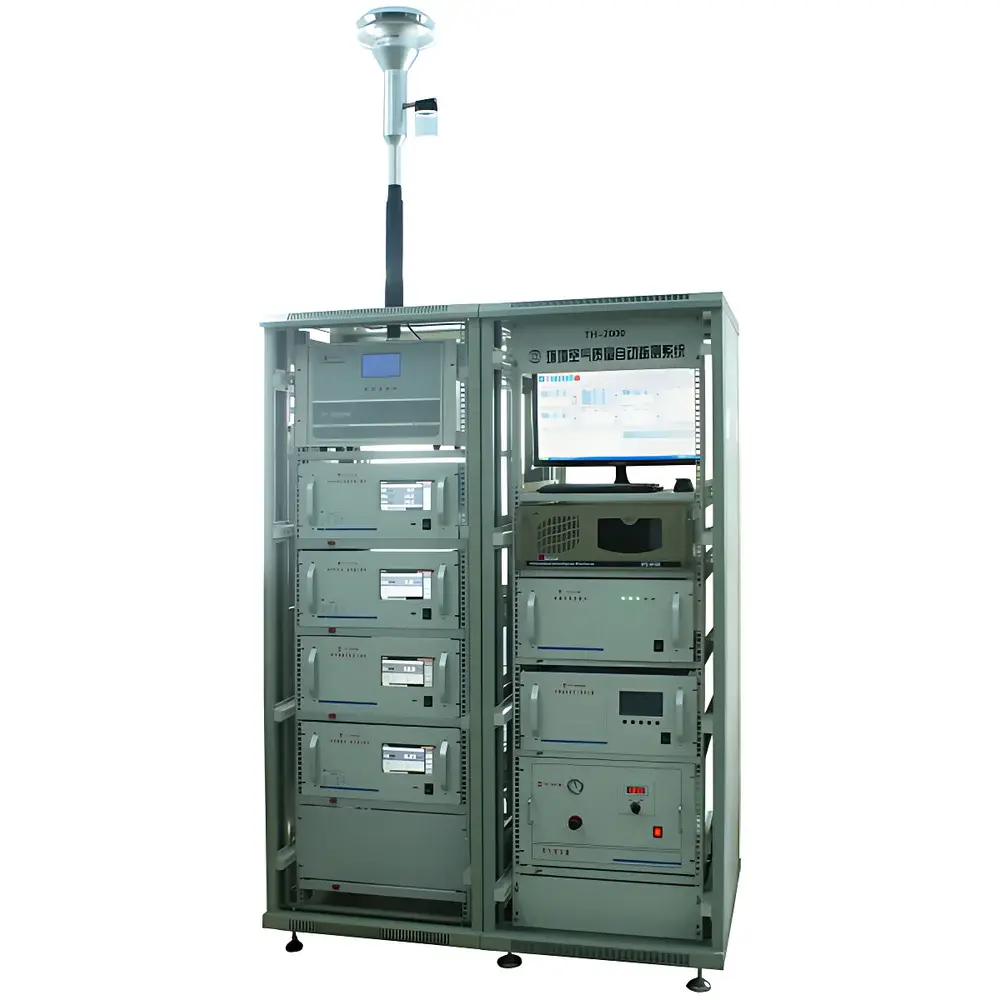
Tianhong TH-2000 Series Automatic Ambient Air Quality Monitoring & Network Management System
| Brand | Tianhong |
|---|---|
| Origin | Hubei, China |
| Manufacturer Type | Authorized Distributor |
| Country of Origin | China |
| Model | TH-2000 Series |
| Pricing | Upon Request |
Overview
The Tianhong TH-2000 Series Automatic Ambient Air Quality Monitoring & Network Management System is a fully integrated, regulatory-compliant environmental monitoring platform engineered for continuous, real-time measurement and centralized management of ambient air pollutants across regional and municipal networks. Designed in strict accordance with China’s national ambient air quality standard GB 3095–2012 and method validation standards including HJ 653–2013, the system employs multiple reference-grade analytical techniques—including beta attenuation (β-ray), chemiluminescence, ultraviolet fluorescence, nondispersive infrared (NDIR), and tapered element oscillating microbalance (TEOM)—to quantify gaseous and particulate pollutants with metrological traceability. The architecture follows a distributed station model: one central data processing station communicates bidirectionally with multiple remote sub-stations via secure, redundant communication channels (wired broadband, GPRS, 3G, or Ethernet). All sub-station instruments—including gas analyzers, PM monitors, meteorological sensors, zero-air generators, and calibration gas systems—operate under synchronized time stamps and unified metadata tagging, enabling audit-ready data lineage from raw sensor output to statutory reporting.
Key Features
- Modular, scalable architecture supporting heterogeneous instrument integration—compatible with domestic and international OEM analyzers via standardized analog/digital I/O and Modbus/RS-485 protocols.
- Regulatory-grade data acquisition and processing: compliant with GB 3095–2012, HJ 653–2013, and aligned with ISO/IEC 17025 principles for environmental testing laboratories.
- Multi-tier software hierarchy: provincial-level software aggregates data from multiple prefectural stations; municipal-level software manages sub-station fleets and forwards validated data upstream to provincial and national monitoring centers.
- Patented hardware subsystems: ZL200910161771.8 zero-air generator (dew point ≤ −15 °C, CO/HC removal); ZL201210105501.7 dual-channel PM splitter; ZL2010201010250048.1 TEOM humidity compensation algorithm.
- Comprehensive remote diagnostics and QA/QC control: remote zero/span calibration, 24-hour drift verification, noise assessment, precision evaluation, and automated filter tape advancement based on real-time mass loading feedback.
- Robust data governance: timestamped raw data logging at user-selectable intervals (1-min, 1-hr, 24-hr means); built-in audit trail for all manual interventions; GLP-aligned data review and approval workflows.
Sample Compatibility & Compliance
The TH-2000 Series supports simultaneous monitoring of TSP, PM₁₀, PM₂.₅, PM₁, SO₂, NO, NO₂, NOₓ, O₃, CO, H₂S, and NH₃. Particulate measurements adhere to gravimetric equivalence principles: β-ray absorption (TH-2000PM/PMb) and TEOM (TH-2000Z1) both report mass concentration in μg/m³ with resolution to 0.1 μg/m³. Gaseous analyzers meet EPA CTM and EN 14625 equivalency requirements where applicable. Meteorological modules (TH-2009) comply with WMO Guide to Meteorological Instruments and Methods of Observation (CIMO Guide) and carry CE certification. All hardware components undergo factory calibration against NIST-traceable standards, with documented uncertainty budgets per ISO/IEC 17025 Annex A.3.
Software & Data Management
The embedded TH-2010 Data Acquisition System implements role-based access control (RBAC), encrypted database storage (SQL Server or PostgreSQL), and full 21 CFR Part 11–compliant electronic signature support for data review/approval. Reporting functions include automated generation of daily, monthly, and annual statistics—API/AQI indices, temporal trend analysis (year-on-year, month-on-month), data capture efficiency (%), validity rate (%), and statistical summaries per pollutant and station. Export formats include UTF-8 TXT, XLSX, and DBF; all reports retain embedded metadata (station ID, instrument serial number, calibration date, QA flag). Data synchronization with third-party platforms (e.g., China National Environmental Monitoring Centre’s CNEMC middleware) is supported via HTTP RESTful API or FTP/SFTP.
Applications
This system is deployed in national ambient air quality monitoring networks, municipal environmental protection bureaus, industrial emission compliance monitoring, roadside traffic pollution studies, and mobile monitoring platforms (e.g., vehicle- or vessel-mounted deployments). Its modular design supports both fixed-site regulatory monitoring and flexible campaign-based deployment. The dual-channel PM₂.₅/PM₁₀ configuration (TH-2000PMb) enables source apportionment studies, while the TEOM+DHS variant (TH-2000Z1) provides humidity-corrected dry-mass concentrations essential for aerosol optical modeling and health impact assessments. Integration with ultra-sonic meteorological stations (TH-2009) allows wind-sector–resolved pollutant dispersion analysis.
FAQ
Does the system support remote firmware updates and configuration changes?
Yes—authorized users can push configuration templates, update instrument parameters, and deploy firmware patches remotely via authenticated HTTPS sessions.
Is raw data accessible for third-party statistical analysis?
Yes—unprocessed 1-minute raw sensor outputs (including temperature, pressure, flow, and analog voltage signals) are stored locally and retrievable via SQL query or bulk export in CSV format.
How is data integrity maintained during network outages?
Each sub-station includes local non-volatile memory (≥5 years at 1-min resolution); data is automatically retransmitted upon network recovery with sequence-numbered packet acknowledgment.
Can the system generate reports compliant with China’s Ministry of Ecology and Environment (MEE) reporting templates?
Yes—preconfigured report layouts align with MEE Circular No. 113 (2020) and automatically populate required fields including station metadata, QA flags, and statistical validity indicators.
What cybersecurity measures are implemented?
The system enforces TLS 1.2+ encryption for all data transmissions, implements IP whitelisting, disables unused services, and logs all administrative actions with immutable timestamps for forensic auditing.







