
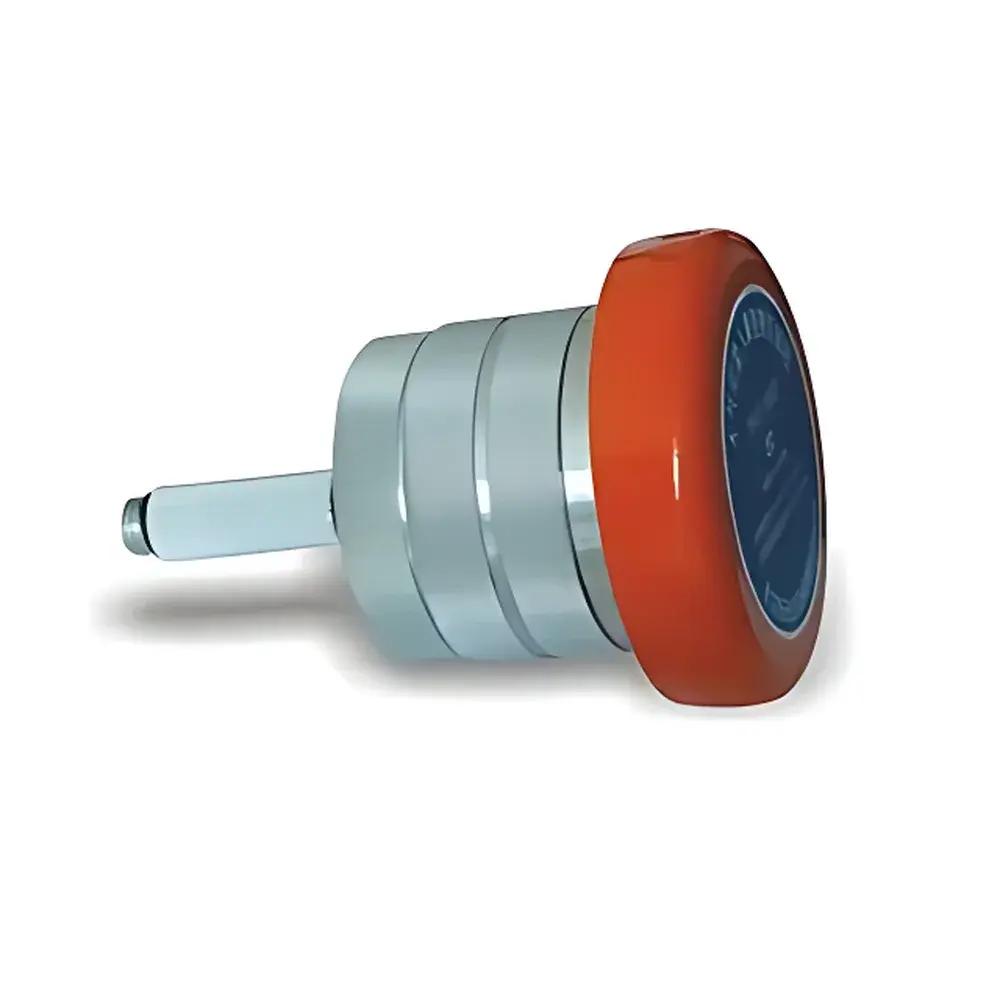
Tianhong PM10-PM5-PM2.5 Multi-Stage Cascade Impactor Sampler
| Brand | Tianhong |
|---|---|
| Origin | Hubei, China |
| Model | PM10-PM5-PM2.5 |
| Cut-off Diameters (da₅₀) | PM10 = 10.2 µm (δg = 1.5), PM5 = 4.93 µm, PM2.5 = 2.47 µm |
| Inlet Design | Compliant with Chinese TSP inlet standard (v = 0.3 m/s |
| Required Flow Rate | 100 L/min ±5% |
| Filter Format | Glass fiber, Ø88 mm |
| Connection Port | Ø18 mm × 2 |
Overview
The Tianhong PM10-PM5-PM2.5 Multi-Stage Cascade Impactor Sampler is a precision-engineered inertial separation device designed for size-resolved ambient particulate matter sampling in compliance with national and international reference methods. Based on the principle of aerodynamic impaction, the sampler employs three sequential impactor stages—each comprising a jet orifice plate and a corresponding collection substrate—to physically segregate airborne particles by aerodynamic diameter. This cascade architecture exploits differences in particle inertia: larger particles deviate from the carrier airflow streamlines upon encountering abrupt flow acceleration at each nozzle array, impacting onto designated collection surfaces, while smaller particles remain entrained downstream to the next stage. The inlet geometry conforms strictly to the Chinese national standard for Total Suspended Particulates (TSP) samplers (GB/T 6921–1986), ensuring representative isokinetic sampling under field conditions. When coupled with the TH-150 series medium-flow air samplers (100 L/min ±5%), this system enables simultaneous or selective collection of TSP, PM₁₀, PM₅, and PM₂.₅ fractions on standardized glass fiber filters (Ø88 mm), supporting gravimetric, elemental, and molecular analysis across environmental monitoring, regulatory compliance, and atmospheric research applications.
Key Features
- Three-stage cascade impactor configuration with identical mechanical design across PM₁₀, PM₅, and PM₂.₅ stages—ensuring consistent fabrication quality and inter-stage comparability.
- Jet orifice plates engineered with calibrated diameters and counts per stage to achieve target cut-point diameters (dₐ₅₀) and geometric standard deviations (δg) in accordance with GB 6921–1986 (PM₁₀), ISO/TR 11805 (PM₂.₅ validation framework), and RMRC reference criteria (PM₅).
- TSP inlet certified to national specifications: nominal inlet velocity of 0.3 m/s and aspect ratio (b/a) of 0.625—minimizing particle loss due to diffusion, sedimentation, or electrostatic deposition during entry.
- Modular interface with dual Ø18 mm ports enabling flexible integration with TH-150 series samplers and optional bypass or parallel sampling configurations.
- Optimized for use with standard 88-mm glass fiber filters—compatible with EPA Method IO-3.2, EN 12341, and ISO 7708 for subsequent mass determination, ICP-MS, XRF, or GC-MS analysis.
Sample Compatibility & Compliance
This impactor is validated for ambient air sampling across urban, rural, industrial, and roadside environments. It meets performance requirements specified in GB 6921–1986 (PM₁₀), GB/T 15432–1995 (TSP), and aligns with the functional definitions of PM₂.₅ in U.S. EPA Reference Method PS-1 and EU Directive 2008/50/EC. While not itself a certified reference method instrument, its dₐ₅₀ and δg values are traceable to laboratory calibrations using monodisperse aerosols (e.g., polystyrene latex spheres) and validated against ISO 29463-3:2017 test protocols. All components are constructed from anodized aluminum and stainless steel to resist corrosion and minimize background contamination during extended deployments. No internal coatings or adhesives contact sampled air—preserving sample integrity for toxicological or isotopic studies.
Software & Data Management
As a passive sampling component, the PM10-PM5-PM2.5 impactor does not incorporate embedded electronics or firmware. However, when deployed with TH-150 series samplers equipped with data loggers, it supports full audit trails compliant with GLP and ISO/IEC 17025 requirements—including timestamped flow rate records, temperature/pressure compensation logs, and operator ID tagging. Raw filter mass data (pre- and post-sampling) must be entered manually into LIMS or Excel-based QA/QC templates aligned with EPA QA/G-5 and ISO 17025 clause 7.7. Calibration certificates for associated flow meters and analytical balances are required for full regulatory defensibility.
Applications
- Regulatory monitoring of PM₁₀ and PM₂.₅ concentrations under national ambient air quality standards (NAAQS equivalents).
- Source apportionment studies requiring size-fractionated samples for receptor modeling (e.g., PMF, CMB).
- Evaluation of filtration efficiency and penetration characteristics of HVAC filters and personal protective equipment.
- Field validation of optical particle counters and low-cost sensor networks via collocated gravimetric reference sampling.
- Long-term trend analysis of coarse (PM₁₀–PM₂.₅), fine (PM₂.₅–PM₁), and ultrafine (<0.1 µm, via downstream nano-impactors) fractions in epidemiological cohort studies.
FAQ
What flow rate is required for accurate operation?
A stable volumetric flow of 100 L/min ±5% is mandatory. Deviations beyond this tolerance invalidate cut-point performance and introduce systematic bias in mass distribution.
Can this impactor be used with non-Tianhong samplers?
Yes—provided the host sampler delivers stable 100 L/min flow, features compatible Ø18 mm inlet/outlet ports, and maintains pressure drop within the impactor’s operational range (typically < 25 kPa at rated flow). Flow calibration against a primary standard (e.g., bubble meter or critical orifice) is strongly recommended.
Is the PM₅ stage recognized in official air quality standards?
While PM₅ is not currently mandated in most national regulations, it serves as an important intermediate metric for characterizing coarse-mode contributions (e.g., road dust, construction emissions) and refining health-effect exposure models where PM₁₀ alone lacks resolution.
How often should the impactor be cleaned and recalibrated?
Clean all stages with isopropanol and lint-free wipes after every 10 sampling events or prior to high-humidity deployments. Annual recalibration using monodisperse aerosol challenges is advised to verify dₐ₅₀ and δg stability—particularly if exposed to corrosive or oily aerosols.
Does the impactor include filter holders or only the separation stages?
The unit includes dedicated filter support plates and retention rings for Ø88 mm glass fiber filters at each stage, but does not supply filters. Filters must be pre-conditioned (24 h at 20–25°C, 40–60% RH) and weighed on a microbalance (±1 µg resolution) per ISO 10175-1.







