
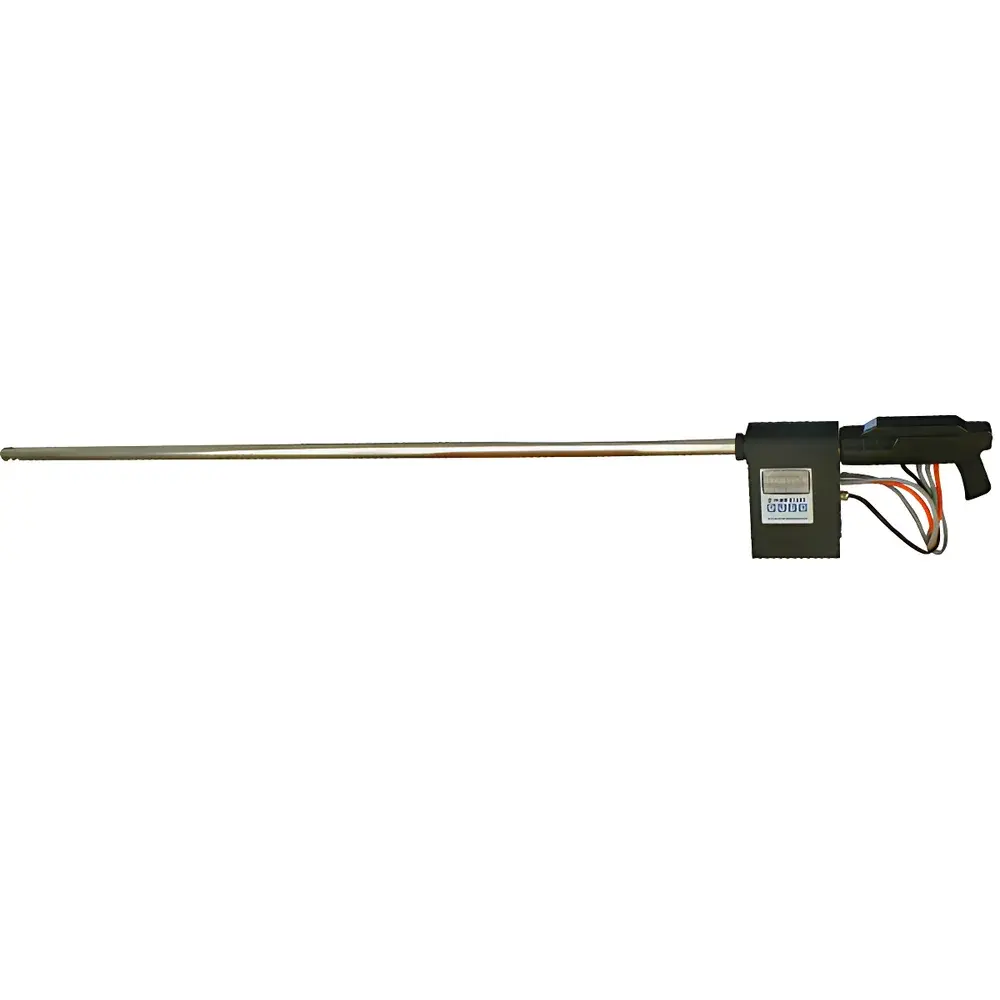
Tianhong TH-210 Two-Dimensional Pitot Tube Flow Velocity Analyzer
| Brand | Tianhong |
|---|---|
| Origin | Hubei, China |
| Manufacturer Type | Authorized Distributor |
| Country of Manufacture | China |
| Model | TH-210 |
| Price Range | USD 140–2,800 |
Overview
The Tianhong TH-210 Two-Dimensional Pitot Tube Flow Velocity Analyzer is an engineered solution for precise in-situ measurement of gas flow vector components in ducts, flues, and industrial exhaust systems. Unlike conventional single-axis Pitot tubes, the TH-210 employs a patented three-hole probe design grounded in classical fluid dynamics principles—specifically, the differential pressure method for resolving orthogonal velocity components (Vx, Vy) in a plane perpendicular to the probe axis. This enables direct determination of both magnitude and direction of local gas velocity, including flow angle deviation from the duct centerline. The instrument is particularly optimized for low-velocity applications (< 1 m/s), where conventional averaging probes suffer from signal-to-noise degradation and directional ambiguity. Its operational principle conforms to ISO 16911-1:2013 (Determination of velocity and volume flow rate of gaseous streams in ducts — Part 1: Velocity measurement by means of pitot-static tubes) and supports compliance with EPA Method 2F and EN 15259 for flue gas monitoring in stationary source emissions testing.
Key Features
- Patented three-hole conical probe with integrated differential pressure transducers for simultaneous acquisition of three independent static/dynamic pressure signals
- Real-time on-board calculation of flow angle (α), yaw angle (β), and axial velocity component (Vaxial) using calibrated multi-point polynomial algorithms
- Microprocessor-controlled embedded system with auto-zeroing, temperature compensation, and dynamic range adaptation (0.1–30 m/s typical operating range)
- Backlit LCD display with Chinese-language interface and contextual prompts for probe alignment correction during field deployment
- Dual-power operation: rechargeable Li-ion battery (≥8 h continuous use) or 12–24 V DC / 100–240 V AC input with galvanic isolation
- Ruggedized aluminum alloy housing rated IP54 for field durability in high-humidity, particulate-laden flue environments
Sample Compatibility & Compliance
The TH-210 is validated for use in circular, rectangular, and irregular cross-section ducts with internal diameters ≥150 mm and gas temperatures up to 180 °C (with optional high-temp probe extension). It accommodates flue gases containing particulates ≤10 µm mass median diameter and moisture content ≤25 vol%. Probe insertion depth is configurable per ISO 16911-2 guidance to ensure representative sampling across velocity profiles. The analyzer meets CE marking requirements for electromagnetic compatibility (EN 61326-1) and safety (EN 61010-1). Data output formats comply with ASTM D6784-22 Annex A2 for integration into continuous emission monitoring systems (CEMS) and supports audit-ready traceability under GLP and ISO/IEC 17025 laboratory quality frameworks.
Software & Data Management
Field data are stored internally (≥2,000 records) with timestamp, GPS-assisted location tagging (optional external module), and probe orientation metadata. USB-C interface enables direct export to CSV or XML via Tianhong’s proprietary TH-DataLink v3.2 software (Windows 10/11 compatible). The software provides automated velocity profile reconstruction, ISO-compliant traverse point weighting, and uncertainty estimation per GUM (JCGM 100:2008). Exported datasets include full calibration certificate references, sensor drift logs, and user-defined annotation fields—supporting 21 CFR Part 11–compliant electronic record retention when deployed with role-based access control and digital signature modules.
Applications
- Stack testing and regulatory compliance verification per EPA Performance Specification 1 (PS-1) and EU Directive 2010/75/EU (IED)
- Energy audit of HVAC duct networks, including leakage assessment and fan system efficiency evaluation
- Process optimization in cement kilns, waste incinerators, and biomass boilers where asymmetric flow patterns impact combustion efficiency
- Validation of CFD model boundary conditions in industrial ventilation design
- Research-grade characterization of turbulent flow structures in wind tunnel test sections and flue gas recirculation loops
FAQ
What standards does the TH-210 conform to for flue gas velocity measurement?
It complies with ISO 16911-1:2013, EPA Method 2F, and EN 15259 for velocity profiling in ducts and stacks.
Can the TH-210 measure flow in wet or corrosive flue gas streams?
Yes—when equipped with the optional Hastelloy C-276 probe tip and PTFE-coated pressure lines, it operates reliably in condensable and mildly acidic gas environments.
Is probe calibration traceable to national metrology institutes?
Each unit ships with a NIST-traceable calibration certificate covering ±0.5° angular accuracy and ±1.5% full-scale velocity uncertainty at 20 °C and 101.3 kPa.
How is flow angle correction applied during measurement?
The instrument continuously computes instantaneous yaw and pitch angles from the three-hole pressure ratio matrix and applies real-time vector projection to derive true axial velocity, eliminating manual trigonometric correction.
Does the TH-210 support automated traverse control?
While standalone operation is manual, the USB-C interface enables synchronization with third-party motorized traverse systems via TTL trigger signals and position feedback protocols.
Related Products







