
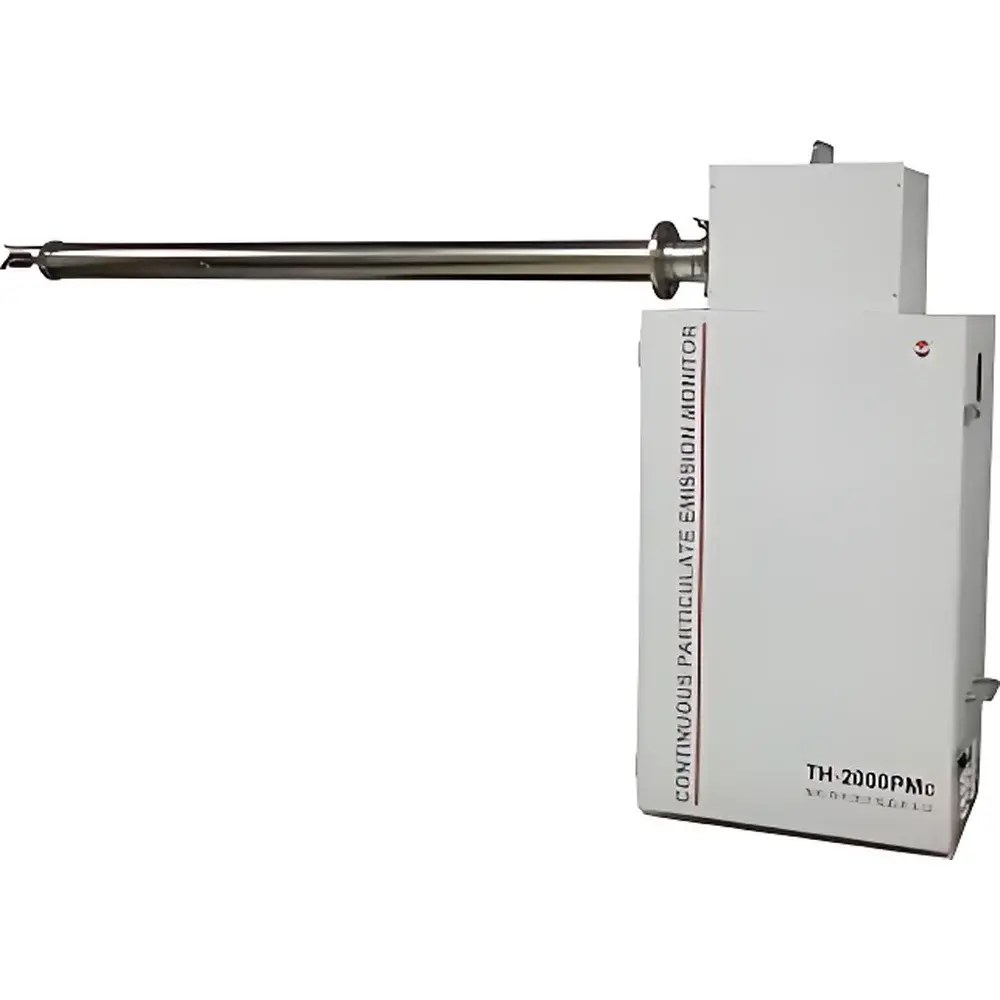
Tianhong TH-2000PMc Beta-Ray + Optical Scattering Ambient Particulate Matter Monitor
| Brand | Tianhong |
|---|---|
| Origin | Hubei, China |
| Model | TH-2000PMc |
| Measured Parameters | TSP, PM10, PM2.5 |
| Detection Principle | Beta-ray attenuation with integrated dynamic heating system (DHS) and optical scattering compensation |
| Data Storage Capacity | ≥2 years (internal flash memory) |
| Power Supply | AC 220 V ±10% or built-in 25 Ah Li-ion battery (≥24 h backup) |
| Communication Interfaces | GPRS/3G/4G wireless, RS232, RS485, USB |
| Display | 4.3-inch capacitive touchscreen |
| Environmental Rating | IP55 for outdoor all-weather operation |
| Mounting Options | Tripod, pole-clamp, rooftop, or wall-mount |
| Compliance | Meets Chinese EPA HJ 653–2013 and HJ 93–2013 technical requirements for reference methods |
Overview
The Tianhong TH-2000PMc is a dual-principle ambient particulate matter monitor engineered for continuous, unattended measurement of total suspended particles (TSP), inhalable particulate matter (PM10), and fine particulate matter (PM2.5) in outdoor environmental monitoring networks. It operates on the gravimetric beta-ray attenuation method—recognized as a reference-equivalent technique under China’s Ministry of Ecology and Environment (MEE) standards HJ 653–2013 and HJ 93–2013—and integrates a real-time optical scattering module to enhance temporal resolution and compensate for humidity-induced signal drift. The instrument employs a dynamic heating system (DHS) upstream of the filter tape to maintain consistent sample conditioning, minimizing hygroscopic bias during high-humidity conditions. Its compact, ruggedized enclosure (IP55-rated) supports permanent deployment on rooftops, roadside cabinets, industrial perimeters, tunnel portals, and temporary monitoring sites requiring rapid installation without civil works.
Key Features
- Dual-sensor architecture: Beta-ray attenuation for mass concentration quantification (traceable to NIST-traceable calibration sources) combined with compensated optical scattering for high-frequency trend analysis.
- Dynamic heating system (DHS): Maintains sample air at controlled temperature and relative humidity (<40% RH) prior to filtration, ensuring compliance with MEE reference method requirements for aerosol drying.
- Automated sampling control: Embedded 32-bit high-speed microcontroller manages filter tape advancement, radiation counting cycles, zero/span checks, and diagnostics without manual intervention.
- Human-machine interface: 4.3-inch capacitive touchscreen with intuitive icon-driven menu navigation; supports multilingual UI (English, Chinese) and local parameter configuration.
- Robust data integrity architecture: Internal non-volatile flash memory stores ≥2 years of 1-minute averaged data (mass concentration, flow rate, temperature, RH, pressure, heater status, beta counts) with automatic timestamping and CRC-32 checksum validation.
- Power resilience: Dual-mode operation via AC mains (220 V ±10%) or internal 25 Ah lithium-ion battery pack—provides ≥24 hours of continuous operation during grid failure with seamless switchover and state retention.
- Flexible communication stack: Standard GPRS module for cellular telemetry; optional 3G/4G LTE upgrade; wired interfaces include RS232, RS485 (Modbus RTU), and USB 2.0 for local data dump or firmware updates.
Sample Compatibility & Compliance
The TH-2000PMc accepts standardized cut-point impactors (e.g., ISO 10791-3 compliant PM10 and PM2.5 cyclones; optional TSP inlet per ISO 7708) mounted directly at the inlet manifold. All mechanical components contacting sampled air are constructed from electropolished stainless steel or anodized aluminum to prevent particle adhesion and corrosion. The system meets electromagnetic compatibility (EMC) requirements per GB/T 17626 series and environmental operating specifications: −30 °C to +50 °C ambient temperature, 0–100% RH (non-condensing). While not certified to EU MCERTS or US EPA EQPM specifications, its measurement methodology aligns with the physical principles underlying EN 12341 and ISO 25597, and its data output structure supports integration into national air quality management platforms compliant with China’s “Blue Sky Defense Campaign” reporting protocols.
Software & Data Management
Data acquisition and remote supervision are enabled via Tianhong’s proprietary AirView™ desktop software (Windows-based), which supports real-time telemetry dashboards, alarm threshold configuration (e.g., PM2.5 > 75 µg/m³), automated report generation (PDF/CSV), and audit-log export with user authentication. The instrument logs full diagnostic metadata—including lamp intensity decay, tape tension error codes, flow sensor zero drift, and radiation background fluctuations—enabling root-cause analysis during QA/QC reviews. All stored records include embedded digital signatures and monotonic timestamps, satisfying basic GLP traceability requirements for regulatory submissions. Firmware updates are delivered via signed binary packages over secure HTTPS channels, with rollback capability and versioned changelogs.
Applications
- Urban and regional air quality monitoring networks operated by municipal EPBs and provincial environmental monitoring centers.
- Industrial fence-line monitoring for cement plants, coal-fired power stations, waste incinerators, and metal smelters subject to MEE discharge permit conditions.
- Construction site PM compliance verification per GB 3096–2008 noise and dust emission limits.
- Indoor-outdoor correlation studies in schools, hospitals, and residential zones using synchronized TH-2000PMc deployments.
- Mobile monitoring campaigns using tripod-mounted units powered by external solar-charged battery banks.
- Research-grade time-series analysis of diurnal PM patterns, long-range transport events, and secondary aerosol formation kinetics.
FAQ
Does the TH-2000PMc meet U.S. EPA or EU MCERTS certification requirements?
No—it is designed and validated against Chinese national standards (HJ 653–2013, HJ 93–2013) and has not undergone third-party EQPM or MCERTS type approval.
Can the instrument operate continuously without maintenance?
Yes—filter tape life is typically 30 days at standard 16.7 L/min flow; routine maintenance (tape replacement, inlet cleaning, flow calibration) is recommended every 30–90 days depending on ambient dust loading.
Is raw beta-count data accessible for independent reprocessing?
Yes—USB export includes unprocessed 1-second count histograms, tape position indices, and environmental sensor readings in ASCII format for algorithmic re-evaluation.
What is the measurement uncertainty at low PM2.5 concentrations (e.g., <5 µg/m³)?
Based on inter-laboratory comparison studies, expanded uncertainty (k=2) is ≤1.8 µg/m³ for PM2.5 below 10 µg/m³, primarily limited by statistical counting error and flow meter precision.
How is data security handled during wireless transmission?
GPRS/4G payloads are encrypted using TLS 1.2; device authentication uses pre-shared keys; no credentials are transmitted in plaintext, and session tokens expire after 24 hours of inactivity.







