
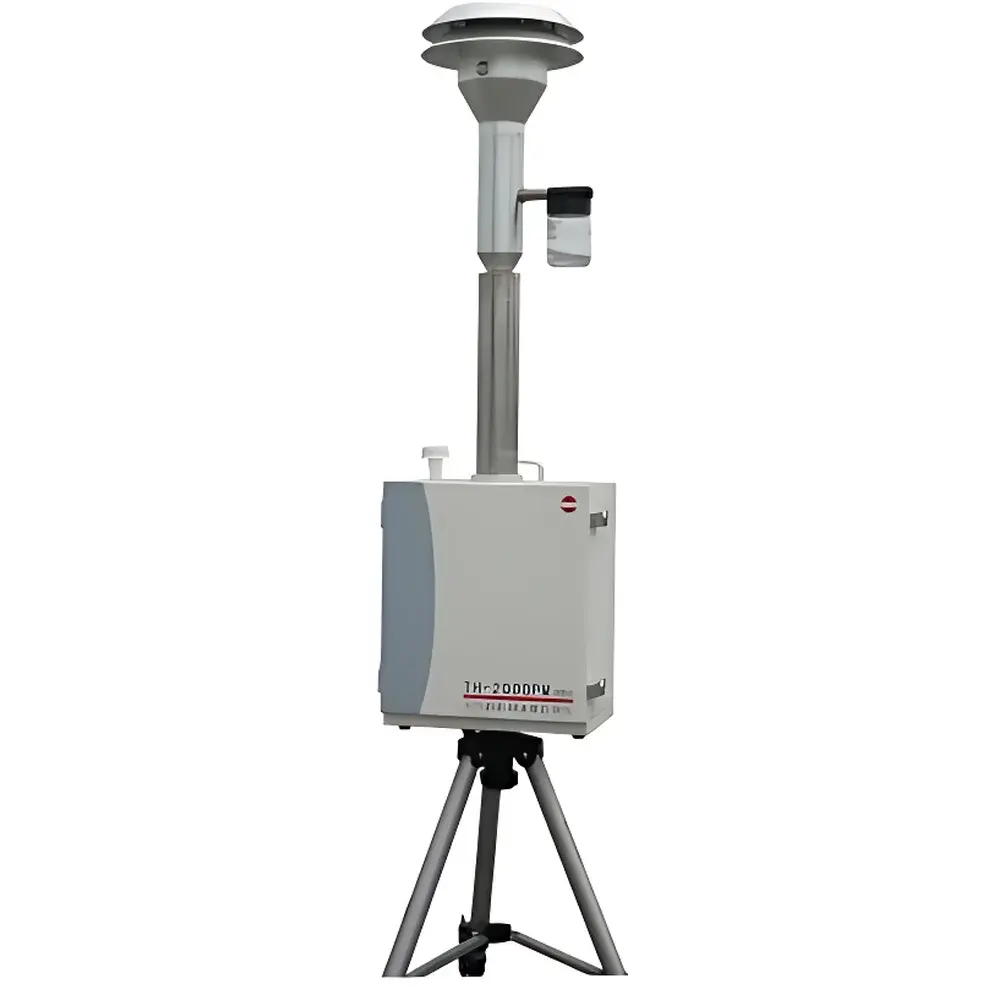
Yuhong TH-2000PM Portable Atmospheric Particulate Matter Monitor
| Brand | Yuhong |
|---|---|
| Origin | Hubei, China |
| Model | TH-2000PM Portable |
| Measurement Principle | Beta-ray Absorption (β-ray) |
| Measured Parameters | PM₁₀ and PM₂.₅ |
| Compliance | HJ 653–2013 |
| Display | 7-inch HD Touchscreen (Chinese UI) |
| Data Storage | Hourly internal logging |
| Communication | Built-in GPRS module, digital output interface |
| Optional Modules | Meteorological sensors (wind speed/direction), GPS, noise monitoring, video capture |
| Radiation Source | Low-activity ¹⁴C beta source (licensed per Chinese radiation safety regulations) |
Overview
The Yuhong TH-2000PM Portable Atmospheric Particulate Matter Monitor is a field-deployable, regulatory-compliant instrument engineered for high-fidelity, real-time measurement of ambient PM₁₀ and PM₂.₅ mass concentrations. It operates on the beta-ray absorption principle—a gravimetric technique in which airborne particulate matter is collected onto a filter tape, and the attenuation of beta particles (emitted from a calibrated ¹⁴C source) through the accumulated mass is quantified to determine mass concentration. This method delivers direct, traceable mass measurement independent of particle optical properties, hygroscopicity, or chemical composition—eliminating reliance on empirical correction factors common in optical scattering-based systems. Designed to meet the stringent technical requirements of HJ 653–2013 (“Technical Requirements and Test Methods for Continuous Automatic Monitoring Systems of Ambient Air Particulate Matter (PM₁₀ and PM₂.₅)”), the TH-2000PM supports environmental compliance monitoring, mobile source assessment, construction site dust surveillance, and rapid-response air quality verification in non-stationary deployment scenarios.
Key Features
- Beta-ray absorption core with dynamic heating system (DHS): Prevents volatilization losses of semi-volatile compounds (e.g., ammonium nitrate, organic aerosols) during sampling, ensuring mass stability and measurement integrity under variable ambient humidity and temperature conditions.
- Integrated environmental sensor suite: Onboard thermistor, capacitive humidity sensor, and piezoresistive barometer enable automatic standard-condition (25 °C, 101.325 kPa) volume correction per ISO 12141 and US EPA Method 201A conventions.
- Thermally stabilized flow control: Variable-frequency drive (VFD)-regulated mass flow controller maintains nominal sampling flow at 16.7 L/min across ambient temperatures ranging from −30 °C to +60 °C—critical for consistent cut-point performance of PM-selective inlets.
- Certified PM₁₀ and PM₂.₅ impactors: Independently validated by the Chinese Center for Disease Control and Prevention (China CDC), Environmental and Health Related Product Safety Institute; test reports available upon request for audit readiness.
- Low-activity ¹⁴C beta source (activity ≤ 370 kBq): Fully licensed under China’s national radiation safety framework; no special shielding or operational restrictions beyond standard lab handling protocols.
- 7-inch resistive touchscreen interface: Localized Chinese-language UI with one-touch startup, real-time concentration plots, diagnostic status indicators, and intuitive navigation—designed for field technicians without specialized instrumentation training.
Sample Compatibility & Compliance
The TH-2000PM is optimized for ambient air matrices containing urban, industrial, and fugitive dust aerosols. Its beta-ray methodology ensures robustness against particle morphology variability (e.g., soot aggregates, mineral dust, sea salt), making it suitable for heterogeneous environments such as construction zones, traffic corridors, and peri-urban interfaces. The instrument complies with HJ 653–2013 for continuous monitoring system performance—including precision (≤5 µg/m³ or ≤5% CV), accuracy (±10% relative to reference gravimetric methods), and data completeness (>90% monthly uptime). While not certified to ISO/IEC 17025 for accredited testing, its design aligns with GLP-aligned field data collection practices and supports traceability via timestamped internal logs, filter tape position tracking, and source activity calibration records.
Software & Data Management
Internal firmware enables hourly automated storage of averaged PM mass concentrations, environmental parameters (T, RH, P), flow rate, and system diagnostics (e.g., filter saturation, heater status, tape advancement errors). Data export is supported via USB mass storage (FAT32-formatted devices) in CSV format, compatible with standard statistical and GIS platforms. The integrated GPRS module transmits encrypted telemetry packets to a cloud-based environmental data platform—accessible via web dashboard or native Android/iOS application. Remote firmware updates, configuration push, and alarm notifications (e.g., low battery, communication timeout, mechanical fault) are configurable via secure HTTPS API. Audit trails include operator login timestamps, parameter change logs, and calibration event records—supporting basic 21 CFR Part 11 alignment for internal QA workflows.
Applications
- Mobile ambient air quality mapping: Paired with GPS and meteorological sensors for spatially resolved PM characterization along transects or in rotating deployment grids.
- Construction and demolition site compliance monitoring: Real-time verification of dust suppression efficacy against local emission limits (e.g., GB 3095–2012 Class II standards).
- Supplemental monitoring for fixed-site networks: Rapid deployment during episodic events (wildfire smoke, sandstorms, industrial incidents) to augment baseline station coverage.
- Environmental enforcement and inspection: Hand-carried use by regulatory personnel for on-the-spot verification of reported emissions or complaint investigations.
- Educational and research field studies: Low-barrier operation and open data export facilitate integration into undergraduate atmospheric science curricula and graduate-level aerosol process investigations.
FAQ
What regulatory standards does the TH-2000PM comply with?
It meets the technical and performance requirements specified in HJ 653–2013, China’s national standard for continuous automatic PM monitoring systems.
Can the instrument operate unattended for extended periods?
Yes—internal rechargeable battery supports ≥8 hours of continuous operation; external 12–24 V DC input enables solar or vehicle-powered deployments.
Is the beta source replaceable, and what is its typical service life?
The ¹⁴C source has a half-life of 5730 years; activity decay is negligible over instrument lifetime. Source replacement is not required under normal use and is performed only by authorized radiation safety personnel during major service intervals.
How is data integrity ensured during power interruption or communication loss?
All measurements are buffered in non-volatile memory; no data is lost during brief outages. Internal clock maintains time synchronization via NTP when network connectivity resumes.
Are third-party calibration services available outside China?
While factory calibration uses NIST-traceable gravimetric standards, international users may perform field verification using co-located reference samplers (e.g., FRM/FRM-equivalent TEOM or gravimetric filters) per ISO 12141 guidance.
Related Products







