
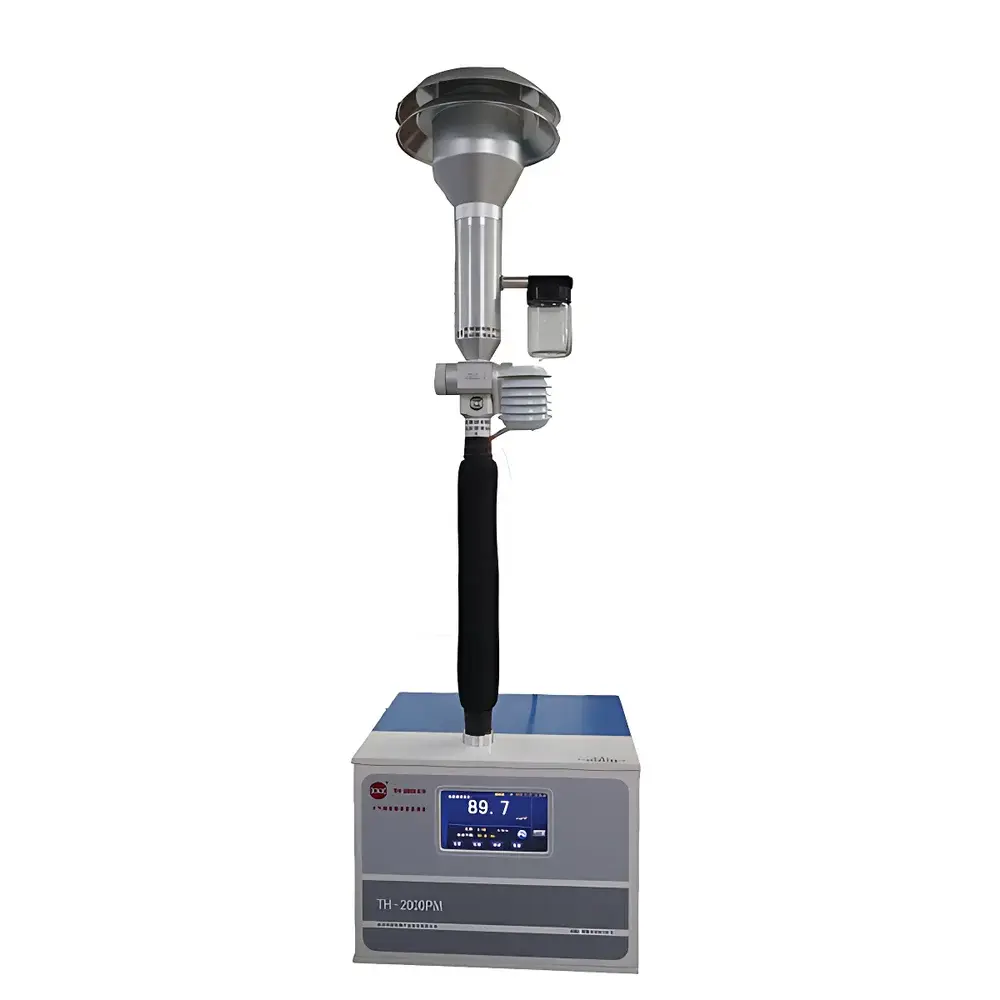
Tianhong TH-2000PM Beta Attenuation Particulate Matter Monitor
| Brand | Tianhong |
|---|---|
| Model | TH-2000PM |
| Measurement Principle | Beta-ray attenuation (¹⁴C source) |
| Particle Size Cuts | TSP, PM₁₀, PM₂.₅, PM₁ |
| Operating Temperature | -30 °C to 50 °C |
| Relative Humidity Range | 0–90% RH (non-condensing) |
| Flow Control | PID-regulated mass flow controller with digital sensor |
| Data Storage | ≥1 year of 1-minute resolution data (internal flash + USB export) |
| Display | 7-inch capacitive touch screen (Chinese UI) |
| Communication Interfaces | RS-232, RS-485, 10/100 Mbps Ethernet, 4–20 mA analog output |
| Radiation Source | ¹⁴C (half-life: 5730 years |
| Power Supply | AC 220 V ±10%, 50 Hz |
| Enclosure Rating | IP54 |
| Compliance | Meets technical requirements of HJ 653–2013 (China), compatible with GB/T 15432–1995 and ISO 10473:2000 for gravimetric equivalence validation |
Overview
The Tianhong TH-2000PM Beta Attenuation Particulate Matter Monitor is a continuous ambient air quality instrument engineered for regulatory-grade measurement of mass concentration of suspended particulate matter—including total suspended particles (TSP), PM₁₀, PM₂.₅, and PM₁—using the beta-ray attenuation (BAM) principle. It employs a sealed, low-activity carbon-14 (¹⁴C) radioactive source emitting beta particles (electrons) at energies suitable for high-sensitivity absorption measurement in thin particulate deposits. As sampled air passes through a precision-machined inlet and is drawn across a moving filter tape, airborne particles are collected incrementally. The same beta beam traverses the clean tape before sampling and the loaded tape after collection; the differential attenuation—governed by the Lambert–Beer law—is directly proportional to the deposited mass per unit area. This physics-based, material-independent quantification eliminates reliance on particle optical properties or assumptions about density and refractive index, enabling traceable, gravimetric-equivalent mass concentration reporting in µg/m³.
Key Features
- Intelligent dynamic heating system integrated into the sampling line, actively regulating temperature to minimize condensation and hygroscopic bias—critical for accurate PM₂.₅ monitoring in high-humidity environments.
- Vertical straight-through gas path design minimizes dead volume and eliminates horizontal bends where dust accumulation could introduce memory effects or flow distortion.
- Digital thermal mass flow sensor coupled with a PID-controlled proportional valve ensures long-term volumetric flow stability within ±1% of setpoint (typically 16.7 L/min), meeting ISO 29463-3 and EN 12341 requirements for reference method comparability.
- Real-time embedded Linux operating system enables deterministic data acquisition, on-board statistical processing (e.g., hourly/daily averages, standard deviations), and fault diagnostics without external PC dependency.
- On-device data retention supports ≥12 months of minute-interval records (mass concentration, flow rate, temperature, humidity, tape position, source intensity, system voltage), accessible via USB 2.0 port for audit-ready export.
- 7-inch industrial-grade capacitive touchscreen with localized Chinese firmware provides intuitive menu navigation, real-time trend visualization, calibration log access, and event-driven alarm configuration.
- Multi-protocol communication architecture includes isolated RS-232/RS-485 (Modbus RTU), IEEE 802.3-compliant Ethernet (TCP/IP with HTTP/FTP server), and 4–20 mA analog output compliant with IEC 61000-6-2/4 EMC standards.
Sample Compatibility & Compliance
The TH-2000PM accepts standardized cut-point impactors (e.g., WINS, BGI SCC 1.062 for PM₁₀; U.S. EPA-designated cyclones for PM₂.₅) mounted upstream of the filter assembly, enabling field-configurable size-selective sampling per national and international reference methods. Its BAM methodology has been validated against gravimetric reference procedures under controlled chamber conditions per HJ 653–2013 and demonstrates linear response across 0–10,000 µg/m³ for PM₂.₅. The ¹⁴C source (activity < 37 kBq) complies with IAEA Safety Standards Series No. SSG-46 and China’s GB 18871–2002 for Class III sealed sources—requiring no special licensing beyond site registration. Instrument housing meets IP54 ingress protection and operates reliably from –30 °C to +50 °C, supporting unattended deployment in fixed-site urban, rural, and roadside monitoring networks.
Software & Data Management
Data handling conforms to environmental data integrity frameworks: all measurements include embedded timestamps (NTP-synchronized when Ethernet-connected), source decay compensation algorithms, and automatic zero/span drift correction logs. Internal database enforces write-once archival behavior for raw channel data, preventing post-acquisition modification. Exported CSV files contain full metadata (instrument ID, firmware version, calibration certificate ID, QA/QC flags), satisfying GLP-aligned recordkeeping. Remote firmware updates and configuration push are supported via secure HTTP POST or FTPS. Optional cloud integration (via MQTT or REST API) enables centralized ingestion into EPA AirNow, EEA Copernicus, or custom SCADA platforms—fully traceable under ISO/IEC 17025 internal audit requirements.
Applications
- Ambient air quality monitoring networks operated by municipal EPBs and provincial ecological environment bureaus.
- Source apportionment studies requiring co-located PM speciation and real-time mass data.
- Indoor air quality assessment in schools, hospitals, and transit hubs where PM₁ penetration correlates with cardiovascular risk.
- Construction site boundary monitoring for compliance with local dust emission ordinances (e.g., Shanghai DB31/964–2016).
- Research-grade exposure assessment in epidemiological cohort studies requiring long-term, stable time-series concentration data.
FAQ
What is the typical calibration frequency recommended for regulatory use?
Annual verification against NIST-traceable gravimetric standards is required per HJ 653–2013; field zero/span checks should be performed every 7 days using certified zero air and calibrated aerosol generators.
Does the instrument support co-location with optical particle counters for comparative analysis?
Yes—the analog output and Modbus registers provide synchronized real-time outputs suitable for parallel operation with OPCs or TEOM systems, enabling hybrid data fusion and bias correction modeling.
How is radiation safety ensured during routine maintenance or tape replacement?
The ¹⁴C source is doubly encapsulated in stainless steel and epoxy resin; dose rate at 5 cm from the housing is <0.1 µSv/h—well below ICRP public exposure limits. No radiation monitoring badges are required for operators following standard tape-handling protocols.
Can historical data be exported in formats compatible with EPA AQS or EEA AQ e-Reporting?
Yes—CSV exports include mandatory AQS fields (site ID, parameter code, units, method code); optional XML schema mapping is available for direct EEA AIRBASE ingestion.
Is remote diagnostic capability built-in?
The embedded web server provides live system status (voltage, temperature, tape life, error codes), historical alarm logs, and firmware version—all accessible via standard browser without proprietary software.
Related Products







