
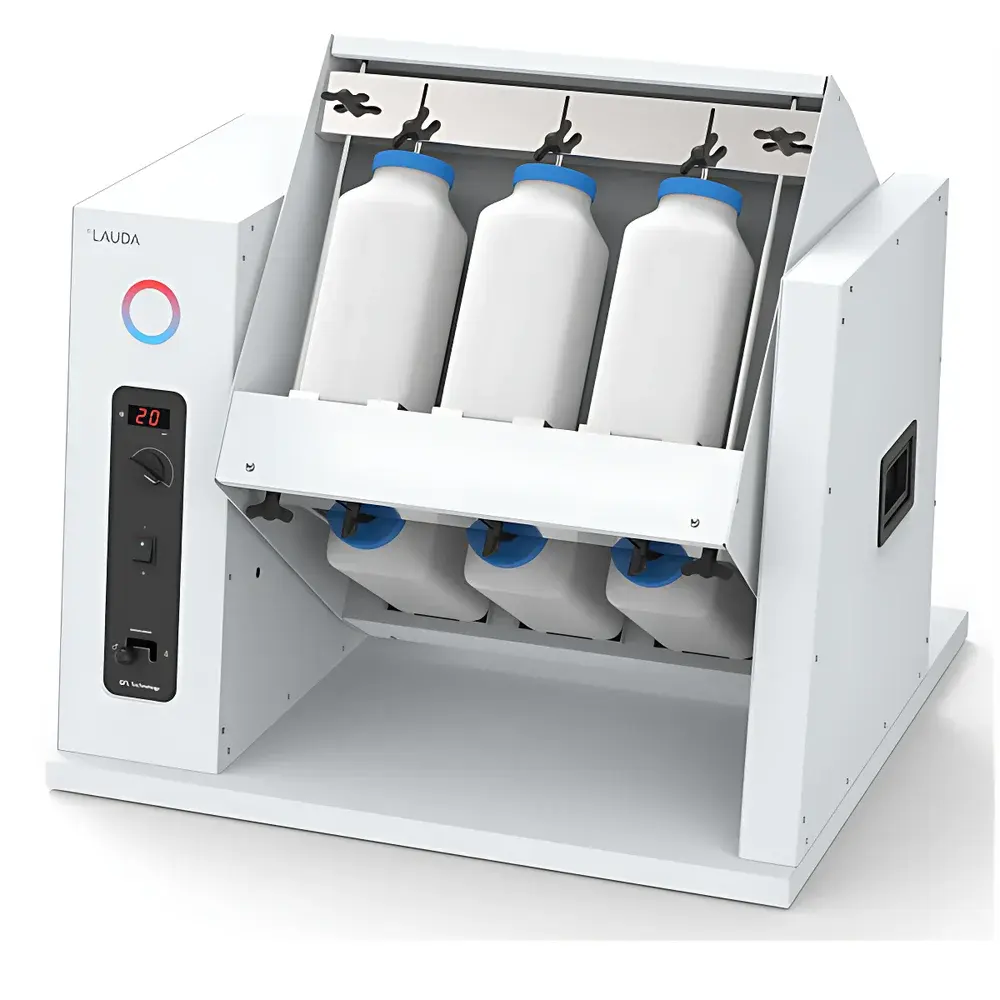
LAUDA Varioshake VS 20 OH Tilt-Shaking Incubator Shaker
| Brand | LAUDA |
|---|---|
| Origin | Germany |
| Model | VS 20 OH |
| Timer Range | 1 min – 99.9 h |
| Oscillation Frequency | 1–20 rpm |
| Ambient Temperature Range | 10–40 °C |
| Max. Power Consumption | 0.1 kW |
| Max. Load Capacity | 20 kg |
| Dimensions (W×D×H) | 770 × 700 × 715 mm |
| Weight | 68 kg |
| Construction | Powder-coated, electrogalvanized steel housing |
| Drive | Overload-protected DC motor with dynamic mass balancing |
| Bearing System | Dual-side ball-bearing tilt frame with sliding hub drive |
| Clamp Mechanism | Height-adjustable stainless steel clamps, accommodates vessels up to Ø110 mm × H270 mm |
| Sample Capacity | Up to 12 round or square containers under uniform loading |
Overview
The LAUDA Varioshake VS 20 OH is a precision-engineered tilt-shaking incubator shaker designed for low-shear, gentle yet thorough mixing of viscous, heterogeneous, and sediment-prone samples in life science and bioprocessing laboratories. Unlike orbital or reciprocating shakers, the VS 20 OH employs a controlled tilting motion—rotating around a horizontal axis—to induce laminar, gravity-assisted sample agitation. This principle ensures effective homogenization of powders, pastes, gels, cell suspensions, and agar-based media without foaming, phase separation, or mechanical stress on sensitive biological entities. Its robust architecture supports continuous operation under ambient conditions (10–40 °C), making it suitable for long-term incubation-compatible shaking protocols where thermal stability is not required—but mechanical reproducibility and load independence are critical.
Key Features
- Gentle, programmable tilt-shaking motion optimized for high-viscosity and particulate-laden samples, minimizing shear-induced denaturation or aggregation.
- Electronically regulated DC motor with closed-loop speed control, delivering consistent 1–20 rpm across full load range (up to 20 kg), independent of vessel weight or fill volume.
- Dynamic mass-balancing system integrated into the tilt frame reduces vibration transmission and extends bearing service life—critical for stable placement on shared lab benches or within containment cabinets.
- Height-adjustable stainless steel clamping assembly accommodates diverse vessel geometries: up to 12 round or square containers (max. Ø110 mm × H270 mm) with secure, tool-free positioning.
- Intuitive analog control panel with rotary speed dial and digital timer display (1 min – 99.9 h), enabling rapid setup without software dependency.
- Compact footprint (770 × 700 × 715 mm) and low power draw (≤0.1 kW) support energy-efficient deployment in space-constrained environments including cleanrooms and BSL-2 labs.
- Powder-coated electrogalvanized steel enclosure provides corrosion resistance and mechanical durability, compliant with ISO 14644-1 Class 7 cleanroom-compatible surface standards.
Sample Compatibility & Compliance
The VS 20 OH is validated for use with standard laboratory containers—including Erlenmeyer flasks, centrifuge tubes, Petri dishes, and custom bioreactor vessels—across academic research, QC microbiology, and upstream biomanufacturing workflows. Its non-orbital agitation mechanism meets ASTM D4084-22 requirements for low-energy mixing of suspension cultures and complies with ISO 20387:2018 (biobanking) guidelines for mechanical stability during sample conditioning. While not an incubated shaker, its ambient-operational design aligns with GLP documentation practices for non-temperature-critical shaking steps, and its timer functionality supports audit-ready protocol adherence per FDA 21 CFR Part 11 when integrated into validated electronic lab notebook (ELN) systems.
Software & Data Management
The VS 20 OH operates as a stand-alone instrument with no embedded firmware or network interface. All operational parameters—including elapsed time and setpoint rpm—are displayed locally via LED indicators. For laboratories requiring traceability, optional external data loggers (e.g., calibrated USB thermohygrometers with timestamped CSV export) may be mounted adjacent to the unit to record ambient environmental conditions during extended runs. The absence of proprietary software eliminates cybersecurity concerns and simplifies IQ/OQ validation in GMP-regulated settings where deterministic, hardware-level control is preferred over cloud-connected platforms.
Applications
- Rehydration and dispersion of lyophilized reagents and powdered culture media.
- Gentle resuspension of bacterial pellets, yeast aggregates, and mammalian cell monolayers prior to passaging or analysis.
- Homogenization of hydrogels, alginate beads, and tissue-derived extracellular matrix preparations.
- Extraction protocols involving solid-phase matrices (e.g., soil, plant tissue, biofilm scrapings) under mild agitation to preserve analyte integrity.
- Long-duration hybridization and washing steps in molecular diagnostics workflows where constant angular displacement prevents settling without vortexing artifacts.
- Pre-incubation equilibration of immunoassay plates and ELISA strips prior to automated reader integration.
FAQ
Is the VS 20 OH suitable for temperature-controlled applications?
No—the VS 20 OH is an ambient-only tilt shaker. It does not incorporate heating, cooling, or humidity control. For temperature-regulated tilt shaking, consider LAUDA’s IR series incubator shakers.
Can it accommodate microtiter plates?
Yes, with optional plate-specific clamp adapters; standard configuration supports up to twelve 100 mL Erlenmeyer flasks or equivalent-volume rectangular containers.
Does it meet electromagnetic compatibility (EMC) standards for laboratory use?
Yes—it conforms to EN 61326-1:2013 for laboratory equipment, ensuring safe co-location with sensitive analytical instrumentation such as mass spectrometers and patch-clamp rigs.
What maintenance is required?
Annual inspection of clamp locking mechanisms and visual verification of bearing smoothness; no lubrication is required due to sealed ball-bearing construction.
Is the unit compatible with ISO/IEC 17025-accredited testing laboratories?
Yes—its mechanical simplicity, load-independent speed accuracy, and absence of software dependencies facilitate straightforward metrological validation and uncertainty budgeting per ISO/IEC 17025:2017 Clause 6.4.



