
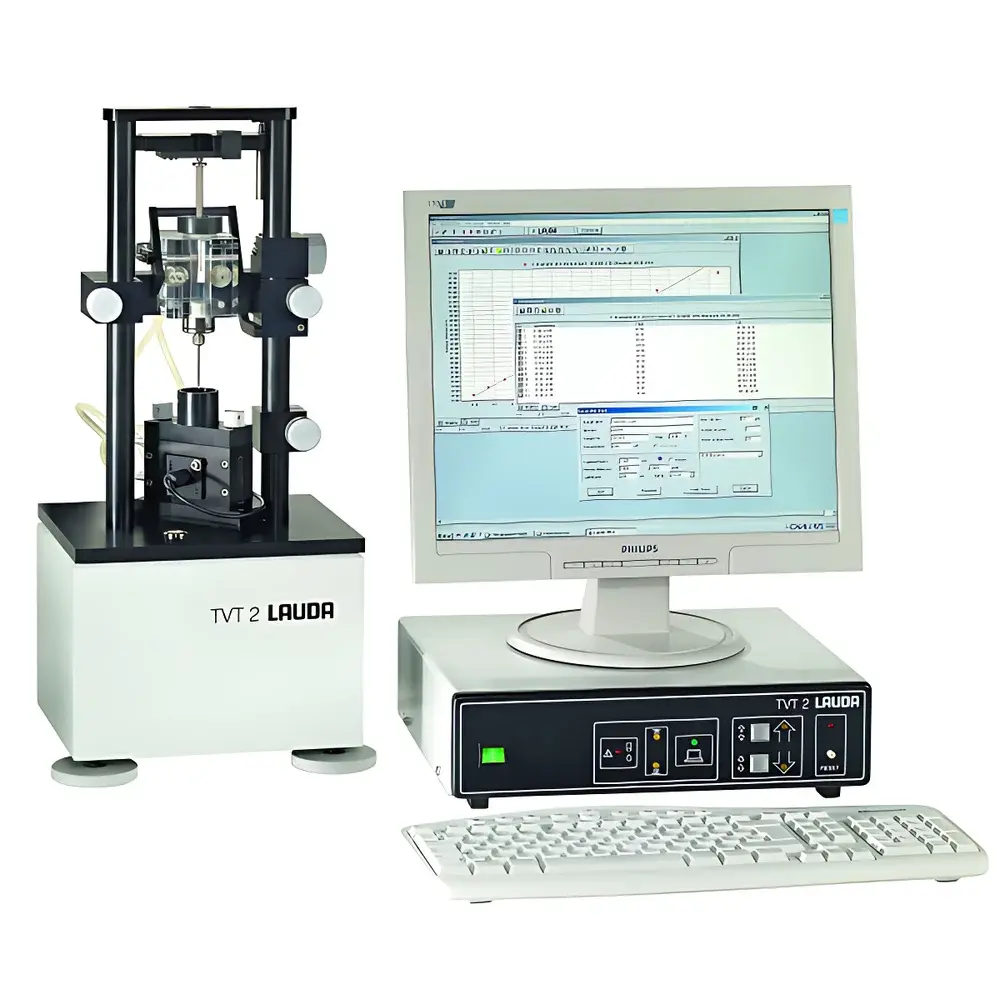
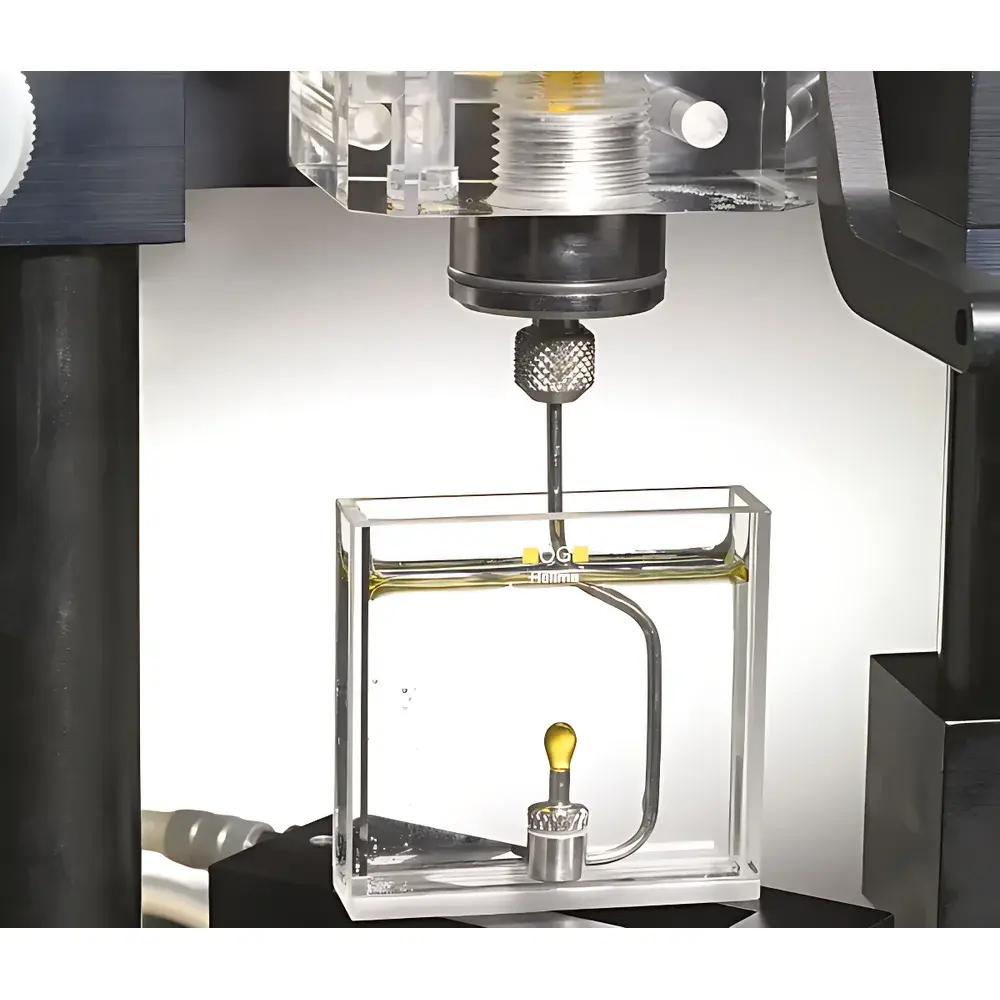
LAUDA TVT 2 Drop Volume Tensiometer
| Brand | LAUDA |
|---|---|
| Origin | Germany |
| Model | TVT 2 |
| Measurement Range | 0.1–100 mN/m |
| Resolution | ±0.01 mN/m |
| Accuracy | ±0.01 mN/m |
| Temperature Range | 5–90 °C |
| Temperature Accuracy | ±0.01 K |
| Measurement Method | Drop Volume Method |
| Sample Volume Requirement | 0.25–5 mL |
| Compatibility | Volatile, Toxic, and High-Viscosity Liquids |
| Thermal Control | Compatible with LAUDA RE415S Circulator (requires US 055 Pt100 probe & LRZ 918 LiBus module) |
Overview
The LAUDA TVT 2 Drop Volume Tensiometer is an engineered precision instrument designed for the quantitative determination of surface tension (γLV) and interfacial tension (γLV) between two immiscible liquid phases—most commonly air–liquid or oil–water systems. It operates on the fundamental physical principle that the volume of a pendant drop formed at the tip of a vertically oriented capillary is inversely proportional to the interfacial energy governing its detachment. By precisely monitoring drop formation kinetics—i.e., the time-dependent growth and release of droplets—the TVT 2 captures dynamic interfacial behavior over timescales ranging from seconds to hours. This capability makes it particularly suited for characterizing surfactant adsorption kinetics, film formation at interfaces, and aging effects in complex formulations such as emulsions, microemulsions, and polymer solutions. Unlike Wilhelmy plate or du Noüy ring methods, the drop volume technique eliminates systematic errors associated with solid–liquid wetting hysteresis, contact angle uncertainty, and buoyancy corrections—ensuring high reproducibility across diverse sample chemistries.
Key Features
- High-resolution dynamic interfacial tension measurement down to 0.1 mN/m, with ±0.01 mN/m resolution and accuracy
- Integrated drop formation control via programmable syringe pump and high-precision stepper motor actuation
- Sealed, inert gas-compatible measurement chamber for safe handling of volatile, flammable, or toxic liquids
- Minimal sample consumption (0.25–5 mL), enabling analysis of precious or synthetically constrained materials
- Broad operational temperature range (5–90 °C) with optional integration into LAUDA RE415S recirculating chillers for precise thermal regulation
- Modular hardware design supporting interchangeable needles and syringes optimized for low- and high-viscosity fluids, including structured liquids and viscoelastic surfactant solutions
Sample Compatibility & Compliance
The TVT 2 accommodates a wide spectrum of liquid systems—including aqueous surfactant solutions, hydrocarbon–water interfaces, ionic liquid mixtures, polymer melts, and biofluids—without requiring surface pretreatment or calibration against reference standards. Its non-contact, geometry-independent methodology satisfies ISO 6295 (petroleum products), ASTM D971 (interfacial tension of oil–water systems), and DIN 53914 (surface tension of surfactant solutions). The sealed cell architecture supports GLP-compliant workflows when paired with audit-trail-enabled software and calibrated temperature probes (e.g., US 055 Pt100 sensor with LRZ 918 LiBus interface). All mechanical and thermal components comply with CE directives and IEC 61010-1 safety standards for laboratory equipment.
Software & Data Management
Data acquisition and analysis are performed using LAUDA’s proprietary Tensiometer Control Software (v3.x), which provides real-time visualization of drop volume evolution, automatic baseline correction, and export of raw time–volume datasets in CSV and ASCII formats. The software supports multi-curve overlay, kinetic modeling (e.g., exponential decay fitting for diffusion-controlled adsorption), and batch processing for comparative studies. For regulated environments, optional 21 CFR Part 11 compliance packages include electronic signatures, user role management, and immutable audit logs—fully traceable to individual measurement sessions, operator IDs, and instrument configuration states.
Applications
- Surfactant formulation development and screening in agrochemicals, detergents, and personal care products
- Stability assessment of oil-in-water and water-in-oil emulsions during shelf-life testing
- Interfacial rheology studies of protein-laden interfaces in food and pharmaceutical colloids
- Quality control of crude oil demulsifiers and enhanced oil recovery (EOR) agents
- Fundamental research on self-assembly kinetics, monolayer formation, and Marangoni-driven instabilities
- Characterization of nanofluid interfacial behavior under controlled thermal gradients
FAQ
What measurement principle does the TVT 2 employ?
It uses the drop volume method, where interfacial tension is calculated from the mass or volume of detached drops formed at a capillary tip under gravitational or controlled dispensing conditions.
Can the TVT 2 measure both surface and interfacial tension?
Yes—it measures surface tension when the drop forms into air and interfacial tension when dispensed into a second immiscible liquid phase (e.g., oil or silicone fluid).
Is temperature control integrated into the base unit?
No—the TVT 2 itself does not include active heating/cooling; however, it is fully compatible with external LAUDA RE415S thermostats when used with the US 055 Pt100 probe and LRZ 918 LiBus module.
How much sample volume is required per measurement?
Between 0.25 mL and 5 mL, depending on needle gauge, dispersion medium volume, and desired measurement duration.
Does the system require wetting-angle correction or calibration standards?
No—unlike plate- or ring-based tensiometers, the drop volume method is inherently independent of contact angle assumptions and does not rely on calibration oils or reference liquids.



