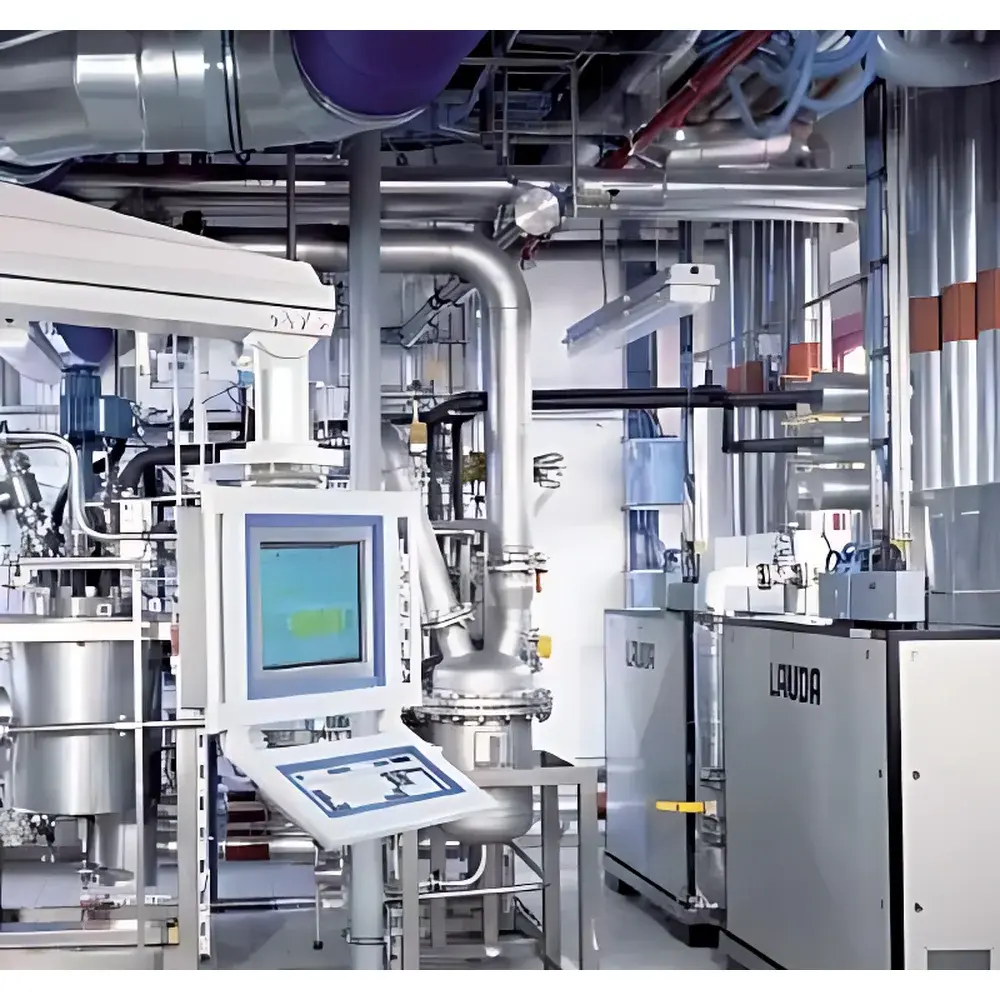
LAUDA HKS Industrial Heating & Cooling Circulation System
| Brand | LAUDA |
|---|---|
| Origin | Germany |
| Manufacturer Type | Authorized Distributor |
| Product Origin | Imported |
| Model Range | Multiple Configurable Models |
| Pricing | Available Upon Request |
| Temperature Range | −150 °C to +400 °C |
| Max. Heating Power | 800 kW |
| Max. Cooling Power | 800 kW |
| Cooling Capacity at −100 °C | 8 kW |
Overview
The LAUDA HKS Industrial Heating & Cooling Circulation System is an engineered thermal management platform designed for continuous, high-stability temperature control in demanding process-scale applications. Based on forced-circulation liquid thermoregulation using synthetic heat-transfer fluids (e.g., silicone oils, polyalkylene glycols, or low-temperature cryogenic media), the HKS series operates across an exceptional temperature span of −150 °C to +400 °C—enabling precise thermal conditioning of large-volume reactors, jacketed vessels, and pilot-scale production units. Unlike laboratory-scale chillers or bath circulators, the HKS architecture integrates industrial-grade compressors, electric resistance heaters, multi-stage expansion systems, and corrosion-resistant fluid circuits rated for sustained operation under high-pressure differential and extended duty cycles. Its design complies with DIN EN 61000-6-2 (EMC immunity) and DIN EN 61000-6-4 (EMC emission) standards, and all pressure components conform to PED 2014/68/EU requirements. The system is engineered for integration into automated process control environments via analog (4–20 mA) and digital (Modbus TCP, Profibus DP) interfaces.
Key Features
- Wide operational temperature range: −150 °C to +400 °C, achieved through cascaded refrigeration stages and high-temperature electric heating modules
- Scalable thermal capacity: nominal heating and cooling power up to 800 kW each, with verified cooling output of 8 kW at −100 °C (measured per ISO 5151)
- Fluid circuit integrity: stainless steel (AISI 316L) piping, double-walled insulated hoses, and leak-detection-ready manifolds
- Process safety architecture: integrated high-limit temperature cut-off, flow monitoring with turbine-based flowmeters, pressure relief valves, and redundant level sensors
- Modular configuration: customizable pump head, heat exchanger surface area, and control cabinet layout to match reactor jacket volume, thermal inertia, and ramp-rate requirements
- Low-maintenance design: oil-free scroll and screw compressors, self-diagnostic PLC controller (Siemens S7-1200), and service-accessible heat exchangers
Sample Compatibility & Compliance
The HKS system is compatible with jacketed reactors, glass-lined vessels, stainless steel autoclaves, and continuous-flow synthesis units used in API manufacturing, polymerization, hydrogenation, and catalytic cracking processes. It supports thermal cycling protocols required by ICH Q5C (stability testing), USP (thermal calibration of process equipment), and ASTM E2877-21 (performance verification of industrial temperature control systems). All models are CE-marked and meet the essential health and safety requirements of the Machinery Directive 2006/42/EC. Optional configurations include ATEX Zone 1/21 certification (EN 60079-0, -1, -7) for use in hazardous areas, and validation documentation packages compliant with GMP Annex 15 and FDA 21 CFR Part 11 for electronic record integrity.
Software & Data Management
The LAUDA HKS is controlled via the LAUDA ProcessControl™ software suite, a Windows-based application supporting recipe-driven operation, real-time PID parameter tuning, and historical trend logging at user-defined intervals (down to 1 s resolution). Data export is available in CSV and XML formats; audit trails—including operator login, setpoint changes, alarm acknowledgments, and system faults—are retained for ≥36 months and comply with ALCOA+ principles. Remote monitoring is enabled through secure HTTPS access, and optional integration with DeltaV, Emerson DCS, or Siemens PCS7 platforms is supported via OPC UA 1.04. Firmware updates follow IEC 62443-2-4 security guidelines, with signed binaries and role-based access control (RBAC) enforced at both local HMI and network levels.
Applications
- Thermal control of 1–10 m³ pilot reactors during exothermic nitration, Grignard reactions, or low-temperature lithiation
- Temperature ramping and hold sequences in pharmaceutical crystallization processes per ICH Q8(R2) design space requirements
- Stabilization of distillation column reboilers and condensers in petrochemical pilot plants
- Cooling of high-power laser diode arrays and vacuum chamber wall conditioning in semiconductor R&D facilities
- Calibration of reference thermometers and secondary standards in national metrology institutes (NMI) and accredited calibration labs
- Support of accelerated aging studies (ASTM D3045) for polymer composites and battery electrolyte formulations
FAQ
What is the minimum fluid volume required for stable operation at −120 °C?
For reliable cascade refrigeration below −100 °C, a minimum system fill volume of 350 L is recommended to ensure adequate subcooling and compressor suction superheat margin.
Can the HKS integrate with existing plant SCADA systems?
Yes—standard Modbus TCP and optional Profibus DP or EtherNet/IP gateways enable bidirectional communication with third-party SCADA and MES platforms.
Is validation support provided for GMP-compliant installations?
LAUDA offers IQ/OQ documentation templates, factory acceptance test (FAT) protocols, and on-site SAT execution support aligned with ASTM E2500 and ISPE Baseline Guide Vol. 5.
What maintenance intervals are specified for compressor oil and filter elements?
Oil-free compressors require no lubricant changes; particulate and coalescing filters are scheduled for replacement every 12 months or 8,000 operating hours, whichever occurs first.
How is temperature uniformity ensured across large reactor jackets?
Uniformity is maintained via computational fluid dynamics (CFD)-optimized flow distribution manifolds, dual-point PT100 sensor feedback (inlet/outlet), and adaptive flow rate modulation synchronized with thermal load prediction algorithms.