
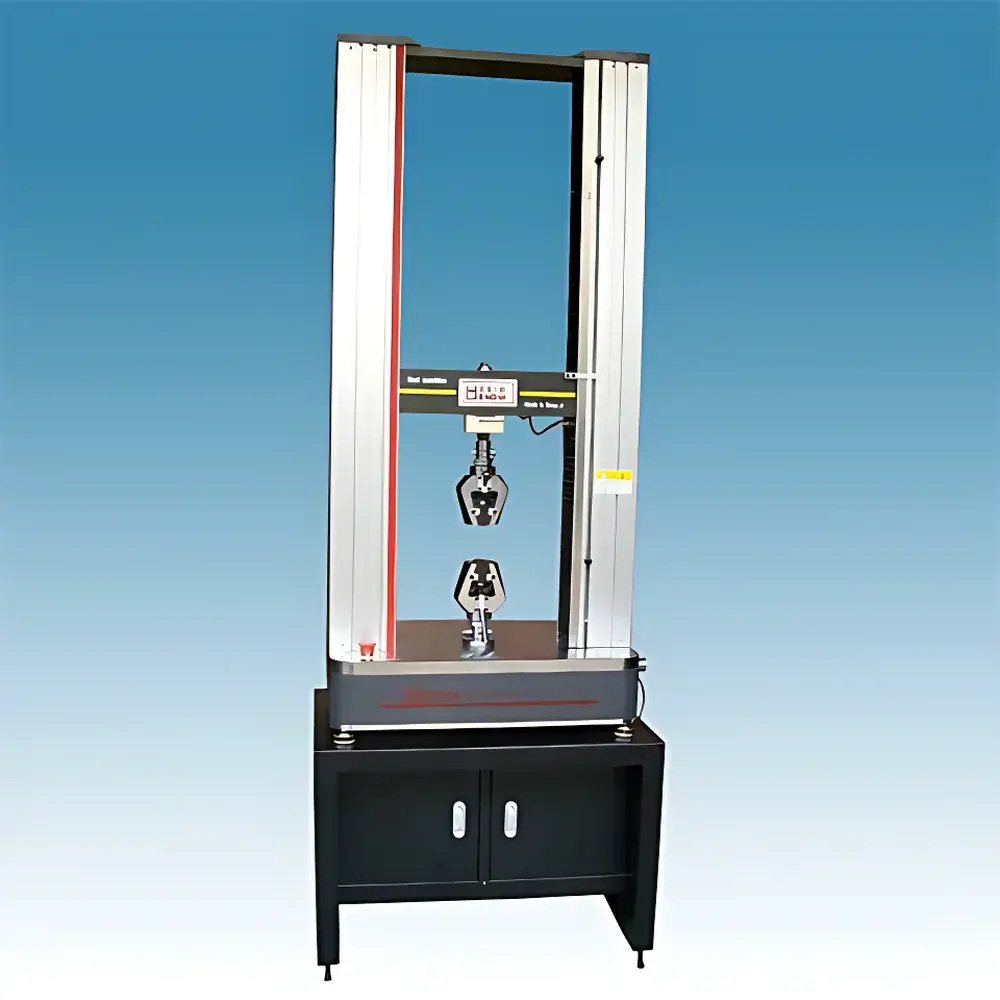
Hengyi Tungsten Alloy Tensile Testing Machine HY-1080TYHHH
| Brand | Hengyi |
|---|---|
| Origin | Shanghai, China |
| Manufacturer Type | Direct Manufacturer |
| Product Category | Domestic |
| Model | HY-1080TYHHH |
| Instrument Type | Electromechanical Tensile Testing Machine |
| Maximum Test Load | 10 kN |
| Force Measurement Range | 0.001–100% of Full Scale |
| Force Accuracy | ±0.5% FS |
| Test Stroke | 800 mm |
| Displacement Resolution | 0.001 mm |
| Load Cell Accuracy | 0.01% FS |
| Speed Range | 0.001–500 mm/min |
| Speed Accuracy | ±0.5% |
| Displacement Measurement Accuracy | ±0.5% |
| Effective Test Width | ~380 mm |
| Safety Features | Electronic Limit Switches, Emergency Stop Button |
| Power Supply | 220 V AC |
| Unit Weight | ~210 kg |
| Dimensions (W×D×H) | 700 × 420 × 1600 mm |
Overview
The Hengyi HY-1080TYHHH is a high-precision electromechanical tensile testing machine engineered for the mechanical characterization of tungsten alloys and other high-strength metallic and non-metallic materials. It operates on the principle of controlled uniaxial force application under closed-loop servo control, enabling accurate measurement of tensile strength, yield strength (including non-proportional yield strength Rp0.2), elongation at break, modulus of elasticity, and stress–strain behavior in accordance with ISO 6892-1, ASTM E8/E21, GB/T 228.1, and JIS Z 2241 standards. Designed specifically to address the demanding requirements of refractory metal testing—including tungsten’s high density (19.25 g/cm³), elevated yield point (>550 MPa), and low ductility at room temperature—the system delivers robust repeatability and metrological traceability across its full 10 kN load capacity.
Key Features
- High-resolution force measurement using a military-grade 24-bit analog-to-digital converter paired with a 32-bit ARM9 microcontroller, achieving load cell accuracy of 0.01% FS and overall system force accuracy better than ±0.5% FS.
- Real-time synchronized acquisition of load, large deformation (via extensometer), small deformation (via strain gauge or clip-on extensometer), and crosshead displacement at up to 1 kHz sampling rate.
- Full-range speed control from 0.001 to 500 mm/min with ±0.5% speed accuracy—enabling quasi-static tensile tests as well as creep and low-cycle fatigue pre-conditioning protocols.
- Optically isolated USB 2.0 interface ensures electromagnetic compatibility in industrial lab environments; supports hot-plug operation without hardware damage.
- Integrated safety architecture including dual-channel electronic stroke limits, hardware-based emergency stop circuitry, and software-enforced overload protection.
- Aluminum alloy frame construction provides long-term dimensional stability, corrosion resistance, and UV-resistant surface finish suitable for ISO Class 7 cleanroom-adjacent installations.
Sample Compatibility & Compliance
The HY-1080TYHHH accommodates standard tensile specimens per ASTM E8 (flat and round bars), ISO 6892-1 (Type 1A, 2A, 5A), and GB/T 228.1 (P1, P2, P3 geometries), with maximum specimen width of 38 mm and gauge length up to 250 mm. It supports interchangeable grips—including wedge-action pneumatic, hydraulic, and manual screw-type—for brittle tungsten alloys, sintered compacts, wire forms, and thin-sheet laminates. All test procedures and data outputs comply with GLP and GMP documentation requirements. Audit trails, user access control, and electronic signature support are available via optional FDA 21 CFR Part 11-compliant software modules. Calibration certificates are traceable to NIM (National Institute of Metrology, China) and can be extended to UKAS or DAkkS equivalence upon request.
Software & Data Management
The proprietary HengyiTest v5.2 software suite runs natively on Windows OS and provides fully configurable test method templates aligned with ISO 17025-accredited laboratories. It features real-time graphical display of stress–strain, load–displacement, and time-based curves with auto-scaling axes, customizable annotation layers, and dynamic parameter tagging (e.g., yield point identification via 0.2% offset method). Raw data export is supported in CSV, XML, and SQL Server formats. Advanced post-processing includes modulus calculation via secant/tangent methods, automatic fracture detection using derivative thresholding, and statistical reporting across batched specimens. Database backend uses Microsoft SQL Server Express for structured storage of metadata—including operator ID, environmental conditions (optional sensor integration), calibration history, and instrument configuration logs.
Applications
- Mechanical qualification of sintered tungsten heavy alloys (W–Ni–Fe/Cu) used in radiation shielding, kinetic energy penetrators, and aerospace counterweights.
- Quality control of tungsten wire and foil in semiconductor packaging and lighting applications.
- Interfacial bond strength evaluation of tungsten–copper composites in high-heat-flux thermal management substrates.
- Research into strain-rate sensitivity and ductile-to-brittle transition behavior in nanostructured tungsten under controlled strain environments.
- Validation of heat treatment effects (e.g., recrystallization annealing) on tensile properties of wrought tungsten sheets.
- Support for ISO/IEC 17025 internal audit requirements through automated uncertainty budgeting per GUM (Guide to the Expression of Uncertainty in Measurement).
FAQ
What standards does the HY-1080TYHHH support for tungsten alloy testing?
It supports ISO 6892-1, ASTM E8/E21, GB/T 228.1, JIS Z 2241, and DIN 50145 for tensile property determination, with method-specific calibration routines embedded in firmware.
Can the system be integrated into an existing LIMS or MES environment?
Yes—via OPC UA or RESTful API interfaces (available as optional add-ons), enabling bidirectional data exchange with laboratory information management systems and enterprise resource planning platforms.
Is third-party calibration certification included with delivery?
A factory calibration report traceable to NIM is provided; ISO/IEC 17025-accredited field calibration services are available upon request.
What extensometer options are compatible with this model?
Both clip-on axial extensometers (50 mm gauge length, ±0.5% accuracy) and non-contact video extensometry systems (with sub-pixel resolution) are supported via standardized analog/digital I/O ports.
Does the controller support cyclic loading for low-cycle fatigue assessment?
While primarily optimized for monotonic tests, the system supports basic block-cycle programming (tension–hold–compression–hold) up to 10 Hz frequency with user-defined waveform profiles. Dedicated fatigue controllers are recommended for high-cycle applications.
Related Products



