
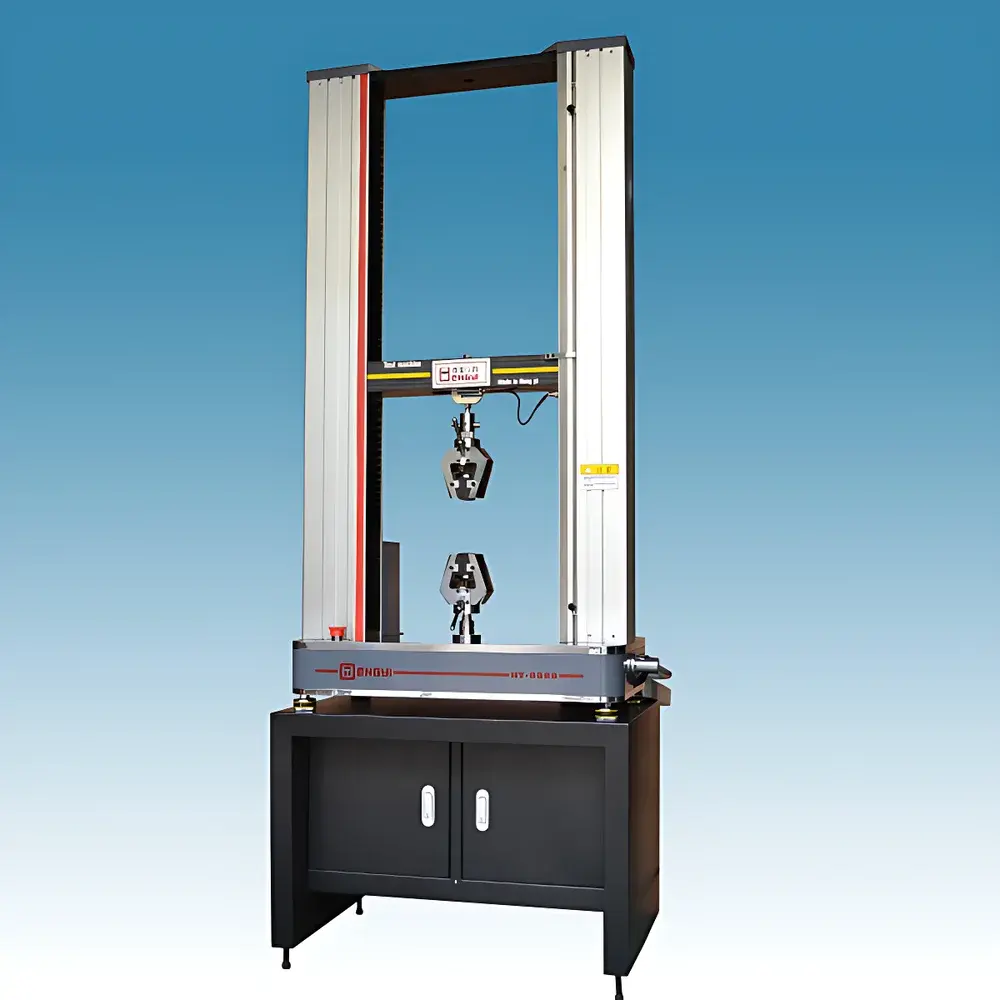
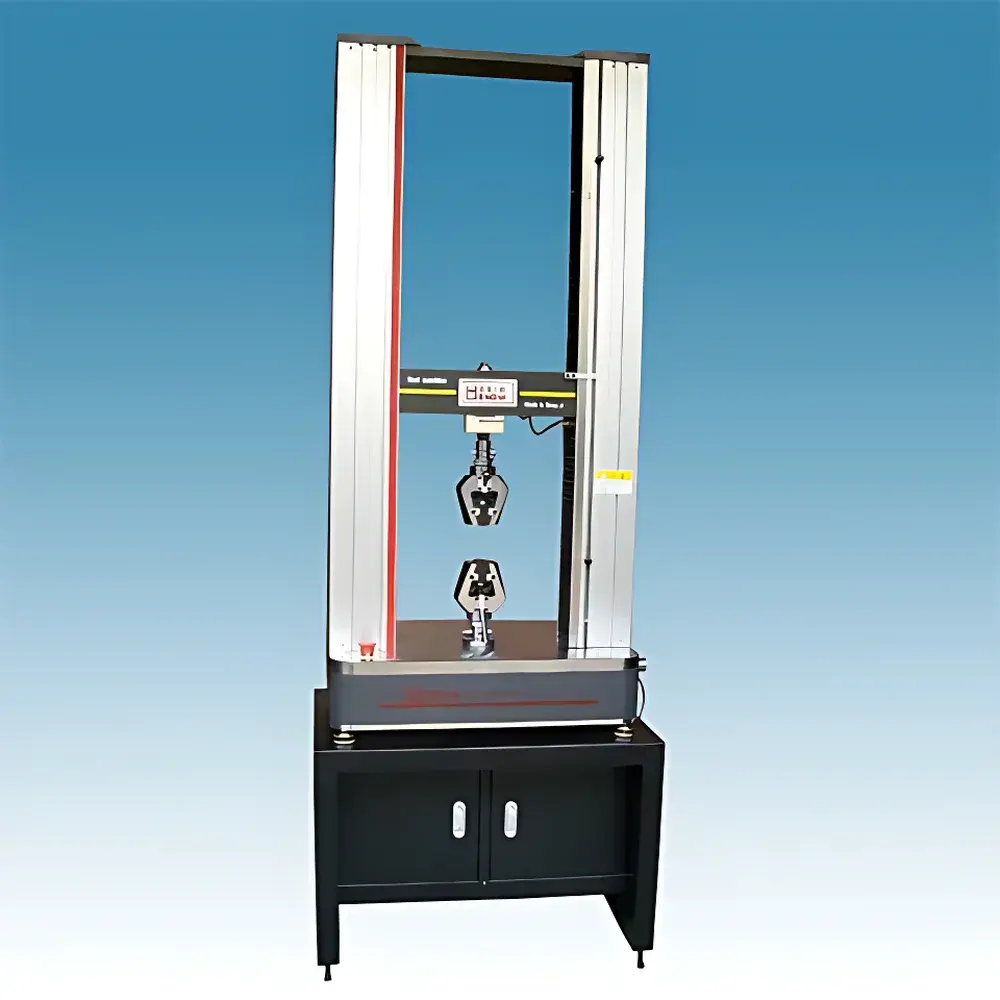
Hengyi HY-3080TYB Computer-Controlled Dual-Column Universal Testing Machine
| Brand | Hengyi |
|---|---|
| Origin | Shanghai, China |
| Manufacturer Type | Direct Manufacturer |
| Regional Category | Domestic (China) |
| Model | HY-3080TYB |
| Instrument Type | Electromechanical Universal Testing Machine |
| Load Capacity Options | 1 N to 30 kN (multiple load cells available) |
| Accuracy Class | ≤0.5% of full scale |
| Effective Test Width | 380 mm (expandable) |
| Effective Test Height | 800 mm (extendable) |
| Speed Range | 0.001–500 mm/min (infinitely variable) |
| Speed Accuracy | ±0.5% of indicated value |
| Displacement Measurement Accuracy | ±0.5% of indicated value |
| Strain Measurement Accuracy | ±0.5% of indicated value |
| Force Resolution | ±500,000 counts (no internal range switching, constant resolution across full scale) |
| Power Supply | 220 V AC, single-phase, 0.75 kW |
| Host Dimensions | 700 × 420 × 1600 mm |
| Net Weight | 210 kg |
Overview
The Hengyi HY-3080TYB is a computer-controlled dual-column universal testing machine engineered for high-precision static mechanical characterization of materials across tensile, compressive, flexural, shear, peel, tear, puncture, and cyclic loading modes. Based on electromechanical servo control architecture and strain-gauge-based load cell technology, it delivers traceable force measurement per ISO 7500-1 Class 0.5 and displacement accuracy compliant with ASTM E4 and ISO 5893. Designed as a modular, floor-standing龙门 (portal-frame) system, the HY-3080TYB supports standardized mechanical testing workflows in R&D laboratories, QC/QA departments, and third-party certification bodies—particularly where compliance with international material standards (e.g., ASTM D638, ISO 527, ISO 6892-1, GB/T 228.1, JIS Z2241) is required. Its rigid dual-column structure minimizes frame deflection under load, ensuring high reproducibility in modulus and strength determinations.
Key Features
- Class 0.5 force accuracy certified per ISO 7500-1, with ±500,000-count resolution and no internal range switching—ensuring consistent sensitivity from 0.1% to 100% of full-scale load.
- Infinitely adjustable crosshead speed: 0.001–500 mm/min, with speed accuracy maintained at ±0.5% of setpoint across the entire range.
- Dual-mode displacement and strain measurement: high-resolution encoder-based position feedback (±0.5% accuracy) plus optional extensometer integration for true strain control (ASTM E83 Class B1 or better).
- Intelligent test automation: programmable stop conditions—including time-, load-, deformation-, and fracture-triggered termination—with configurable pre-test safety checks and real-time overload protection (10% over capacity).
- Robust mechanical architecture: 210 kg reinforced steel frame, electronic limit switches, motorized up/down jog controls, and automatic return-to-start functionality post-test.
- Comprehensive data integrity safeguards: built-in self-diagnostic routines for load cell, drive system, and sensor subsystems; automatic fault logging and emergency shutdown on overvoltage, overcurrent, or thermal anomaly detection.
Sample Compatibility & Compliance
The HY-3080TYB accommodates diverse specimen geometries and mechanical behaviors—from thin polymer films (≥10 µm), elastomeric foams, and biomedical tubing to high-strength metallic wires (up to 30 kN ultimate tensile load), composite laminates, and rigid packaging substrates. Standard fixtures include wedge-action tensile grips, compression platens, three- and four-point bend assemblies, peel jigs, and puncture probes—all designed to minimize slippage and stress concentration. The system meets essential regulatory requirements for method validation in GLP and GMP environments: audit trail capability (via HYtestV7.0 software), electronic signature support, and full traceability of calibration history, operator ID, environmental metadata, and raw channel data. It supports compliance with ISO/IEC 17025, ASTM E4, ISO 5893, and national standards including GB/T 228.1 (metallic materials), GB/T 1040 (plastics), and YY/T 0681 (medical packaging).
Software & Data Management
HYtestV7.0 is a multilingual (9-language) PC-based test control and analysis platform built on VB.NET and SQL Server architecture. It provides real-time synchronized acquisition of force, displacement, and optional strain channels at up to 1 kHz sampling rate. The interface supports fully customizable test methods—including user-defined ramp-hold cycles, multi-step protocols, and conditional branching logic—and allows parameter export in CSV, XML, and PDF formats. Curve analysis tools enable precise identification of yield point, elastic modulus (E), offset yield strength (0.2% proof stress), ultimate tensile strength (UTS), elongation at break, and secant modulus. All test data are stored in a relational database with immutable timestamps, operator authentication logs, and version-controlled method templates—fully aligned with FDA 21 CFR Part 11 requirements for electronic records and signatures when configured with appropriate access controls and audit trail settings.
Applications
This system serves as a core mechanical characterization tool across regulated and industrial sectors. In polymer science, it quantifies tensile modulus, yield behavior, and ductility of thermoplastics, elastomers, and biodegradable films. In medical device manufacturing, it validates suture tensile strength (ISO 10555), catheter kink resistance (ISO 8536), and packaging seal integrity (ASTM F88). Automotive suppliers use it for rubber bushing compression set, brake hose burst pressure simulation, and composite panel flexural stiffness. Electronics manufacturers assess solder joint shear strength and flexible PCB peel adhesion. Academic labs employ it for fundamental viscoelastic modeling (e.g., time–temperature superposition), while packaging engineers rely on it for box compression (ISO 12048), tape adhesion (ASTM D3330), and foam cushioning performance (ASTM D3574). Its broad load range and modular fixture ecosystem make it suitable for both routine QC release testing and advanced failure mechanism studies.
FAQ
What standards does the HY-3080TYB support for calibration and verification?
It complies with ISO 7500-1 (force measurement), ISO 5893 (displacement and speed), and ASTM E4 (verification of force-measuring instruments), with documentation traceable to national metrology institutes.
Can the system perform closed-loop strain control?
Yes—when equipped with an ASTM E83-compliant extensometer and configured via HYtestV7.0, it supports strain-controlled ramp, hold, and cyclic tests with rate accuracy per ISO 6892-1 Annex C.
Is the software validated for regulated environments?
HYtestV7.0 includes Part 11-ready features (audit trail, electronic signatures, role-based access), though site-specific IQ/OQ/PQ validation remains the user’s responsibility per internal SOPs.
What load cell options are available?
Standard configurations span 1 N to 30 kN; multiple interchangeable load cells can be calibrated and registered within the software for seamless range switching without recalibration.
Does the machine support dynamic or fatigue testing?
The HY-3080TYB is optimized for quasi-static testing (0.001–500 mm/min); for high-cycle fatigue applications, a dedicated servo-hydraulic or electrodynamic system is recommended.



