
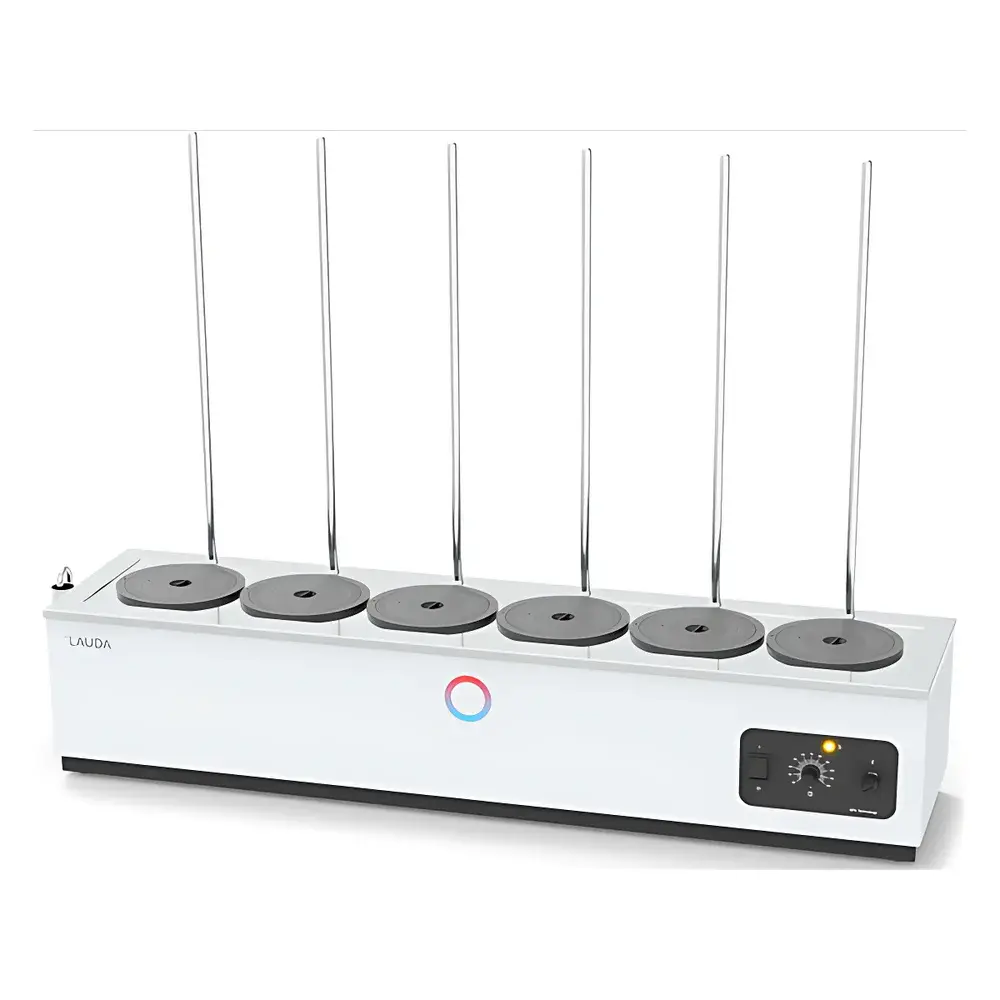
LAUDA Hydro H 9 V Evaporation Water Bath
| Brand | LAUDA |
|---|---|
| Origin | Germany |
| Model | H 9 V |
| Temperature Range | 25–100 °C |
| Temperature Stability | ±3 °C |
| Bath Volume | 8.0 L |
| Heating Power | 1.5 kW |
| Dimensions (W×D×H) | 1010×270×192 mm |
| Bath Opening Diameter | 131 mm |
| Bath Usable Depth | 90 mm |
| Number of Bath Openings | 6 |
| Weight | 19 kg |
| Power Supply | 230 V, 50/60 Hz |
| Material | Stainless Steel (bath interior, bottom sieve plate, cover, heating element), Heat-Resistant Polymer (adjustable ring inserts) |
| Safety Features | Low-Level Fluid Detection, Auto-Shutoff |
Overview
The LAUDA Hydro H 9 V Evaporation Water Bath is a precision-engineered, benchtop thermal platform designed for controlled, gentle solvent removal in analytical, synthetic, and preparative laboratory workflows. Operating on the principle of conductive heat transfer via temperature-regulated water medium, it maintains stable thermal conditions across multiple sample vessels simultaneously—enabling reproducible evaporation without thermal degradation of thermolabile compounds. Unlike open-flame or hotplate-based methods, this unit eliminates direct contact heating and localized overheating risks. Its 6-position circular bath configuration supports parallel processing of conical flasks, round-bottom flasks, and beakers, while its stainless-steel construction ensures long-term corrosion resistance in aqueous and mildly aggressive chemical environments. The system is engineered for unattended operation under routine laboratory conditions, incorporating fail-safe fluid-level monitoring and automatic thermal cutoff to comply with IEC 61000-6-2 and EN 61010-1 safety standards for laboratory electrical equipment.
Key Features
- Stainless-steel bath chamber, bottom sieve plate, cover, and heating element—resistant to water scale, chlorinated solutions, and common organic solvents
- Adjustable polymer ring inserts for precise vessel stabilization: six removable rings accommodate glassware diameters from 25 mm to 100 mm
- Mechanical single-point temperature controller with calibrated dial scale (±3 °C stability over full 25–100 °C range)
- Integrated low-level detection circuit that deactivates heating when water volume falls below operational threshold—preventing dry-run damage
- Modular water level regulator with overflow drainage port for consistent bath depth and simplified refilling
- Supplied with 600 mm × 12 mm stainless-steel support rod for optional clamp-mounting of condensers or reflux apparatus
- No external circulation pump required—optimized internal convection design ensures uniform thermal distribution across all six wells
Sample Compatibility & Compliance
The H 9 V accommodates standard laboratory glassware including DIN 12330-conforming Erlenmeyer flasks (50–500 mL), ISO 385 round-bottom flasks (25–250 mL), and ASTM E200-compliant volumetric beakers. Its stainless-steel wetted surfaces meet FDA-recommended material criteria for non-contact lab equipment used in pharmaceutical process development. While not certified for GMP production environments, the unit supports GLP-aligned documentation practices through traceable mechanical control settings and observable operational status (heating indicator LED, audible low-level alert). It conforms to CE marking requirements under the EU Machinery Directive 2006/42/EC and Low Voltage Directive 2014/35/EU.
Software & Data Management
The LAUDA Hydro H 9 V operates as a standalone analog instrument with no embedded microprocessor or digital interface. Temperature is set manually via calibrated rotary knob; no software drivers, firmware updates, or data logging capabilities are provided. This architecture eliminates cybersecurity vulnerabilities, reduces validation burden in regulated QC labs, and ensures deterministic response during extended unattended runs. For laboratories requiring electronic audit trails, integration with external temperature dataloggers (e.g., compliant with ISO/IEC 17025 calibration protocols) is supported via placement of Class A Pt100 probes directly into the bath medium adjacent to sample vessels.
Applications
- Routine concentration of reaction mixtures prior to NMR or LC-MS analysis
- Gentle removal of volatile solvents (e.g., dichloromethane, ethyl acetate, hexane) from natural product extracts
- Preparative-scale solvent exchange in peptide synthesis workflows
- Controlled drying of precipitated salts or crystalline intermediates
- Standardized evaporation steps in pharmacopeial assays (e.g., USP dissolution method development)
- Environmental sample preparation per EPA Method 3510C (separation of aqueous extracts)
FAQ
Is the H 9 V compatible with vacuum-assisted evaporation?
No—this unit lacks integrated vacuum ports or pressure-rated seals. It is intended for ambient-pressure evaporation only.
Can the bath be filled with liquids other than deionized water?
Yes—silicone oil or glycerol-water mixtures may be used up to 100 °C, but stainless-steel compatibility must be verified per ASTM G154 for prolonged exposure.
Does LAUDA provide calibration certificates for the H 9 V?
No factory-issued certificate is included; however, the mechanical thermostat is adjustable and verifiable using an accredited external thermometer per ISO/IEC 17025 procedures.
What maintenance is required to ensure long-term performance?
Monthly descaling with 5% citric acid solution is recommended for hard-water regions; annual inspection of the float switch mechanism and gasket integrity is advised.
Is the unit suitable for use in fume hoods?
Yes—its compact footprint and absence of exhaust requirements allow safe installation within Class II A2 biosafety cabinets or general-purpose fume hoods.



