
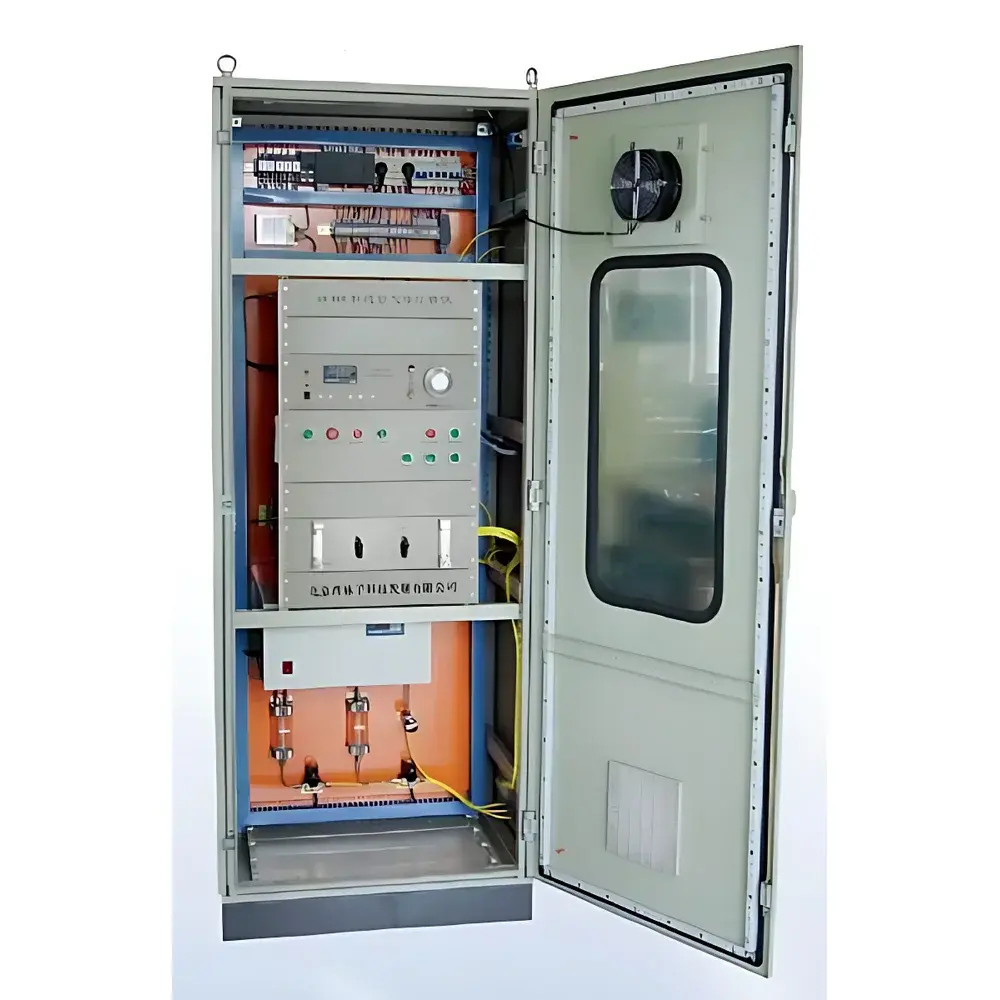
SIELINS XLZ-800 Cement Kiln Gas Analysis System
| Brand | SIELINS |
|---|---|
| Origin | Beijing, China |
| Manufacturer Type | Authorized Distributor |
| Country of Origin | China |
| Model | XLZ-800 |
| Pricing | Upon Request |
| Measured Gases (Cold-Point) | CO, NOₓ (HOx interpreted as NOₓ per industry convention), O₂ |
| Measured Gases (Hot-Point) | CO, NOₓ, O₂, CO₂ |
| Maximum Sampling Temperature | 1400 °C |
| Inlet Dust Loading | < 2000 g/m³ |
| Application Scope | Preheater exit, kiln exhaust, clinker cooler bypass, raw mill exhaust, coal mill & coal dust collector, calciner off-gas |
Overview
The SIELINS XLZ-800 Cement Kiln Gas Analysis System is an industrial-grade, in-situ and extractive gas monitoring solution engineered for continuous, real-time compositional analysis of flue and process gases across the full thermal profile of cement manufacturing lines. Designed to operate under extreme ambient conditions—including sustained exposure to temperatures up to 1400 °C, particulate loadings exceeding 1500 g/m³, and high relative humidity—the system integrates robust hot-gas sampling, dynamic self-cleaning mechanisms, and fail-safe interlock logic to ensure uninterrupted data integrity and operational safety. Its measurement principle relies on extractive sampling with heated transport lines, followed by selective detection via electrochemical (O₂, CO), non-dispersive infrared (CO₂, NOₓ), and paramagnetic (O₂) or zirconia-based sensors—configured per measurement point requirements. The XLZ-800 supports both cold-point (e.g., preheater exit, baghouse inlet) and hot-point (e.g., rotary kiln exhaust, calciner outlet) applications, delivering traceable, repeatable concentration data critical for combustion optimization, energy efficiency control, and regulatory compliance with emission limits under EU IED, China’s GB 4915–2013, and EPA Method 3A/7E.
Key Features
- Multi-point configurable architecture supporting simultaneous monitoring of up to six independent sampling locations—including preheater exit, kiln inlet/outlet, calciner, coal mill, coal dust collector, and clinker cooler bypass
- High-temperature probe assembly rated for continuous operation at 1400 °C, fabricated from sintered silicon carbide and ceramic-coated stainless steel for erosion and thermal shock resistance
- Integrated hot-gas filtration with back-pulse cleaning and automatic soot blow-down cycles, minimizing maintenance intervals and eliminating manual filter replacement during operation
- Heated sample transport lines (maintained at >180 °C) to prevent condensation and adsorption losses of polar species (e.g., NO₂, SO₂, NH₃)
- Redundant safety interlocks including temperature over-limit shutdown, flow loss alarm, pressure differential monitoring, and emergency purge activation upon sensor fault or power interruption
- Modular analyzer cabinet with IP65-rated enclosure, conformal-coated PCBs, and industrial-grade power conditioning for stable operation in electrically noisy plant environments
Sample Compatibility & Compliance
The XLZ-800 accommodates heterogeneous gas streams containing alkali vapors (K₂O, Na₂O), sulfur compounds (SO₂, SO₃), chlorine species (HCl, Cl₂), and heavy metal volatiles typical of cement kiln off-gas. Its sampling train includes alkali-resistant quartz filters, corrosion-resistant Hastelloy C-276 wet scrubbers (optional), and catalytic converters for NOₓ speciation correction where required. All gas-handling components comply with ISO 14644-1 Class 8 cleanroom standards for particulate control and meet CE Machinery Directive 2006/42/EC and ATEX Zone 22 certification for dust explosion protection. Data reporting adheres to ISO 14064-1 greenhouse gas quantification protocols and supports audit-ready traceability per ISO/IEC 17025:2017 for testing laboratories.
Software & Data Management
The embedded SIELINS GasView™ v4.2 software provides real-time multichannel visualization, trend logging at 1-second resolution, and automated report generation in PDF/CSV formats compliant with ISO 17025 documentation requirements. It features dual-layer user access control (operator, engineer, administrator), electronic signature capability, and full audit trail functionality—including timestamped parameter changes, calibration events, and alarm acknowledgments—to satisfy FDA 21 CFR Part 11 and EU Annex 11 data integrity expectations. Historical datasets integrate seamlessly with DCS/SCADA systems via OPC UA (v1.04) and Modbus TCP; optional cloud gateway enables remote diagnostics and predictive maintenance alerts through encrypted TLS 1.2 MQTT communication.
Applications
- Combustion optimization: Real-time O₂ and CO feedback for precise air-fuel ratio control in rotary kilns and calciners, reducing thermal NOₓ formation and unburnt carbon carryover
- Energy efficiency auditing: Correlation of CO₂/O₂ ratios with specific heat consumption (MJ/kg-clinker) to identify kiln shell losses and refractory degradation
- Safety monitoring: Continuous CO surveillance in coal handling systems (mill, silo, dust collector) to prevent spontaneous combustion and explosion hazards
- Environmental compliance: Automated hourly average reporting for NOₓ, CO, and SO₂ emissions against national permit limits (e.g., China’s “Ultra-Low Emission” thresholds)
- Process stability assessment: Detection of abnormal HOx (NOₓ) spikes indicating flame instability or feed composition shifts in raw meal
- Carbon accounting: High-accuracy CO₂ concentration data integrated into plant-level GHG inventories aligned with ISO 14064 and CDP reporting frameworks
FAQ
What gas species can the XLZ-800 measure simultaneously at a single hot-point location?
The system supports concurrent analysis of CO, NOₓ (as NO + NO₂), O₂, and CO₂ at any designated high-temperature sampling point—subject to sensor module configuration and cross-interference compensation algorithms.
Is the system certified for use in hazardous areas classified under IECEx or ATEX?
Yes—probe assemblies are certified for ATEX Zone 22 (dust) and IECEx Z22, while analyzer cabinets meet ATEX Zone 2 (gas) requirements when equipped with optional intrinsically safe barriers.
How does the XLZ-800 handle alkali-induced sensor poisoning common in cement kiln gases?
It employs alkali-scavenging pre-filters, heated sample lines to avoid condensation-driven alkali deposition, and periodic auto-calibration with certified span gases to correct for baseline drift induced by long-term exposure.
Can the system interface with Siemens PCS7 or Honeywell Experion DCS platforms?
Yes—native OPC UA server implementation ensures seamless bidirectional integration, including real-time setpoint updates, alarm forwarding, and diagnostic status mapping to standard DCS tag structures.
What is the recommended calibration frequency under continuous 24/7 operation?
Zero and span calibration is advised every 7 days for O₂ and CO channels, and every 14 days for CO₂ and NOₓ modules—though extended intervals up to 30 days are permissible with documented performance verification per ISO 6145-7.
Related Products







