
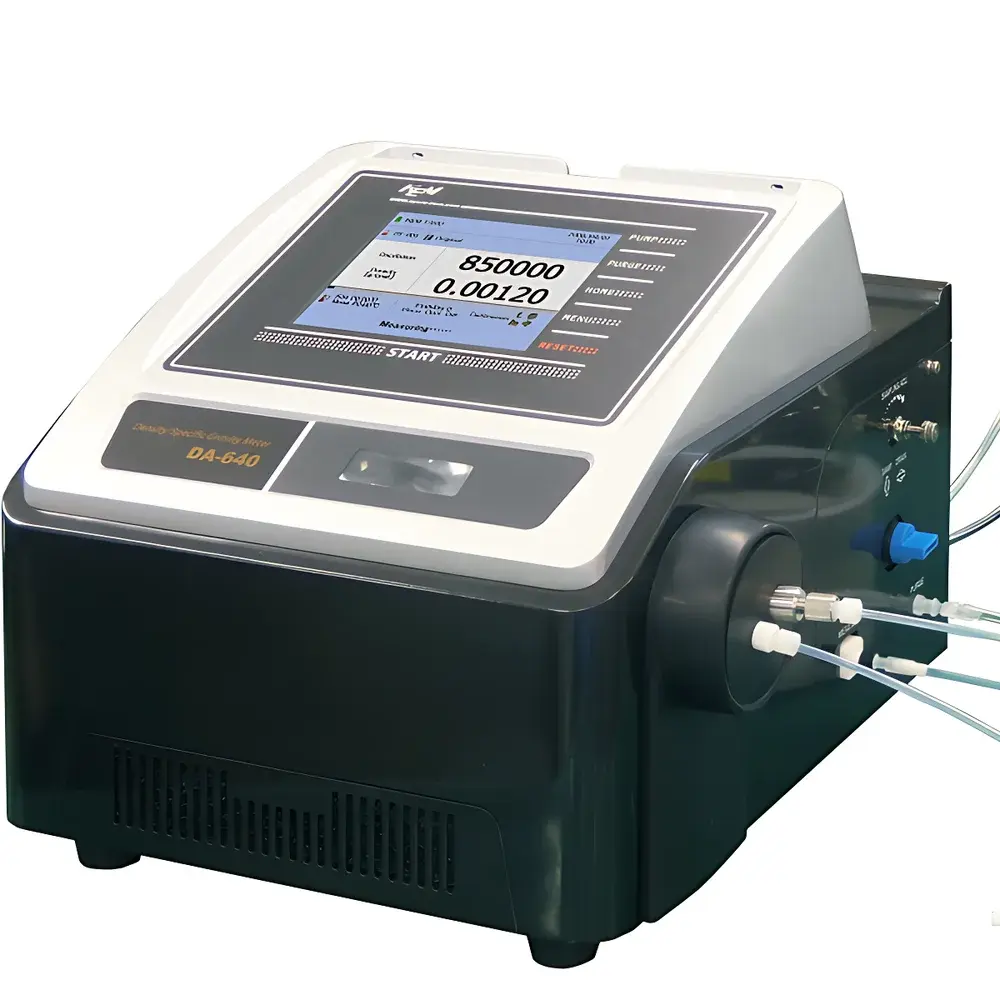
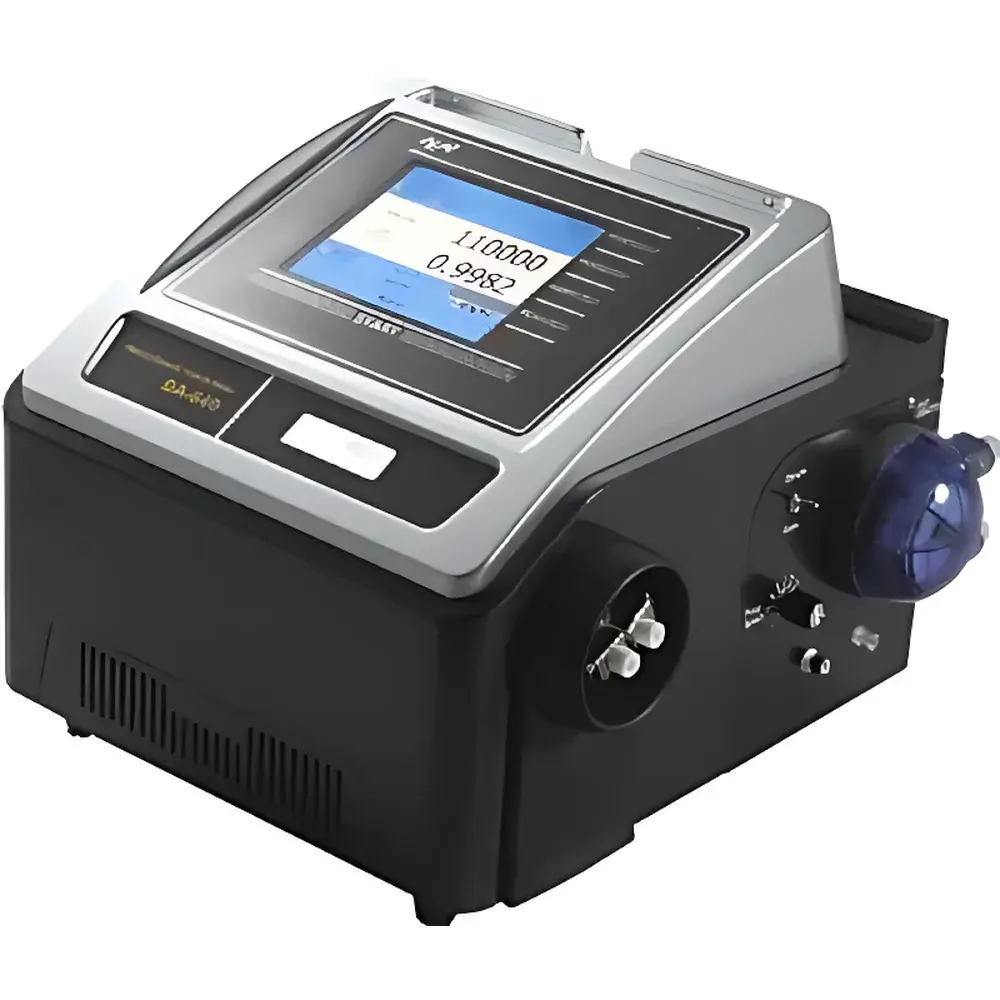
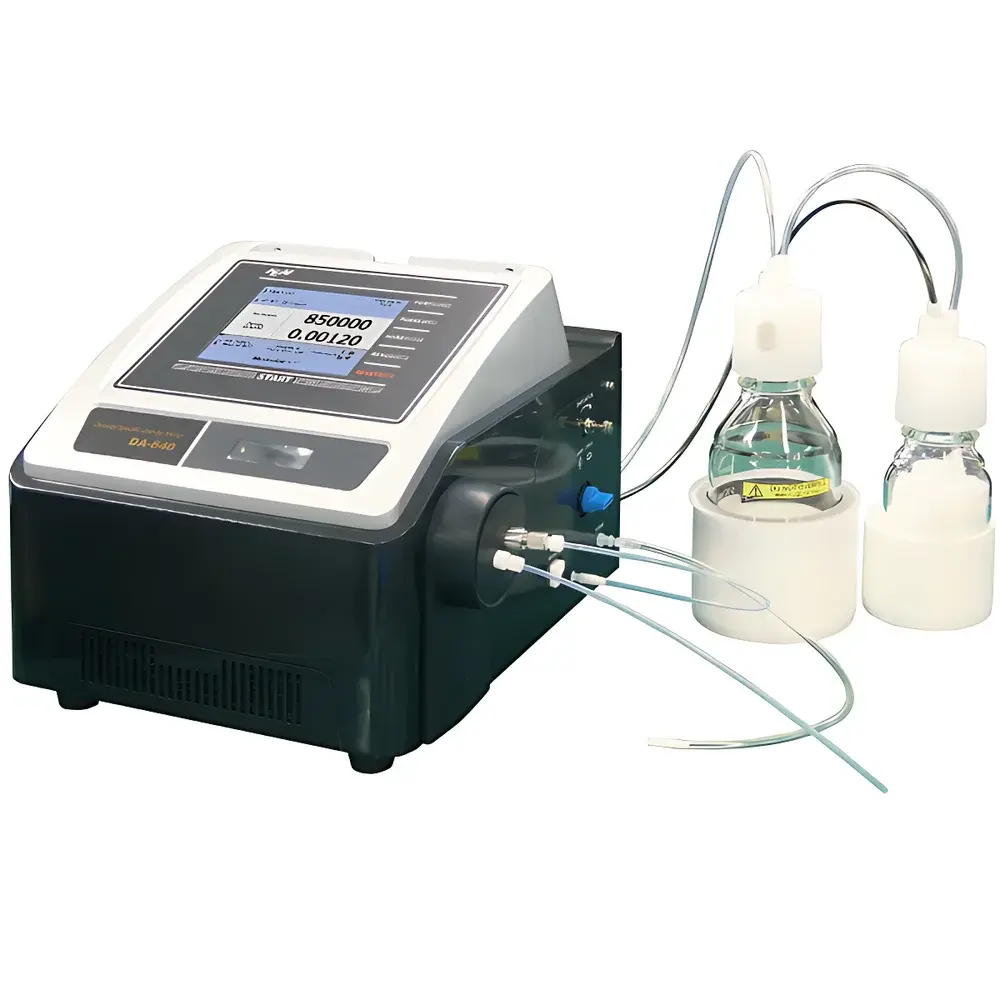
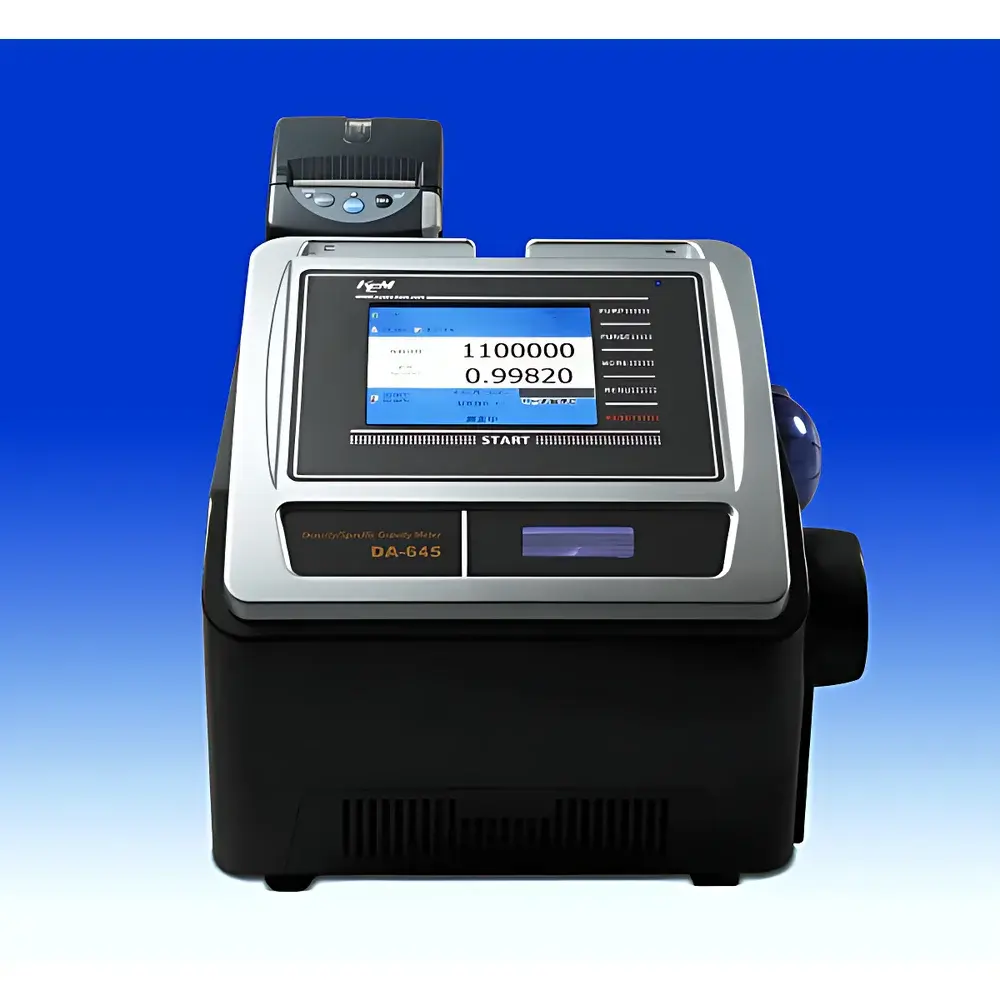
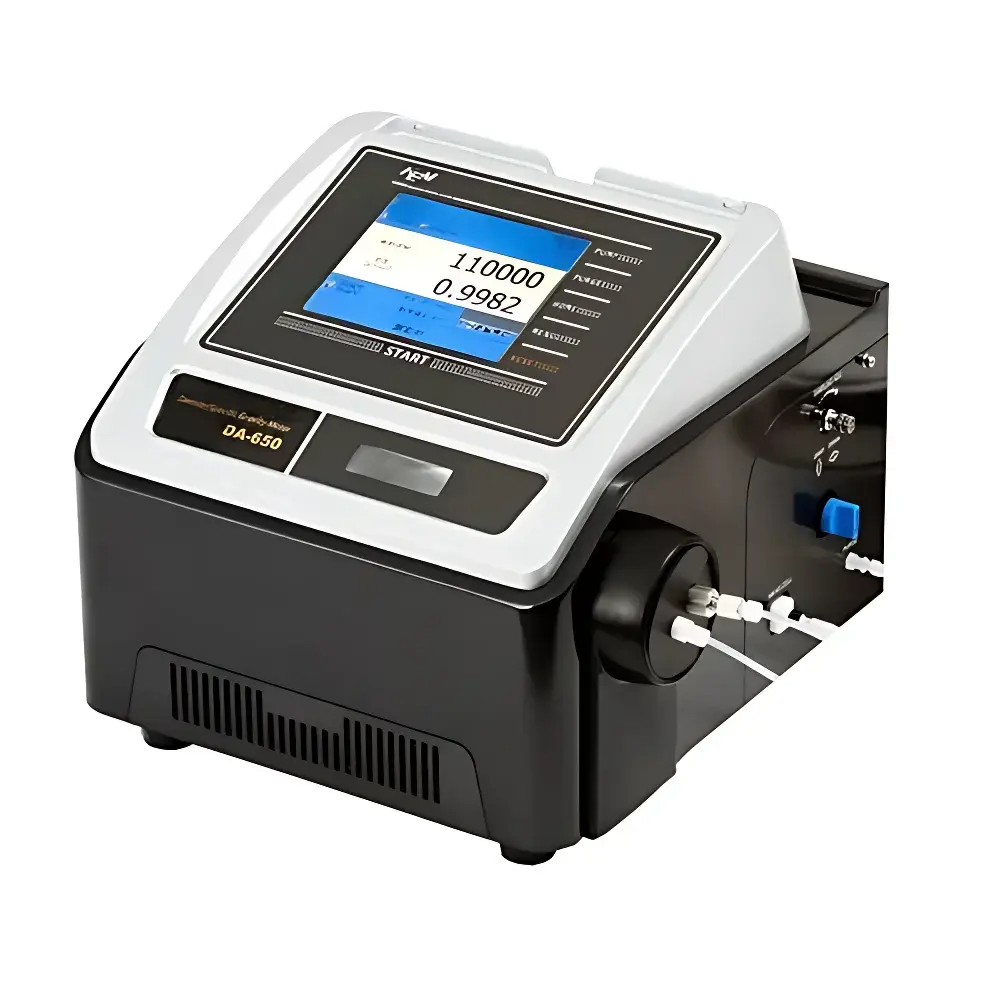
KEM DA-645 Desktop U-Tube Oscillating Density Meter
| Brand | KEM (Kyoto Electronics Manufacturing) |
|---|---|
| Origin | Japan |
| Manufacturer | Yes |
| Instrument Type | Laboratory Benchtop Oscillating U-Tube Densimeter |
| Sample Type | Liquids Only |
| Density Range | 0–3 g/cm³ |
| Density Accuracy | ±5×10⁻⁵ g/cm³ |
| Density Resolution & Repeatability | 1×10⁻⁵ g/cm³ |
| Temperature Control Range | 0–96 °C (±0.03 °C) |
| Temperature Resolution | 0.01 °C |
| Minimum Sample Volume | 1 mL (manual), ~2 mL (auto-pump) |
| Measurement Time | ~20 s (stabilized sample), 2–10 min (full auto-cycle) |
| Display | 5.7″ TFT capacitive touchscreen (English/Chinese/Japanese UI) |
| Interfaces | LAN, USB 1.1, RS-232C |
| Compliance | ASTM D4052, D3505, D5002, D5931 |
Overview
The KEM DA-645 Desktop U-Tube Oscillating Density Meter is a high-precision laboratory instrument engineered for accurate, rapid, and repeatable determination of density, specific gravity, relative density, and derived concentration values in liquid samples. It operates on the fundamental principle of oscillating U-tube densimetry: a precisely machined borosilicate glass U-shaped tube is electromagnetically excited into resonant vibration; the presence of a liquid sample alters the system’s mass-inertia relationship, resulting in a measurable shift in natural oscillation frequency. This frequency shift is linearly correlated to the sample’s density via factory calibration using traceable standards (e.g., air and water at defined temperatures). The DA-645 integrates a Peltier-based thermostatic control system, ensuring temperature stability within ±0.03 °C across its full operational range (0–96 °C), critical for compliance with international standard methods including ASTM D4052-18a, ISO 15212-1, and GB/T 2013-2010. Designed for routine QC/QA environments, it delivers resolution and repeatability of 1×10⁻⁵ g/cm³—sufficient for pharmaceutical excipient qualification, fuel blending verification, beverage alcohol content analysis (per GB 5009.225), and high-grade chemical purity assessment.
Key Features
- High-stability U-tube sensor with seamless internal geometry minimizes bubble entrapment and ensures laminar, uniform sample flow during automated filling and rinsing.
- Integrated peristaltic sampling pump enables fully automated sequence: sample aspiration → measurement → waste discharge → solvent rinse → drying cycle — reducing operator exposure and cross-contamination risk.
- Real-time automatic viscosity correction algorithm eliminates manual input of kinematic viscosity; compensates for damping effects across a wide viscosity range without reference tables or external viscometer integration.
- 5.7-inch high-brightness TFT capacitive touchscreen with multilingual OS (English, Chinese, Japanese) supports intuitive method setup, real-time parameter monitoring (frequency, temperature, density drift), and contextual help.
- GLP-compliant data architecture: user authentication with role-based permissions, encrypted audit trail for all measurements, calibrations, and maintenance events; timestamped storage of calibration certificates and verification logs.
- Dual-mode operation: manual syringe injection (≥1 mL) for rapid screening or automated pump-driven workflow (≈2 mL) for unattended batch processing with programmable cleaning protocols.
Sample Compatibility & Compliance
The DA-645 is validated for use with homogeneous, non-particulate, non-volatile, and low-to-moderate volatility liquids—including hydrocarbons (crude oil, diesel, jet fuel per SH/T 0604), aqueous solutions (pharmaceutical buffers, electrolytes), food-grade liquids (juices, syrups, ethanol/water blends per GB 5009.225), cosmetics (surfactant solutions, fragrances per GB/T 13531.4), and industrial coolants (per ASTM D5931). It excludes suspensions, emulsions, highly viscous polymers (>500 mPa·s), and corrosive halogenated solvents unless verified with chemically resistant tubing kits. Regulatory alignment includes full support for 21 CFR Part 11 electronic records (via optional KEM Data Manager software), ISO/IEC 17025 method validation documentation, and adherence to ASTM, ISO, GB, and EN standards cited in its type-approval scope.
Software & Data Management
Data export and instrument control are facilitated through native LAN (TCP/IP), USB 1.1, and RS-232C interfaces. All measurements—alongside raw frequency data, temperature logs, and system diagnostics—are timestamped and stored internally with configurable retention policies. User-defined concentration conversion tables (e.g., Brix, %v/v ethanol, API gravity, Baume) are embedded and applied in real time. Statistical functions compute mean, SD, RSD, and confidence intervals across replicate runs. KEM’s optional Data Manager software provides centralized fleet monitoring, SPC charting, CSV/PDF report generation, and secure cloud backup compatible with LIMS integration. Calibration history—including date, standard IDs, deviation plots, and technician signature—is retained indefinitely and exportable for regulatory audits.
Applications
- Quality control of petroleum products: density grading of gasoline, kerosene, and lubricants per ASTM D1250 and SH/T 0604.
- Pharmaceutical manufacturing: density verification of solvents, APIs in solution, and final dosage forms per USP and ICH Q5C.
- Food & beverage laboratories: alcohol quantification in spirits (GB/T 11856–11858), sugar content via Brix correlation, and density-based authenticity testing of honey and fruit juices.
- Chemical R&D: precise density tracking during reaction progress, polymer solution characterization, and solvent purity assessment per ASTM D3505.
- Academic research: thermophysical property studies requiring high-resolution density vs. temperature profiling (0–96 °C).
FAQ
What is the minimum required sample volume for manual operation?
Approximately 1 mL is sufficient when using a precision syringe for direct injection into the U-tube cell.
Does the DA-645 require external calibration standards for daily use?
No—factory calibration with certified air/water references is retained; however, periodic verification using NIST-traceable standards (e.g., degassed water at 20 °C) is recommended per ISO/IEC 17025 and internal SOPs.
Can the instrument measure samples above 96 °C?
No—the maximum controlled temperature is 96 °C; exceeding this risks sensor degradation and invalidates compliance with ASTM D4052 and ISO 15212-1.
Is the built-in viscosity correction validated for non-Newtonian fluids?
The algorithm is optimized for Newtonian and mildly shear-thinning liquids; strongly non-Newtonian or thixotropic samples require empirical validation prior to routine use.
How does the DA-645 ensure measurement integrity during ambient temperature fluctuations?
Its redesigned thermal enclosure and dual-sensor Peltier system reduce sensitivity to ambient drift by >50% versus prior-generation models (DA-500 series), maintaining ±0.03 °C bath stability even in labs with ±5 °C diurnal variation.



