
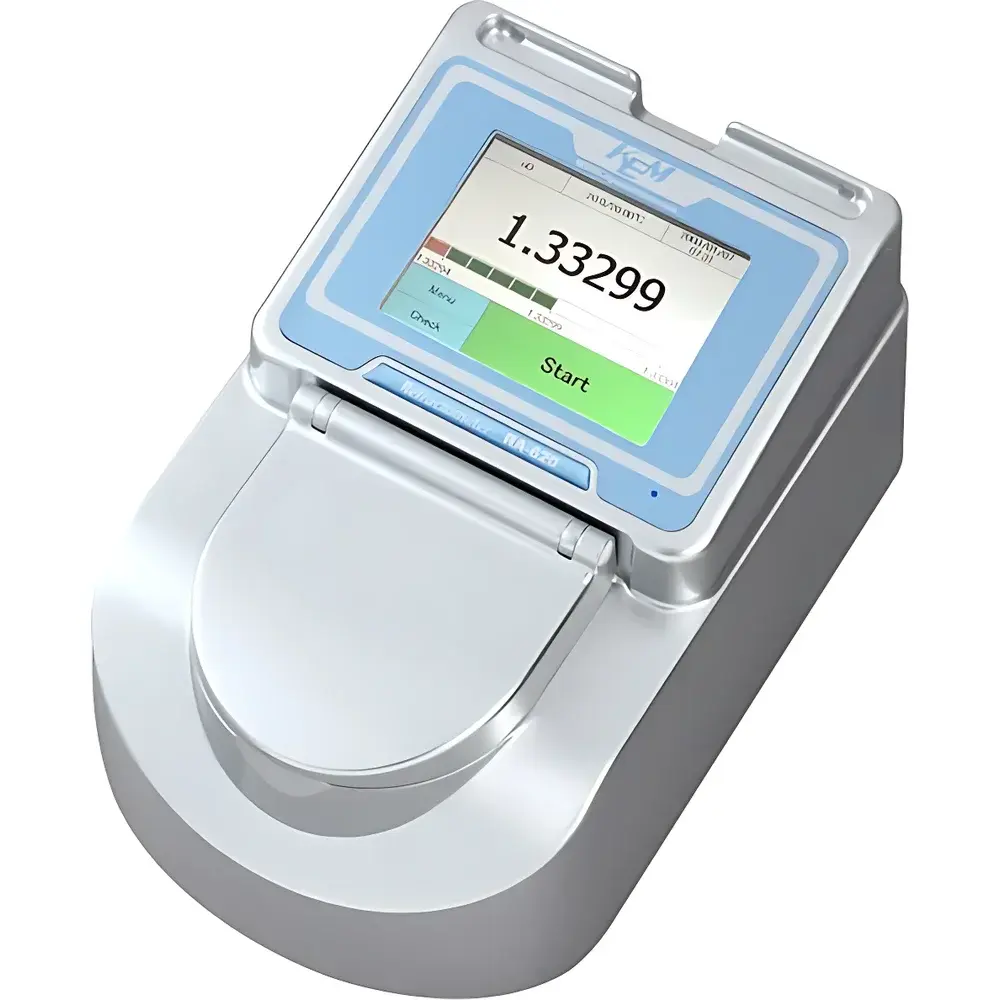
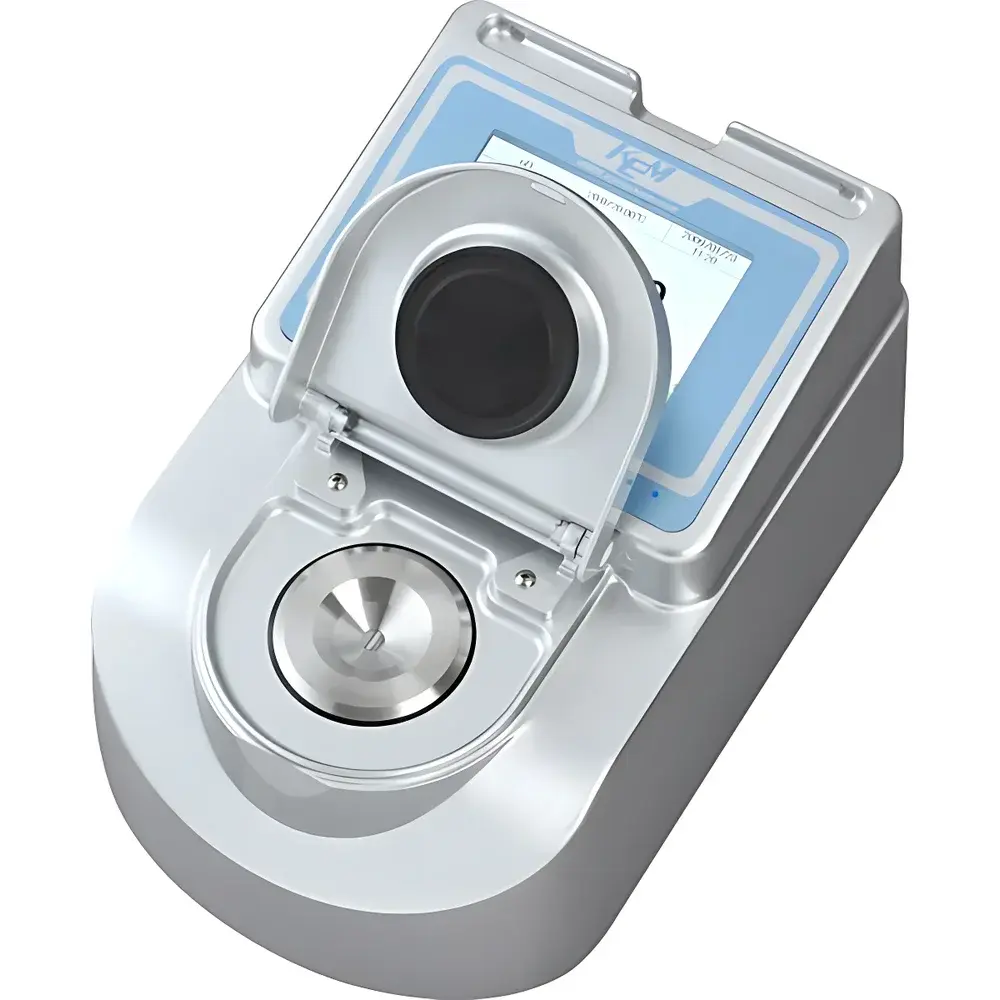
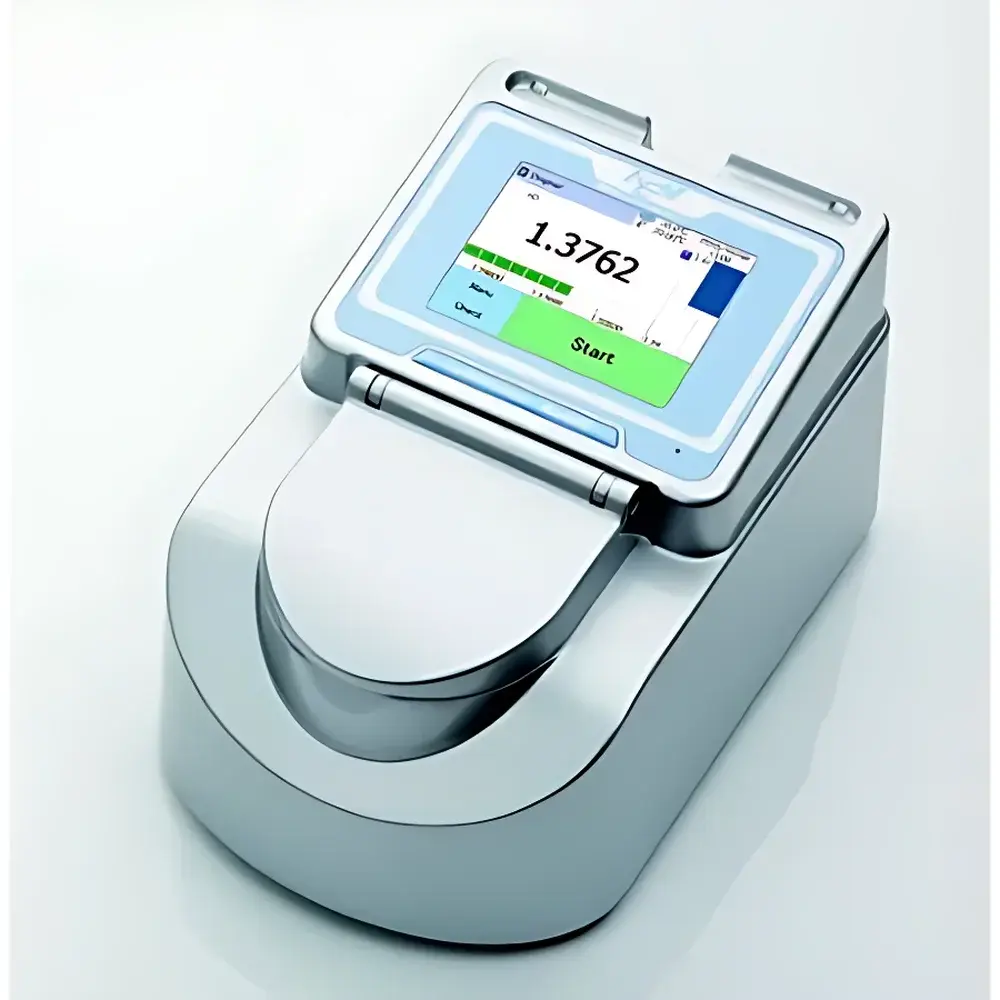
KEM RA-620/RA-600 Automated Digital Refractometer & Brix Meter
| Brand | KEM (Kyoto Electronics Manufacturing) |
|---|---|
| Origin | Japan |
| Manufacturer Type | Original Equipment Manufacturer (OEM) |
| Instrument Type | Destructive Sampling Refractometer |
| Model | RA-620 / RA-600 |
| Measurement Principle | Sodium D-line (589.3 nm) Refractive Index at 20 °C |
| RI Range (RA-620) | 1.32000–1.58000 nD |
| RI Range (RA-600) | 1.3200–1.7000 nD |
| Brix Range | 0–100 % |
| RI Accuracy (RA-620) | ±0.00002 nD |
| RI Accuracy (RA-600) | ±0.0001 nD |
| Brix Accuracy (RA-620) | ±0.014 % |
| Brix Accuracy (RA-600) | ±0.1 % |
| RI Repeatability (RA-620) | ±0.00001 nD |
| RI Repeatability (RA-600) | ±0.0001 nD |
| Temperature Control Range | 5–75 °C (RA-600 optional up to 100 °C) |
| Temp. Resolution (RA-620) | 0.01 °C |
| Temp. Resolution (RA-600) | 0.1 °C |
| Minimum Sample Volume | 0.2 mL |
| Prism Material | Sapphire |
| Sample Stage Material | Stainless Steel SUS316 |
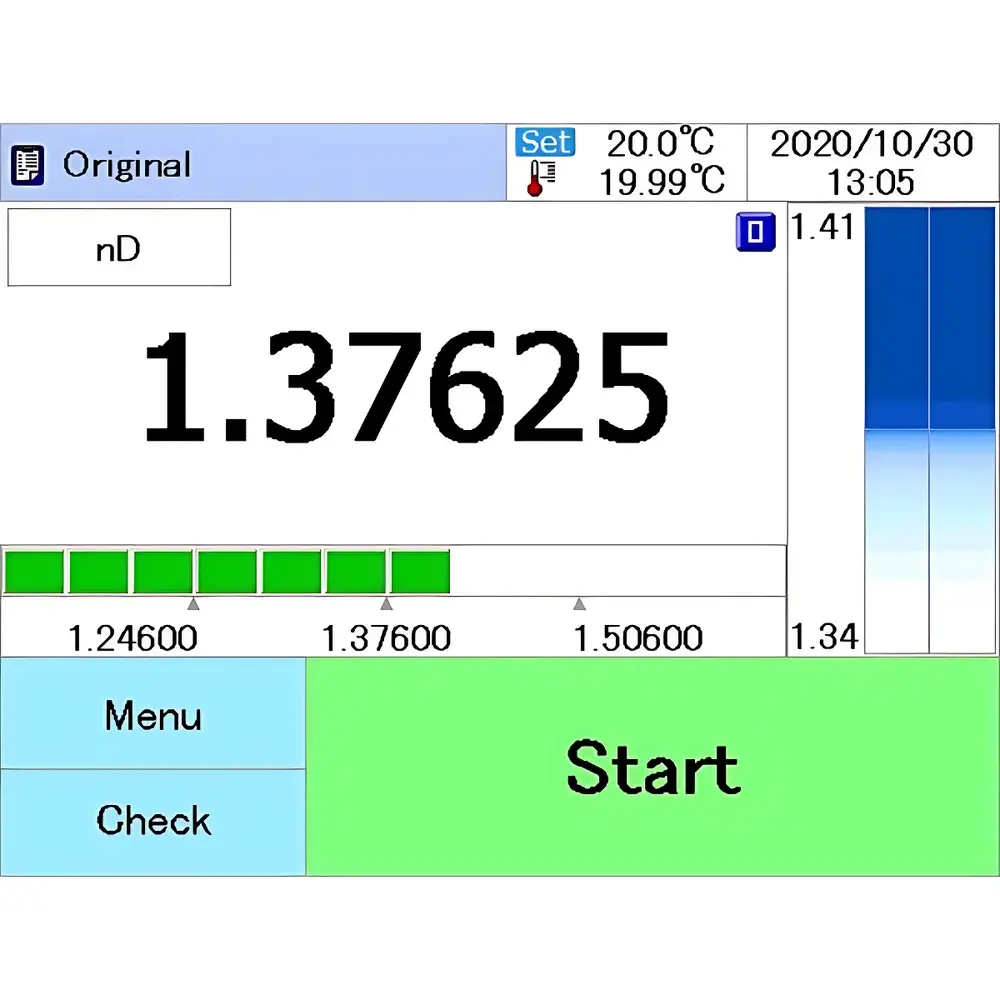
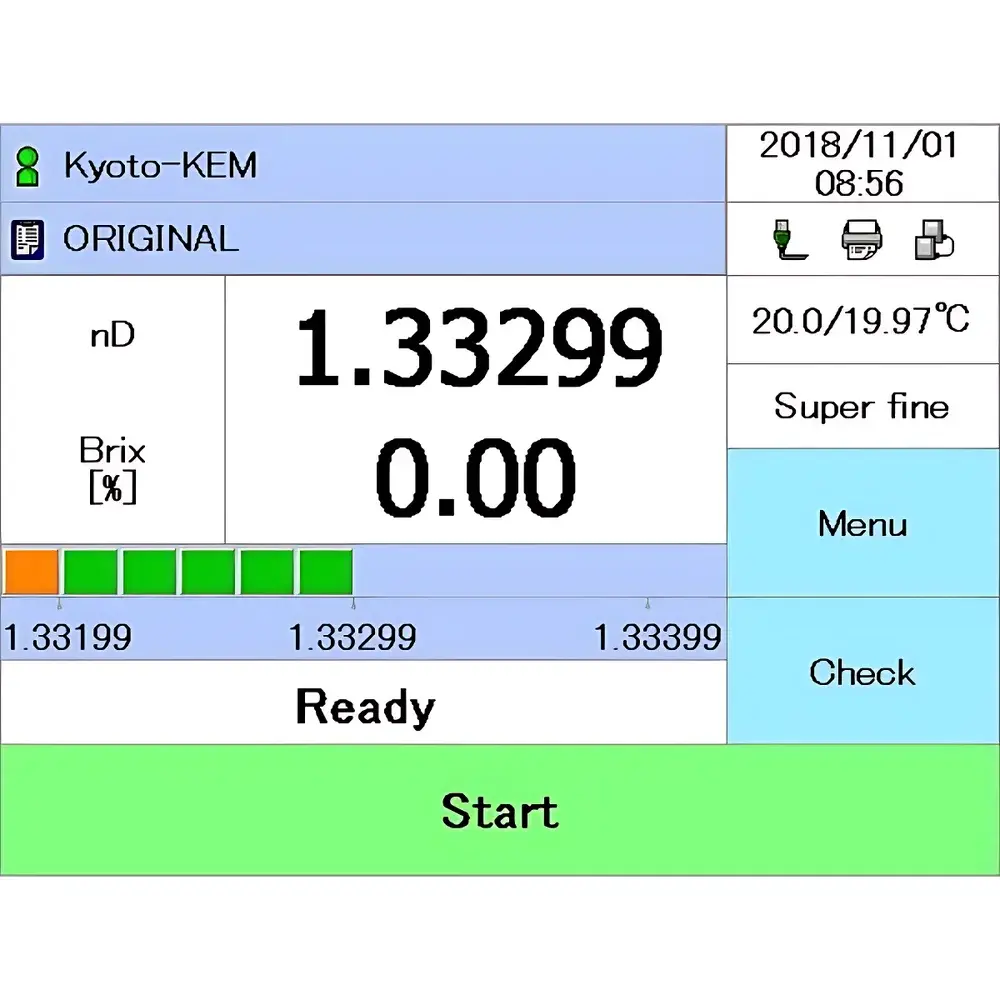
| Display | Full-color TFT touchscreen (Chinese/English/Japanese UI) |
| Data Storage | 100 methods, 300 results, 20 calibration logs |
| Interface | Ethernet (LAN), USB, RS-232C |
| Power | AC 100–240 V, 50/60 Hz, 20 W |
Overview
The KEM RA-620 and RA-600 are high-precision, fully automated digital refractometers engineered for accurate, traceable measurement of refractive index (nD) and soluble solids content (Brix %) in liquid and semi-liquid samples. Operating on the principle of total internal reflection at the prism–sample interface under monochromatic sodium D-line illumination (589.3 nm), these instruments comply with internationally recognized optical metrology standards including ISO 2173, AOAC 932.12, and ASTM D1218. The RA-620 delivers laboratory-grade resolution (0.00001 nD) and accuracy (±0.00002 nD), making it suitable for R&D, QC validation, and regulatory-compliant environments where reproducibility is critical—such as pharmaceutical excipient analysis, high-purity syrup formulation, and botanical extract standardization. The RA-600 provides robust industrial performance with extended refractive index range (up to 1.7000 nD), optimized for applications involving high-concentration sucrose syrups, molasses, glycerol-based formulations, and viscous polymer solutions. Both models feature Peltier-based thermostatic control calibrated to ±0.01 °C (RA-620) or ±0.1 °C (RA-600), ensuring strict adherence to temperature-dependent measurement protocols defined in USP <731> and ISO 5725.
Key Features
- Full-color TFT touchscreen interface supporting multilingual operation (English, Chinese, Japanese) with intuitive graphical navigation and real-time dual-parameter display (nD, Brix %, temperature, concentration units)
- Integrated Peltier thermoelectric module enabling rapid, bidirectional temperature stabilization (5–75 °C standard; RA-600 optionally extends to 100 °C), eliminating external water baths and reducing thermal equilibration time by >60 %
- Sapphire prism and SUS316 stainless steel sample stage ensure long-term mechanical durability, chemical resistance to aggressive solvents (e.g., ethanol, organic acids), and minimal surface wear during routine cleaning
- Front-access sample chamber design minimizes operator-induced contamination risk and simplifies residue removal—critical for food-grade and GMP-aligned workflows
- Total internal reflection optics enable reliable measurement of turbid, deeply colored, or low-transmittance samples (e.g., fruit pulps, caramelized syrups, herbal tinctures) without filtration or dilution
- Configurable auto-conversion engine supports direct output in user-defined units: Brix %, HFCS-42/55/90 concentration, alcohol % v/v, specific gravity, or custom polynomial-based concentration tables (up to 100 user-defined points)
- Automated calibration verification with built-in reference check (distilled water + certified sucrose standards), error logging, and full audit trail generation per measurement cycle
Sample Compatibility & Compliance
The RA-620/RA-600 accommodates a broad spectrum of aqueous and non-aqueous matrices with minimum sample volume of only 0.2 mL—ideal for precious or limited-availability samples. Compatible sample types include fruit juices, soft drinks, wine musts, dairy concentrates, pharmaceutical syrups, battery electrolytes, and industrial coolants. The sapphire prism’s hardness (Mohs 9) resists scratching from particulates commonly found in unfiltered beverages or plant extracts. All firmware and data handling routines conform to FDA 21 CFR Part 11 requirements for electronic records and signatures when paired with validated network configurations and user access controls. Instrument qualification documentation—including IQ/OQ templates, traceable calibration certificates (NIST-traceable standards), and uncertainty budgets—is available upon request to support GLP, GMP, and ISO/IEC 17025 accreditation processes.
Software & Data Management
Data integrity is enforced through embedded timestamped storage (300 results, 100 methods, 20 calibration logs), with export options via USB flash drive (FAT32), Ethernet (TCP/IP), or RS-232C serial interface. Optional KEM WinCT software enables remote instrument control, batch report generation (PDF/CSV), statistical process monitoring (X̄-R charts), and integration into LIMS environments via HL7 or ASTM E1384 messaging protocols. Audit trails record operator ID, method version, environmental conditions (ambient temperature/humidity), and all parameter modifications—supporting full compliance with ALCOA+ principles (Attributable, Legible, Contemporaneous, Original, Accurate, Complete, Consistent, Enduring, Available).
Applications
- Food & Beverage: Brix standardization of orange juice, maple syrup grading, honey adulteration screening, soft drink formulation QC
- Pharmaceuticals: Excipient concentration verification (e.g., sucrose, dextrose, sorbitol in oral solutions), stability-indicating assay support
- Chemical Industry: Glycol/water mixture ratio control, solvent purity assessment, polymer solution concentration monitoring
- Agriculture & Biotech: Plant sap osmolality estimation, fermentation broth sugar tracking, cell culture media optimization
- Academic Research: Thermodynamic modeling of binary/multicomponent systems using temperature-dependent nD datasets
FAQ
What is the difference between RA-620 and RA-600 in terms of metrological performance?
The RA-620 offers higher resolution (0.00001 nD) and tighter accuracy (±0.00002 nD), targeting analytical laboratories requiring ISO/IEC 17025-compliant measurements. The RA-600 trades minor precision for broader refractive index coverage (up to 1.7000 nD) and enhanced ruggedness in continuous production environments.
Can the instrument measure volatile samples like ethanol-water mixtures without evaporation loss?
Yes—the optional vapor-tight sample cover suppresses evaporation during measurement, and the Peltier-controlled chamber maintains stable thermal equilibrium even for low-boiling-point solvents.
Is external calibration required after installation?
No—factory calibration is performed using NIST-traceable sucrose standards. Users perform daily verification with distilled water and a secondary standard; full recalibration is recommended annually or per internal SOP.
Does the system support 21 CFR Part 11 compliance out-of-the-box?
Yes—when configured with role-based user accounts, electronic signatures, and enabled audit trail logging, the RA-620/RA-600 meets core technical requirements for Part 11 compliance; validation documentation is provided to support site-specific implementation.
Can density and refractive index be measured simultaneously?
Yes—via optional integration with KEM DA-130N portable density meter or DA-6xx series benchtop densitometers using synchronized trigger signals and shared KEM WinCT platform.





