
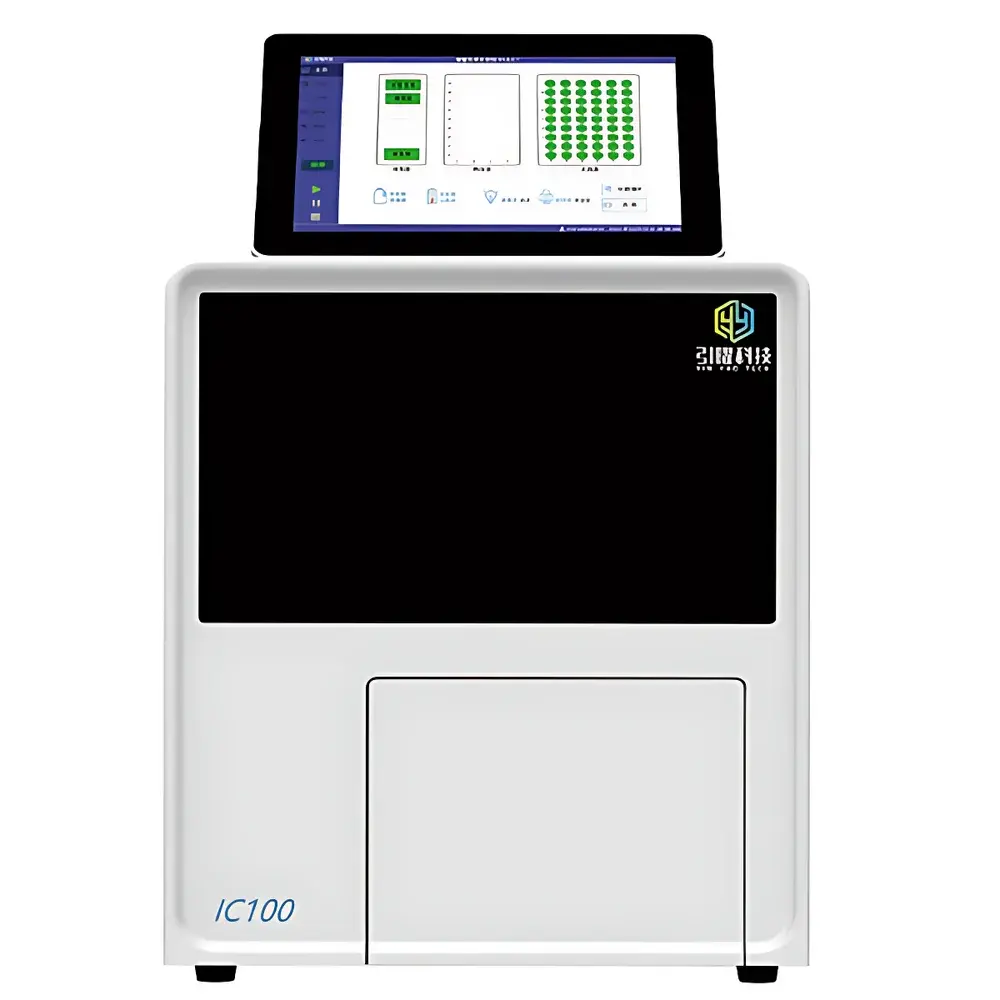
INNYAO IC-100 Intelligent Discrete Flow Analyzer
| Brand | INNYAO |
|---|---|
| Origin | Zhejiang, China |
| Manufacturer Type | Authorized Distributor |
| Product Category | Domestic |
| Model | IC-100 |
| Instrument Type | Discrete Flow Analyzer |
| Wavelength Range | 340–880 nm |
| Sample Capacity | 200 positions (standard carousel) / 100 positions (optional dual-rack configuration) |
| Reagent Positions | 4 |
| Cuvette Path Length | 10 mm |
| Light Source | Single-beam halogen lamp (6 V / 10 W) |
| Optical System | Fixed-wavelength photometric detection with selectable filters |
Overview
The INNYAO IC-100 Intelligent Discrete Flow Analyzer is a fully automated benchtop system engineered for high-precision, low-volume wet-chemical analysis using discrete (segmented) flow methodology. Unlike continuous-flow or classical flow injection systems, the IC-100 employs a precise robotic arm to aspirate, dispense, and mix discrete sample and reagent aliquots into individual cuvettes—enabling true reaction control, programmable incubation times, and minimized cross-contamination. Its photometric detection module operates across a broad visible spectrum (340–880 nm), supporting standardized colorimetric and enzymatic assays widely adopted in environmental monitoring (e.g., nitrate, phosphate, ammonia), clinical chemistry (e.g., creatinine, uric acid), food safety (e.g., sulfite, total phenolics), and wastewater compliance testing. The system’s architecture complies with fundamental principles outlined in ISO 8466-2 (water quality — calibration of analytical methods) and supports method validation per EPA Method 365.4 and ASTM D5179 for nutrient analysis.
Key Features
- Robotic sample handling with dual-capacity carousel (200-position standard / 100-position dual-rack option) for unattended operation over extended batch runs.
- Four dedicated reagent ports with independent temperature-stabilized storage (ambient or optional +4 °C cooling module available).
- Fixed-pathlength (10 mm) quartz or optical-grade plastic cuvettes ensuring consistent absorbance geometry and traceable calibration.
- Single-beam halogen light source (6 V / 10 W) coupled with interference filter wheel (pre-configured for up to 8 wavelengths; user-replaceable) for stable, low-drift photometry.
- Integrated wash station with multi-step cleaning protocol (acid, base, deionized water) to maintain cuvette integrity and prevent carryover between analyses.
- Modular design compliant with IEC 61000-6-3 (EMC emission standards) and CE marking requirements for laboratory instrumentation.
Sample Compatibility & Compliance
The IC-100 accommodates aqueous liquid samples within viscosity limits typical of environmental and biological matrices (< 5 mPa·s at 25 °C). It supports direct analysis of filtered surface water, digested soil extracts, serum/plasma dilutions, and beverage filtrates without prior derivatization in most standard protocols. All fluidic pathways are constructed from chemically inert PTFE, PEEK, and borosilicate glass components to resist corrosion from acidic, alkaline, or oxidizing reagents. The system meets essential regulatory expectations for routine QC/QA workflows: audit trails are timestamped and user-logged; calibration curves are stored with metadata (date, operator, reference standards used); and raw absorbance data files adhere to ASTM E1382-95 (standard guide for computerized analytical data systems) formatting conventions.
Software & Data Management
Control and data acquisition are managed via INNYAO Analytical Suite v3.2—a Windows-based application supporting method development, sequence programming, real-time absorbance monitoring, and statistical reporting. The software implements role-based access control (RBAC), electronic signature capability, and configurable audit trail logging aligned with FDA 21 CFR Part 11 requirements for regulated environments. Raw data export is supported in CSV, TXT, and XML formats; integration with LIMS platforms is achieved through ODBC-compliant drivers. Calibration models include linear, quadratic, and log-log regression with residual diagnostics, while QC flagging follows Westgard multirule logic (12s, 13s, 22s, R4s, 41s, 10x) to ensure measurement consistency across shifts.
Applications
- Environmental laboratories performing EPA-compliant nutrient profiling (NO3−, NO2−, PO43−, NH3-N) in drinking water, wastewater effluent, and groundwater.
- Food and beverage QA departments quantifying preservatives (e.g., SO2), antioxidants (e.g., total polyphenols), and adulterants (e.g., melamine via indirect assay).
- Clinical research labs conducting high-throughput screening of enzymatic biomarkers (e.g., ALP, AST, GGT) in serum using standardized kinetic or endpoint protocols.
- Educational institutions utilizing the IC-100 for teaching analytical method validation, Beer–Lambert law verification, and automation principles in instrumental analysis courses.
FAQ
Is the IC-100 compatible with existing laboratory information management systems (LIMS)?
Yes—the instrument supports bidirectional data exchange via ODBC-compliant drivers and flat-file export (CSV/XML) with customizable field mapping.
Can users define custom wavelengths outside the factory-installed filter set?
No—the optical module uses fixed interference filters; however, eight-position filter wheels can be ordered as an optional upgrade for expanded spectral flexibility.
What maintenance intervals are recommended for long-term photometric stability?
Halogen lamp replacement is advised every 1,000 operating hours; cuvette alignment verification and baseline drift calibration should be performed weekly using certified neutral density standards.
Does the system support GLP/GMP-compliant audit trails and electronic signatures?
Yes—INNYAO Analytical Suite v3.2 includes full 21 CFR Part 11 functionality, including user authentication, immutable audit logs, and digital signature capture for report approval.
Is method transfer possible from legacy continuous-flow analyzers?
Method adaptation is feasible for most colorimetric assays; required adjustments typically involve re-optimizing reagent/sample ratios, incubation timing, and dilution factors to match discrete reaction kinetics.




