
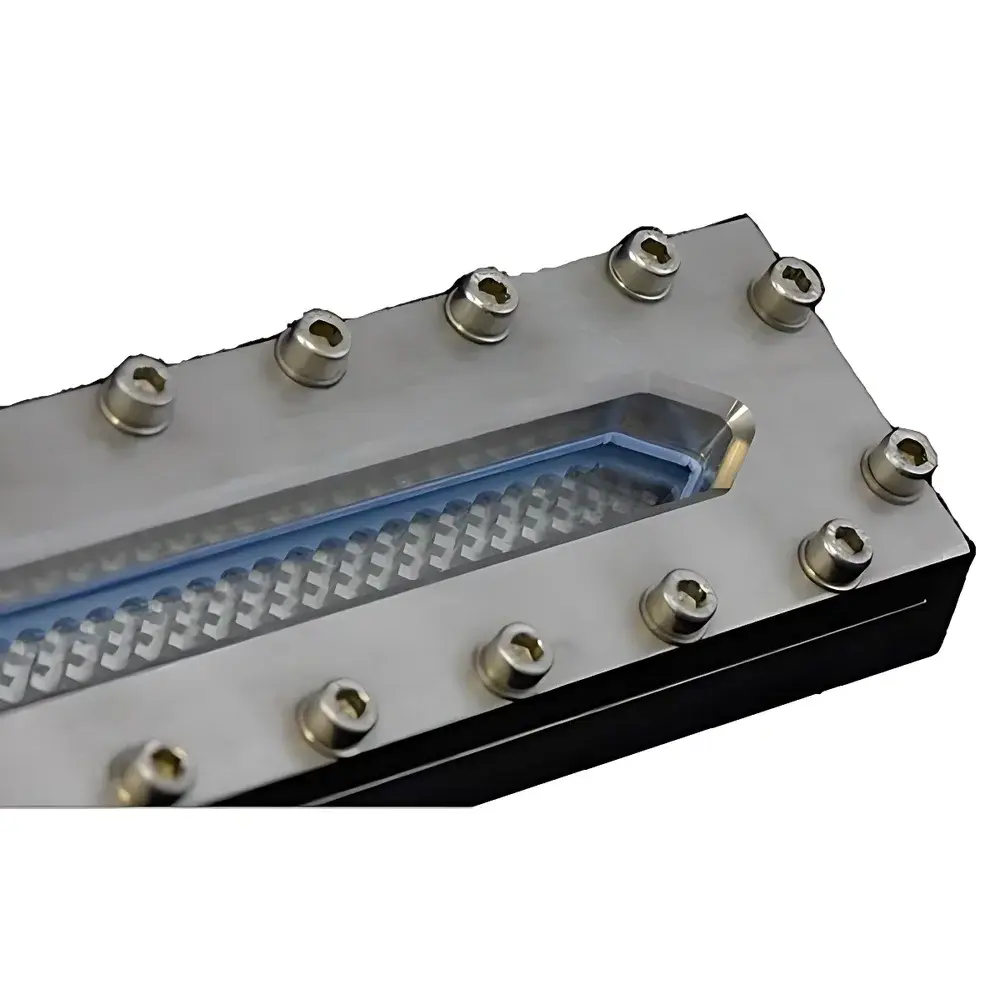
HANU HX-15 Continuous-Flow Photochemical Reactor
| Brand | CREAFLOW |
|---|---|
| Origin | Belgium |
| Model | HX-15 |
| Reactor Volume | 15 mL |
| Operating Pressure | 0–10 bar |
| Temperature Range | –20 to +80 °C |
| Window Material | Borosilicate glass (transmission >325 nm) or Quartz (transmission >200 nm) |
| Wetted Materials | 316L stainless steel, Hastelloy C-276 (customizable) |
| Heat Exchange | External thermal fluid circuit |
| Flow Channel Dimensions | 2 mm × 2 mm |
| Mixing Mechanism | Static baffled elements + synchronized pulsation |
| Residence Time Distribution | Narrow (Péclet number >100) |
| PAT Integration | In-line UV-Vis spectroscopy compatible |
| Cleanability | Fully disassemblable for cGMP-compliant cleaning |
Overview
The HANU HX-15 Continuous-Flow Photochemical Reactor is an engineered platform designed for precise, scalable, and analytically integrated photochemical synthesis under controlled flow conditions. Built upon the COSTA (Controlled Oscillatory Shear and Turbulent Advection) fluid dynamics architecture, it combines passive static mixing with active pulsed flow modulation to achieve high-intensity photon delivery, uniform irradiation exposure, and narrow residence time distribution (RTD). Unlike batch photoreactors subject to photon attenuation and thermal gradients, the HX-15 operates on a true continuous-flow principle—enabling reproducible photochemical transformations with quantifiable light fluence (mol·photon·m⁻²·s⁻¹), defined thermal management via external thermal fluid exchange, and real-time reaction progress tracking. Its design conforms to fundamental requirements for process intensification in modern pharmaceutical, agrochemical, and fine chemical development—particularly where photolysis, [2+2] cycloadditions, C–H functionalization, or singlet oxygen-mediated oxidations demand strict control over photon flux, mixing efficiency, and interfacial mass transfer.
Key Features
- Optimized photon utilization via dual-window irradiation geometry: borosilicate (UV-A/visible) or fused quartz (deep-UV) transparent windows ensure >90% optical transmission across defined spectral bands, while rapid liquid film refreshment at the window interface mitigates fouling and photodegradation.
- Hybrid mixing architecture: 2 mm × 2 mm microchannel geometry embedded with staggered baffle elements induces primary turbulent advection; superimposed pulsation (frequency- and amplitude-tunable) delivers secondary shear enhancement—yielding effective Reynolds numbers >2,000 even at low volumetric flow rates (0.1–5 mL/min).
- Modular, fully disassemblable construction: all wetted components—including reactor core, end caps, window retainers, and thermal jacket interfaces—are accessible without tools, supporting full visual inspection, manual cleaning validation, and swab-based residue testing per ICH Q5C and EU Annex 15 guidelines.
- Integrated thermal management: jacketed design compatible with external circulators (–20 to +80 °C), enabling precise exotherm control during high-quantum-yield reactions and cryogenic photochemistry (e.g., triplet sensitization below 0 °C).
- Pressure-rated operation up to 10 bar: facilitates gas–liquid photochemistry (e.g., photocatalytic CO₂ reduction, aerobic oxidations) with back-pressure regulation and inline gas dissolution monitoring.
Sample Compatibility & Compliance
The HX-15 accommodates homogeneous solutions, emulsions, suspensions (including heterogeneous photocatalysts such as TiO₂, Ru(bpy)₃²⁺ immobilized on silica, or organic semiconductor nanoparticles), and viscous media up to 500 mPa·s. All wetted surfaces comply with ASTM F86 surface finish standards (Ra ≤ 0.4 µm for 316L; Ra ≤ 0.6 µm for Hastelloy C-276), and electropolished finishes meet ASME BPE-2022 specifications for biopharmaceutical-grade equipment. The reactor supports IQ/OQ documentation packages and is compatible with FDA 21 CFR Part 11–compliant data acquisition systems when paired with validated PAT probes. Design adheres to ISO 13485 principles for medical device–related synthesis and aligns with ICH Q8(R2) Quality by Design frameworks for photochemical route development.
Software & Data Management
While the HX-15 operates as a hardware platform independent of proprietary software, its mechanical and optical interfaces are standardized for integration with third-party control systems (e.g., LabVIEW, DeltaV, or Siemens Desigo CC). Analog/digital I/O ports support synchronization with UV-Vis spectrometers (e.g., Ocean Insight USB2000+, Hamamatsu C12880MA), pressure transducers, and thermal fluid controllers. All sensor inputs can be timestamped and logged with audit-trail capability when routed through compliant SCADA environments. Optional firmware add-ons enable automated pulse profile sequencing, irradiance calibration logging (via NIST-traceable photodiode), and RTD modeling export (MATLAB/Python-compatible .csv or .h5 formats).
Applications
- Pharmaceutical process development: synthesis of photolabile APIs (e.g., aryl halide deprotection, Norrish-type cleavages) with defined photonic dose and minimized side-product formation.
- Flow-based photocatalysis: visible-light-driven C–N couplings using Ir or Cu complexes; heterogeneous photocatalysis with suspended g-C₃N₄ or CdS nanosheets.
- Photochemical oxidation/reduction: singlet oxygen generation for ene reactions; reductive dehalogenation under blue LED irradiation.
- Materials chemistry: controlled polymerization (PET-RAFT), quantum dot surface functionalization, and metal–organic framework (MOF) photoactivation.
- cGMP pilot-scale validation: linear scale-up from HX-15 (15 mL hold-up) to HX-150 (150 mL) maintains identical specific photon flux, shear rate, and thermal time constant—enabling direct tech-transfer without re-optimization.
FAQ
What light sources are compatible with the HX-15?
Standard configurations support collimated LED arrays (365, 405, 450, and 525 nm), mercury-xenon arc lamps (with bandpass filtering), and tunable monochromator-coupled systems. Optical coupling is via SMA905 or FC/PC fiber interfaces with calibrated irradiance mapping (±5% spatial uniformity across window area).
Can the reactor handle solid catalysts or slurries?
Yes—its pulse-enhanced mixing and 2 mm channel height prevent particle settling or clogging; tested with TiO₂ (20–50 nm), Pd/C (10 wt%), and enzyme-immobilized resins at loadings up to 15 wt% solids.
Is the system suitable for GMP manufacturing?
The HX-15 is qualified for Phase II–III clinical material synthesis under cGMP when operated within validated parameter ranges (flow rate ±2%, temperature ±1.0 °C, pressure ±0.2 bar) and supported by documented cleaning procedures, calibration logs, and electronic batch records.
How is residence time controlled and verified?
Residence time is calculated from volumetric flow rate and fixed internal volume (15.0 ± 0.2 mL); experimentally confirmed via tracer studies (NaNO₂ pulse injection + conductivity detection) yielding polydispersity index (PDI) <1.15 under standard operating conditions.
What maintenance is required for long-term optical performance?
Quartz windows require periodic cleaning with piranha solution (for organic residue) or dilute HF (for metal oxide deposits), followed by DI water rinse and nitrogen drying; borosilicate windows are cleaned with isopropanol and lint-free wipes. No recalibration is needed between cleanings if handling protocols are followed.



