
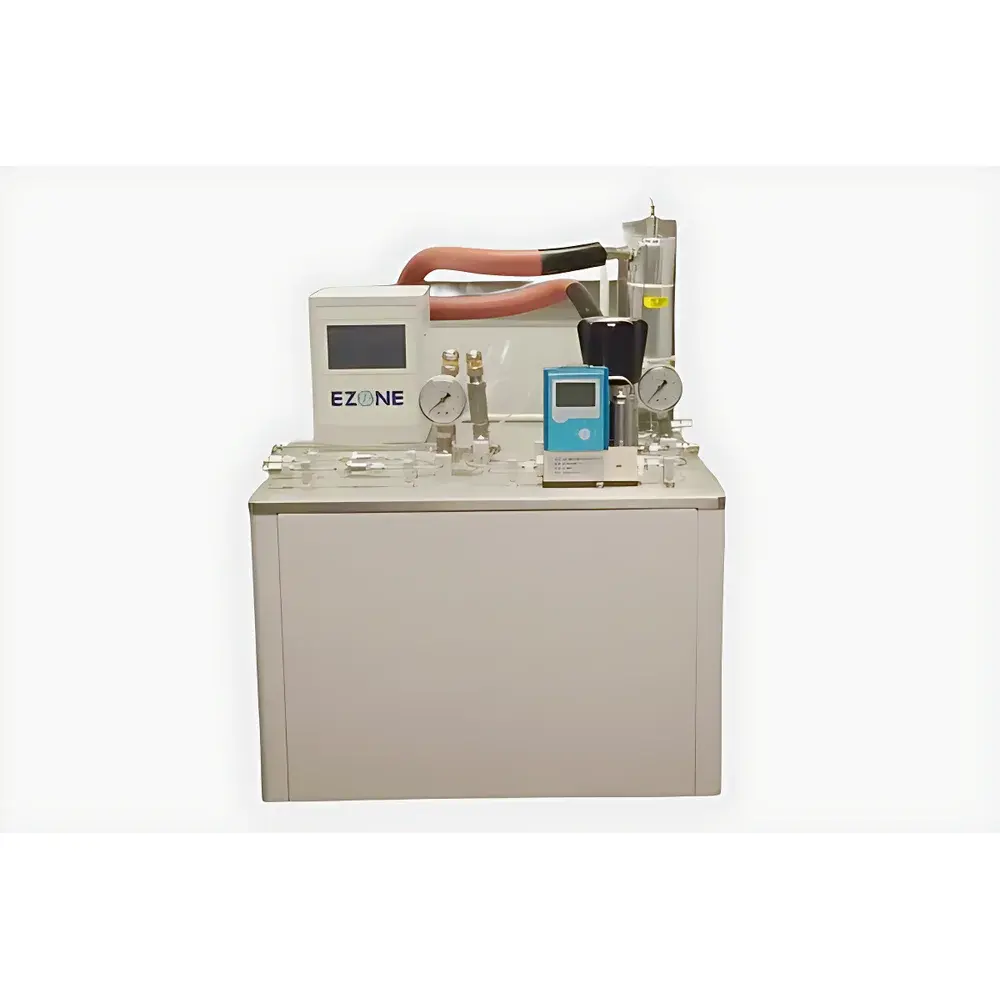
EZONE CHEMIST MF-200 Microchannel Fixed-Bed Reactor
| Brand | EZONE CHEMIST |
|---|---|
| Origin | Guangdong, China |
| Model | MF-200 |
| Temperature Range | -20 to 200 °C |
| Temperature Control Accuracy | ±0.1 °C |
| Channel Dimensions | 250 × 200 µm |
| Reaction Volume | 1–10 mL |
| Operating Pressure | ≤100 bar |
| Flow Rate Range | 0.2–10 mL/min |
| Wetted Materials | 316L stainless steel, FFKM, PTFE, SiC (optional) |
| Reactor Configurations | Modular microchannel + fixed-bed |
Overview
The EZONE CHEMIST MF-200 Microchannel Fixed-Bed Reactor is an integrated continuous-flow reaction platform engineered for rigorous process development under elevated temperature and pressure conditions. It uniquely combines the mass-transfer advantages of microstructured flow reactors with the catalytic versatility of packed-bed configurations—enabling seamless transition between homogeneous liquid-phase, gas–liquid, and three-phase (gas–liquid–solid) catalytic reactions. The core reactor module features a precision-machined Zig-Zag microfluidic mixing structure fabricated in 316L stainless steel, delivering rapid radial mixing at millisecond timescales without mechanical agitation. This geometry ensures high interfacial area, low pressure drop (<5 bar at 5 mL/min), and exceptional thermal stability across its full operating range (–20 to 200 °C). Designed for reproducible kinetic studies and catalyst screening, the MF-200 supports direct scalability assessment through geometric and residence-time equivalence with industrial-scale tubular or trickle-bed reactors.
Key Features
- Modular dual-mode architecture: Independently configurable as a microchannel reactor or fixed-bed reactor—or operable in series/parallel combinations for multi-step or hybrid-phase synthesis.
- Zig-Zag microstructured mixer with 250 × 200 µm cross-section: Achieves >95% mixing uniformity at flow rates as low as 0.2 mL/min, validated via residence time distribution (RTD) analysis.
- Integrated high-fidelity thermal management: Dual-zone PID-controlled heating/cooling system with ±0.1 °C setpoint accuracy and ramp rates up to 10 °C/min.
- Precise multi-phase delivery: Two independent liquid syringe pumps (0.01–10 mL/min, ±0.5% accuracy) and one mass-flow-controlled gas inlet (0–50 sccm, N₂/Ar/H₂ compatible).
- Chemically resistant wetted path: Standard 316L SS body with FFKM seals and PTFE-lined fluidic connections; optional SiC reactor cartridges available for aggressive media (e.g., HF, hot conc. HNO₃).
- Plug-and-play hardware interface: Pre-calibrated pressure transducers (0–100 bar), RTD temperature sensors (Pt100, Class A), and digital I/O for external automation integration (Modbus TCP, RS485).
Sample Compatibility & Compliance
The MF-200 accommodates heterogeneous catalysts (e.g., Pd/C, Pt/Al₂O₃, zeolites) in particle sizes from 50 µm to 2 mm, loaded into removable 4 mm or 10 mm ID stainless-steel cartridges. Its design conforms to ASME B31.3 process piping guidelines for high-pressure fluid service and meets ISO 14001 environmental safety prerequisites for lab-scale chemical processing equipment. All electrical components comply with IEC 61000-6-3 EMC standards and UL 61010-1 for laboratory instrumentation. When operated with audit-trail-enabled software (see Software & Data Management), the system supports GLP-compliant experimental documentation per OECD Principles of Good Laboratory Practice and aligns with foundational elements of FDA 21 CFR Part 11 for electronic records in process R&D.
Software & Data Management
The MF-200 operates with EZONE’s proprietary ReactFlow Control Suite (v3.2+), a Windows-based application supporting real-time monitoring of temperature, pressure, flow rates, and valve states. Data logging occurs at 10 Hz with automatic timestamping, CSV export, and metadata tagging (operator ID, experiment ID, catalyst lot number). The software implements role-based user access control, electronic signature capture, and immutable audit trails—including parameter change history and manual override logs. Raw data files are SHA-256 hashed upon generation and archived in hierarchical folder structures compliant with ISO/IEC 17025 clause 7.5.2 for result reporting integrity. Optional API integration enables bidirectional communication with LIMS platforms (e.g., LabVantage, Thermo Fisher SampleManager) and MATLAB/Simulink for model-predictive control deployment.
Applications
- High-throughput catalyst evaluation for hydrogenation, oxidation, and C–C coupling reactions under industrially relevant T/P conditions.
- Kinetic modeling of exothermic nitration or diazotization processes using precise residence time control (τ = V/Q) and inline IR/UV-Vis detection interfaces.
- Process intensification studies comparing microchannel vs. fixed-bed performance metrics (space-time yield, selectivity, catalyst lifetime).
- Safe handling of thermally unstable intermediates (e.g., diazonium salts, acyl nitrates) via sub-second residence time and distributed heat removal.
- Development of continuous pharmaceutical API routes compliant with ICH Q8(R2) Quality by Design principles.
- Teaching modules on multiphase reactor engineering, transport phenomena, and scale-up heuristics in university chemical engineering laboratories.
FAQ
Can the MF-200 be used for supercritical fluid reactions?
Yes—when equipped with compatible FFKM seals and calibrated for CO₂ or ethane feed systems, the reactor supports operations up to 100 bar and 200 °C, covering common scCO₂ process windows.
Is catalyst loading standardized or customizable?
Cartridge dimensions (4 mm and 10 mm ID) and bed heights (5–50 mm) are user-adjustable; packing density and void fraction are documented per run to enable Ergun equation-based pressure drop prediction.
Does the system support corrosion-resistant materials beyond 316L SS?
Optional reactor cores in silicon carbide (SiC) and PTFE-lined variants are available for hydrofluoric acid, molten salt, or strongly oxidizing environments.
How is temperature uniformity verified across the reaction zone?
Each unit undergoes factory validation using embedded thermocouple mapping (n ≥ 5 axial/radial points) per ASTM E220, with longitudinal ΔT < ±0.3 °C reported in the Certificate of Conformance.
Can third-party analytical instruments be synchronized with the MF-200?
Yes—via TTL triggers and analog voltage outputs, the system interfaces with GC, HPLC, FTIR, and Raman spectrometers for automated sampling and reaction progress monitoring.
Related Products



