
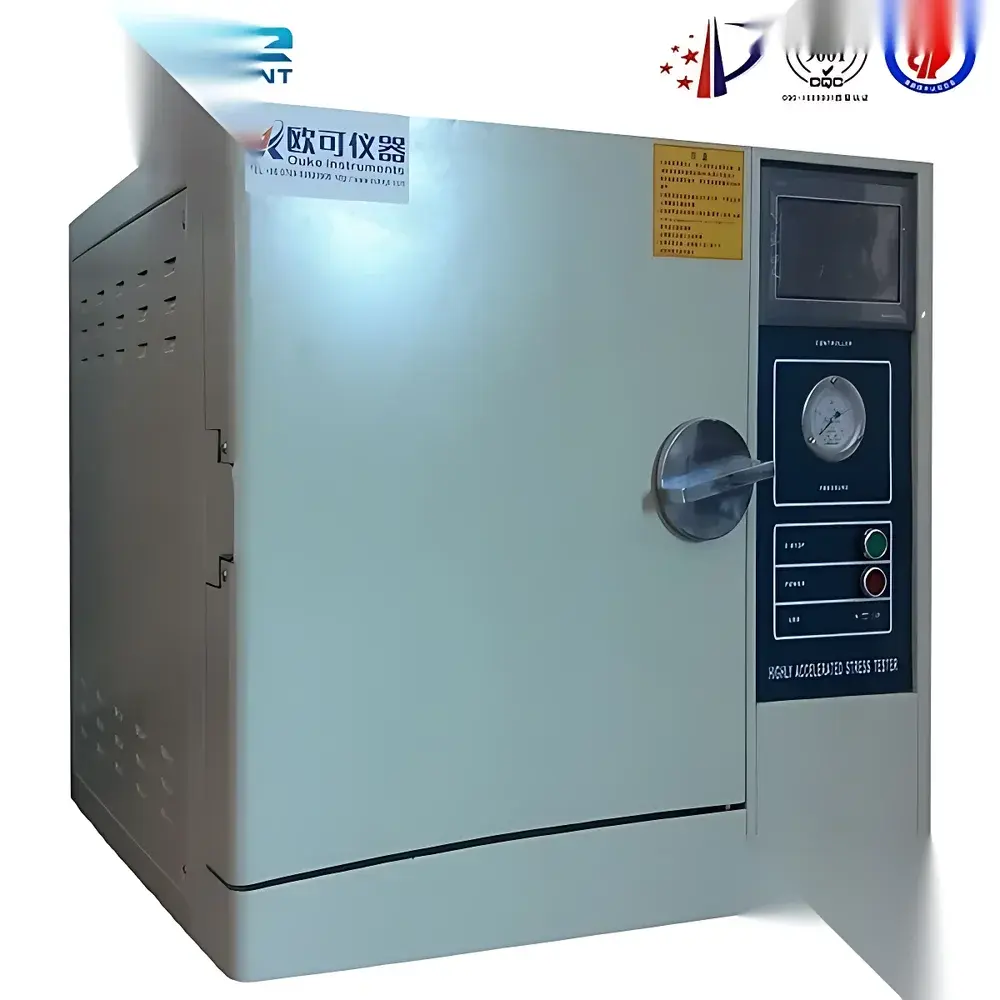
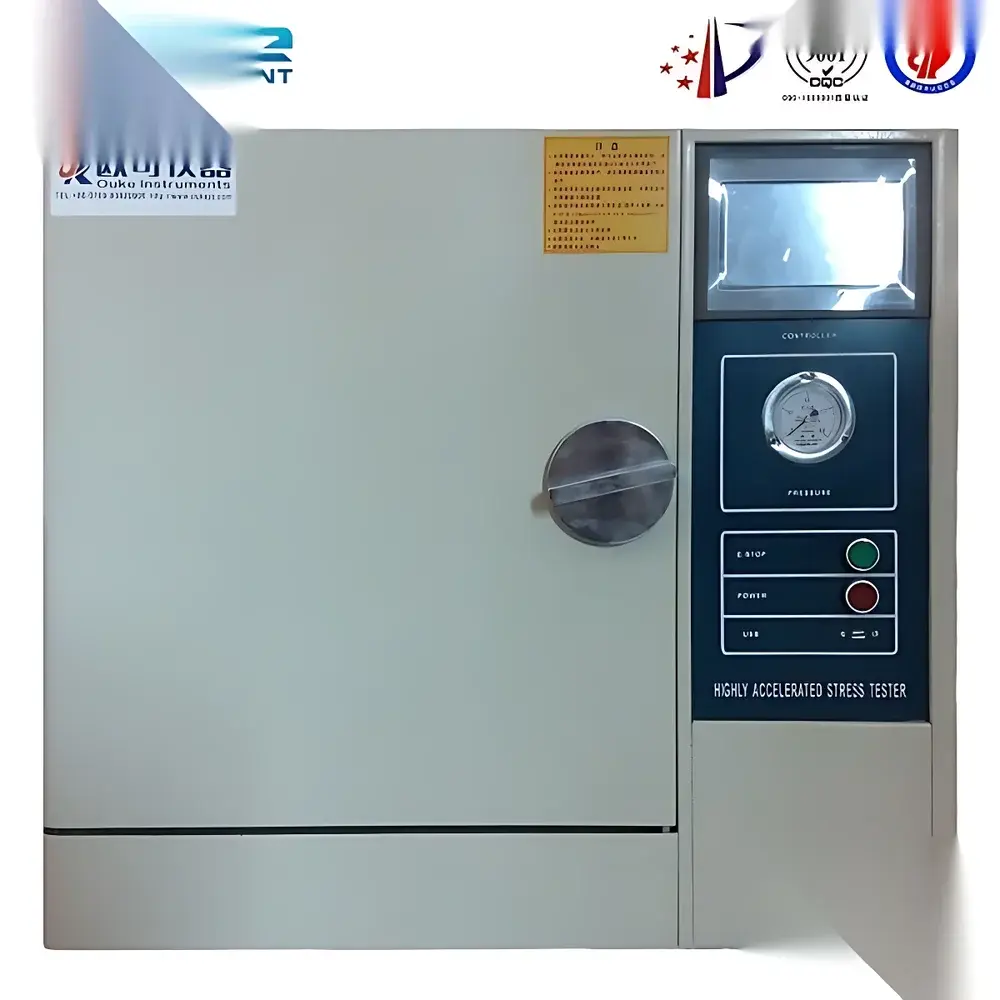
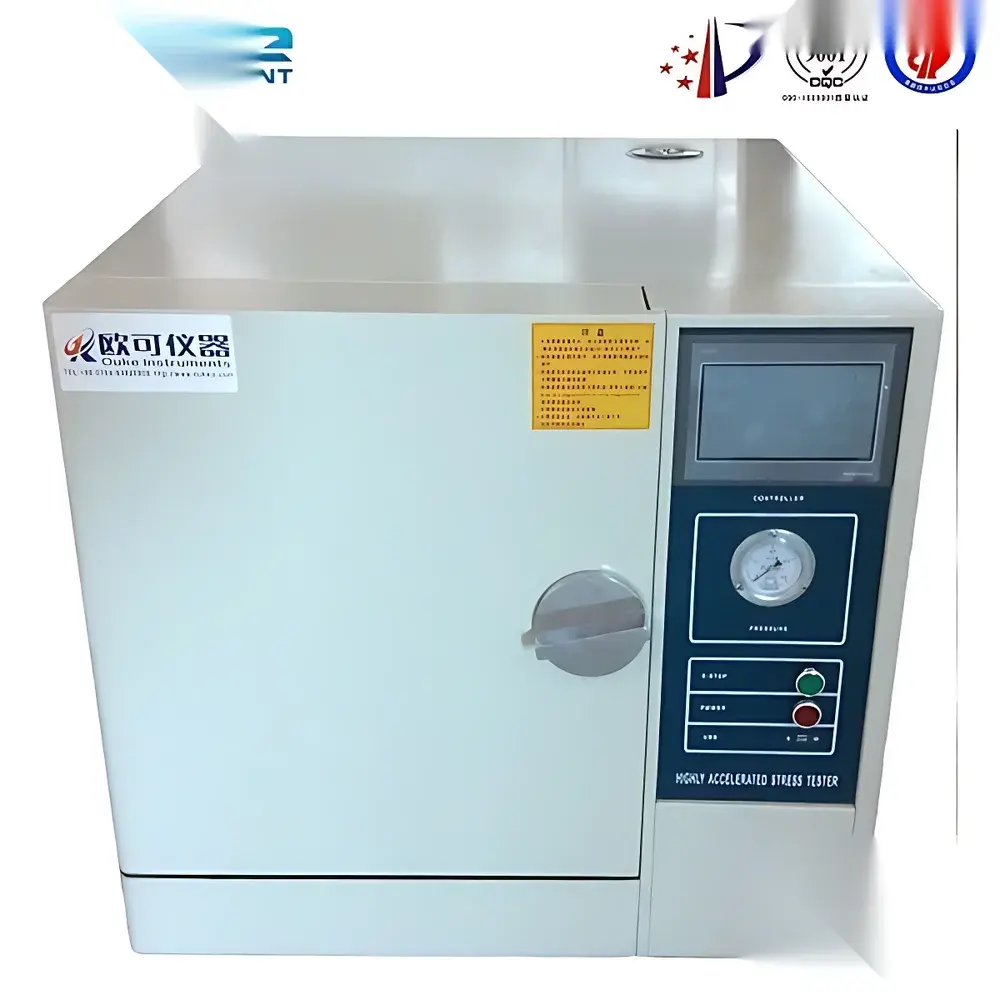
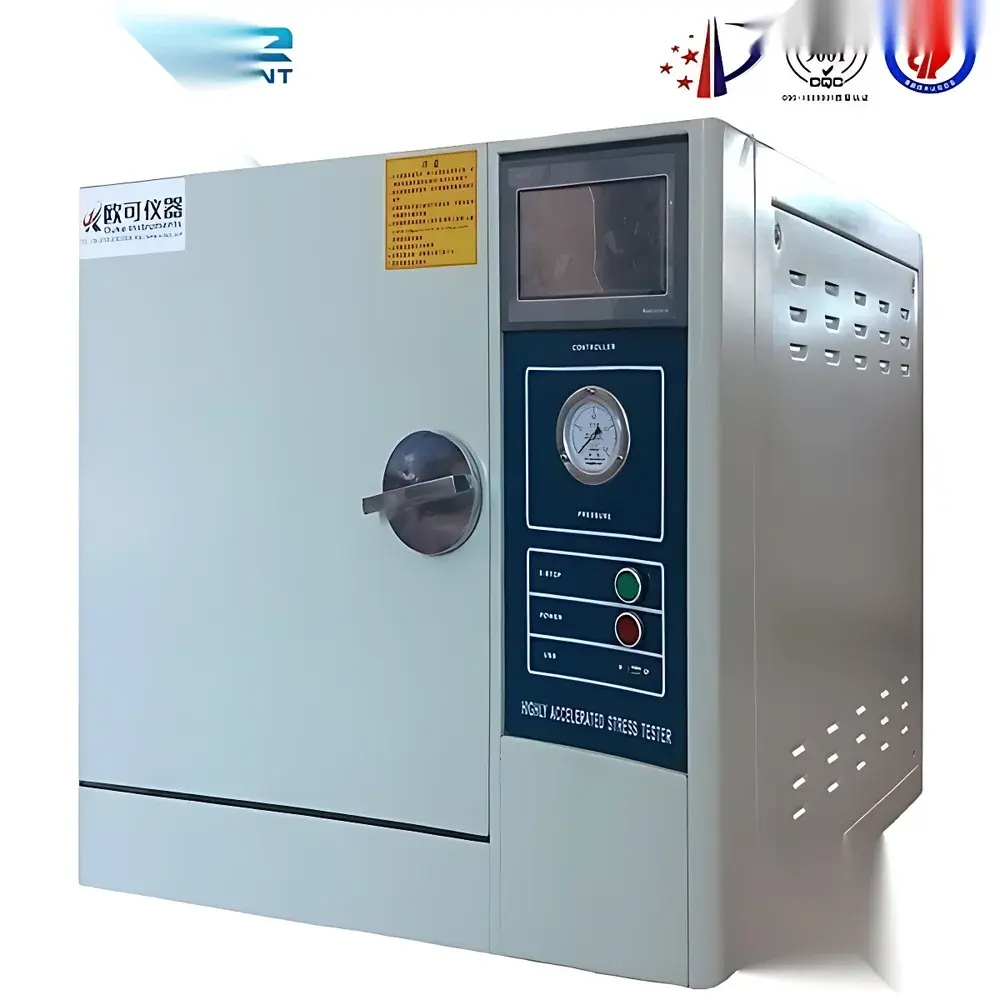
English Product Name
| Brand | OK Instruments |
|---|---|
| Origin | Imported |
| Manufacturer Type | Authorized Distributor |
| Temperature Range | +10 °C to 132 °C (optional custom up to 147 °C) |
| Pressure Range | 0–2.5 kg/cm² (gauge), 1.0–2.5 kg/cm² (absolute) |
| Internal Dimensions (Ø×H, cm) | 250×300 |
| Chamber Material | ASTM A240 UNS S31603 stainless steel |
| Humidification Method | Immersed electric heating tube |
| Water Replenishment | Stainless steel float valve system |
| Heating/Cooling Cycle | Natural convection steam circulation |
| Power Supply | 220–240 V, 50/60 Hz, single-phase |
| Pressurization Time | ~45 min to 2.0 kg/cm² |
| Safety Features | Interlocked circular door with pressure-activated start inhibition, dual-mode pressure relief (automatic + manual), low-water-level auto-refill (up to 200 h continuous operation) |
Overview
The OK-HAST Non-Saturated Accelerated Stress Test Chamber is an engineered environmental reliability testing system designed for high-acceleration stress screening of electronic components, printed circuit boards (PCBs), and encapsulated semiconductor packages under elevated temperature, humidity, and pressure conditions—without full saturation. Unlike traditional saturated steam autoclave-based HAST (Highly Accelerated Stress Test) systems defined in JESD22-A110 and JEDEC standards, this chamber operates in a non-saturated regime where relative humidity remains below 100%, enabling controlled moisture ingress kinetics while mitigating condensation-induced thermal shock and electrical leakage risks. Its core architecture employs natural-convection steam circulation within a fully sealed, rotationally symmetric cylindrical chamber, minimizing thermal gradients and ensuring uniform exposure across the test load. The system is calibrated and validated for compliance with IPC-TM-650 2.6.25.1, IEC 60068-2-66, and MIL-STD-883 Method 1030.4 test protocols.
Key Features
- Pressure-Interlocked Circular Door Mechanism: Mechanical safety lock prevents initiation of test cycles unless chamber sealing integrity and pressure containment are verified—ensuring operator safety and test repeatability.
- Auto-Replenishment System: Precision stainless-steel float valve maintains consistent water level in the reservoir for uninterrupted operation up to 200 hours; integrated low-level detection triggers refill before critical depletion.
- Cylindrical Liner Design: Inner chamber lined with seamless 316 stainless steel (ASTM A240) and optimized radial geometry to dissipate localized steam superheat, reducing thermal shock to DUTs and preserving measurement fidelity.
- Digital LED Timer with Temperature-Triggered Start Logic: Timer initiates only after chamber internal temperature reaches setpoint—eliminating premature counting errors; timing sequence follows standardized Table 1 activation criteria per JEDEC JESD22-A110.
- Multi-Stage Pressure Relief Architecture: Dual-path overpressure protection includes both automatic solenoid-actuated venting and manually operable pressure release valve, compliant with ASME BPVC Section VIII Div. 1 requirements for Class I pressure vessels.
- Thermal Stability Engineering: Chamber base mounted on precision leveling feet with built-in bubble-level verification; recommended installation ambient: 25–30 °C, stable and well-ventilated—critical for long-term calibration stability and sensor drift minimization.
Sample Compatibility & Compliance
The OK-HAST chamber accommodates a wide range of non-explosive, non-flammable, and non-exothermic test specimens—including bare dies, molded ICs, BGAs, QFNs, and multilayer PCB assemblies. It excludes materials with volatile organic content, pyrophoric compounds, or active lithium-based chemistries. All models meet CE marking requirements under the EU Machinery Directive 2006/42/EC and Pressure Equipment Directive 2014/68/EU. Internal wetted surfaces comply with USP Class VI biocompatibility standards for material compatibility assessments. Routine operation supports GLP-compliant audit trails when paired with optional data logging modules (IEC 62304 Annex C, FDA 21 CFR Part 11-ready firmware upgrade available).
Software & Data Management
While the base configuration features standalone digital control with LED interface, optional Ethernet-enabled controllers support Modbus TCP and OPC UA integration for centralized lab management systems (LIMS). Real-time temperature, pressure, and elapsed time data can be exported as CSV or XML for traceability. Firmware supports configurable alarm thresholds, event logging with timestamps (including door open/close, pressure breach, refill cycle), and password-protected parameter locking—meeting ISO/IEC 17025 clause 7.7.1 requirements for equipment control integrity.
Applications
- Failure mechanism analysis of moisture-sensitive devices (MSL 2a–6) per J-STD-020.
- Qualification testing of conformal coatings and underfill materials under combined thermo-hygro-mechanical stress.
- Reliability validation of automotive-grade electronics (AEC-Q200) subjected to under-hood thermal cycling with humidity acceleration.
- Process capability assessment of wafer-level packaging prior to burn-in and final test.
- Comparative lifetime modeling using Arrhenius–Peck humidity acceleration factors under non-saturated boundary conditions.
FAQ
What distinguishes non-saturated HAST from saturated HAST?
Non-saturated HAST maintains RH <100% at elevated temperature and pressure, allowing diffusion-controlled moisture ingress without condensation—reducing risk of interfacial delamination and electrochemical migration observed in saturated regimes.
Can the chamber operate continuously for 200 hours without supervision?
Yes—provided initial water volume is sufficient and ambient conditions remain within specification (25–30 °C, stable voltage); auto-refill ensures uninterrupted operation, but periodic visual inspection of pressure relief path is recommended per maintenance schedule.
Is calibration certification included with shipment?
Each unit ships with NIST-traceable factory calibration report for temperature (±0.3 °C) and pressure (±0.02 kg/cm²) sensors; on-site IQ/OQ documentation templates are provided for GMP/GLP environments.
What electrical infrastructure is required for installation?
Dedicated single-phase 220–240 V AC circuit with minimum 20 A breaker, grounded via TN-S earthing system; voltage fluctuation must not exceed ±5% during pressurization phase.
Does the system support custom test profiles beyond standard JEDEC conditions?
Yes—via optional programmable controller (part no. OK-PC-2000), users may define multi-step ramps for temperature, pressure, and dwell time, with user-defined pass/fail logic and automated abort triggers.



