
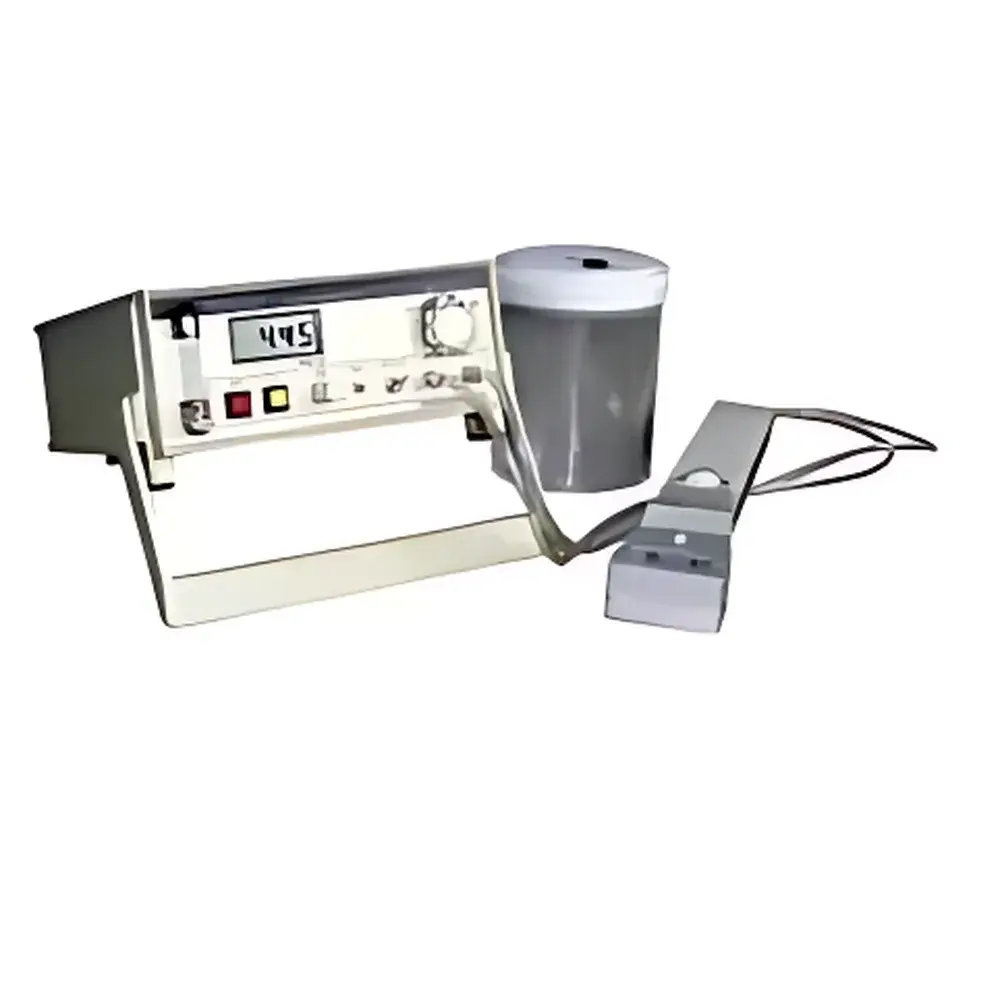
SIELINS XLZ-3091 Portable Photosynthesis System
| Brand | SIELINS |
|---|---|
| Model | XLZ-3091 |
| CO₂ Measurement Principle | Non-dispersive Infrared (NDIR) |
| CO₂ Range | 0–1000 ppm |
| CO₂ Resolution | 0.1 ppm |
| CO₂ Accuracy | ±3 ppm |
| Relative Humidity Range | 0–100% RH (non-condensing) |
| Power Supply | 6 V DC, rechargeable Ni-MH battery |
| Operating Duration | 5–8 hours per charge |
| Data Storage Capacity | 3000 measurements |
| Data Interface | USB |
| Measurement Mode | Closed-loop gas exchange system |
| Units for Photosynthetic Rate | µmol CO₂·m⁻²·s⁻¹ |
Overview
The SIELINS XLZ-3091 Portable Photosynthesis System is an entry-level, field-deployable gas exchange instrument engineered for quantitative measurement of net photosynthetic rate (Pn), dark respiration rate (Rd), and associated leaf-level physiological parameters in controlled or semi-field environments. It operates on a closed-loop gas exchange principle: ambient air is recirculated through a leaf chamber and an integrated non-dispersive infrared (NDIR) CO₂ analyzer, enabling real-time detection of CO₂ depletion during photosynthesis or accumulation during respiration. The system computes Pn using the standardized closed-system equation accounting for chamber volume (V), leaf area (S), temperature (T), atmospheric pressure (P), and time-resolved CO₂ differentials (C₁−C₂). Designed with pedagogical and foundational research applications in mind, the XLZ-3091 delivers reproducible, traceable CO₂ flux data without requiring external calibration gases or complex infrastructure.
Key Features
- Integrated NDIR CO₂ sensor with 0–1000 ppm range, 0.1 ppm resolution, and ±3 ppm accuracy under laboratory conditions
- Self-contained, portable architecture powered by a rechargeable 6 V Ni-MH battery supporting 5–8 hours of continuous operation
- Closed-loop configuration eliminates dependence on ambient air supply, minimizing external interference and enabling stable measurements in variable outdoor microclimates
- Dedicated leaf chamber with adjustable gasket seal and standardized mounting interface for consistent leaf area definition
- Onboard humidity sensing (0–100% RH, non-condensing) to support concurrent assessment of stomatal conductance proxies
- Internal memory stores up to 3000 timestamped CO₂ concentration points, temperature readings, and calculated Pn values
- USB interface enables direct data export to Windows-based analysis software for post-acquisition processing and visualization
Sample Compatibility & Compliance
The XLZ-3091 accommodates intact, attached leaves from herbaceous and woody species with maximum dimensions of 8 cm × 6 cm (standard chamber footprint). It supports both light-saturated and low-light protocols, as well as dark-adapted respiration assays. While not certified for GLP or GMP-regulated environments, its measurement methodology aligns with foundational principles outlined in ASTM E2745-10 (Standard Guide for Gas Exchange Measurements on Plant Leaves) and ISO 17025–compatible operational practices when used with documented calibration procedures. The device meets CE marking requirements for electromagnetic compatibility (EMC Directive 2014/30/EU) and low-voltage safety (LVD Directive 2014/35/EU). No FDA or USP compliance claims are made; it is intended for educational, ecological survey, and preclinical plant physiology applications only.
Software & Data Management
Data acquisition and export are managed via proprietary Windows-compatible desktop software provided with each unit. The application supports raw CO₂ time-series plotting, manual annotation of light/dark transitions, batch calculation of Pn using user-input chamber volume, leaf area, and barometric pressure, and export to CSV format for integration with R, Python (Pandas), or MATLAB workflows. Audit trails are not implemented; however, all stored measurements retain embedded timestamps and sequential index identifiers. For laboratories requiring 21 CFR Part 11 compliance, third-party validated data logging platforms (e.g., LabArchives or Benchling) may be employed to archive exported datasets with electronic signatures and version control.
Applications
- Undergraduate and graduate teaching labs: Demonstrating light-response curves, A/Ci response analysis, and environmental stress effects (e.g., drought, salinity) on carbon assimilation
- Ecological field surveys: Rapid screening of photosynthetic performance across plant communities in grasslands, agroforestry systems, or urban green spaces
- Plant breeding programs: Preliminary phenotyping of photosynthetic efficiency traits in segregating populations
- Soil–plant interaction studies: Paired measurements of leaf photosynthesis and soil respiration (using optional soil collar adapter)
- Climate change simulation experiments: Monitoring diurnal Pn dynamics under controlled temperature and CO₂ enrichment setups
FAQ
What is the recommended calibration frequency for the NDIR CO₂ sensor?
We recommend zero-point verification using ambient air (assumed ~400 ppm CO₂) before each experimental session. Full two-point calibration with certified gas standards (e.g., 0 ppm and 500 ppm) is advised every 30 days or after exposure to condensation or extreme temperature gradients.
Can the XLZ-3091 measure stomatal conductance directly?
No — it does not include a built-in H₂O vapor analyzer. Stomatal conductance must be estimated indirectly using empirical relationships between CO₂ assimilation rate and leaf-to-air vapor pressure deficit (VPD), requiring supplementary psychrometric data.
Is the leaf chamber temperature actively controlled?
No — chamber temperature equilibrates passively with ambient or growth chamber conditions. Users should monitor and log external temperature to ensure accurate Pn computation per the thermodynamic correction factor in the standard equation.
Does the system support automated light intensity ramping?
No — light intensity must be manually adjusted using external LED or halogen sources. The device records only CO₂, RH, and time; no digital light sensor or PWM control interface is included.
What is the minimum leaf thickness compatible with the chamber seal?
Leaves ≥0.1 mm thick are reliably sealed; highly succulent or waxy cuticles may require gentle surface abrasion or application of a thin silicone grease layer to ensure gas-tight closure.
Related Products



