
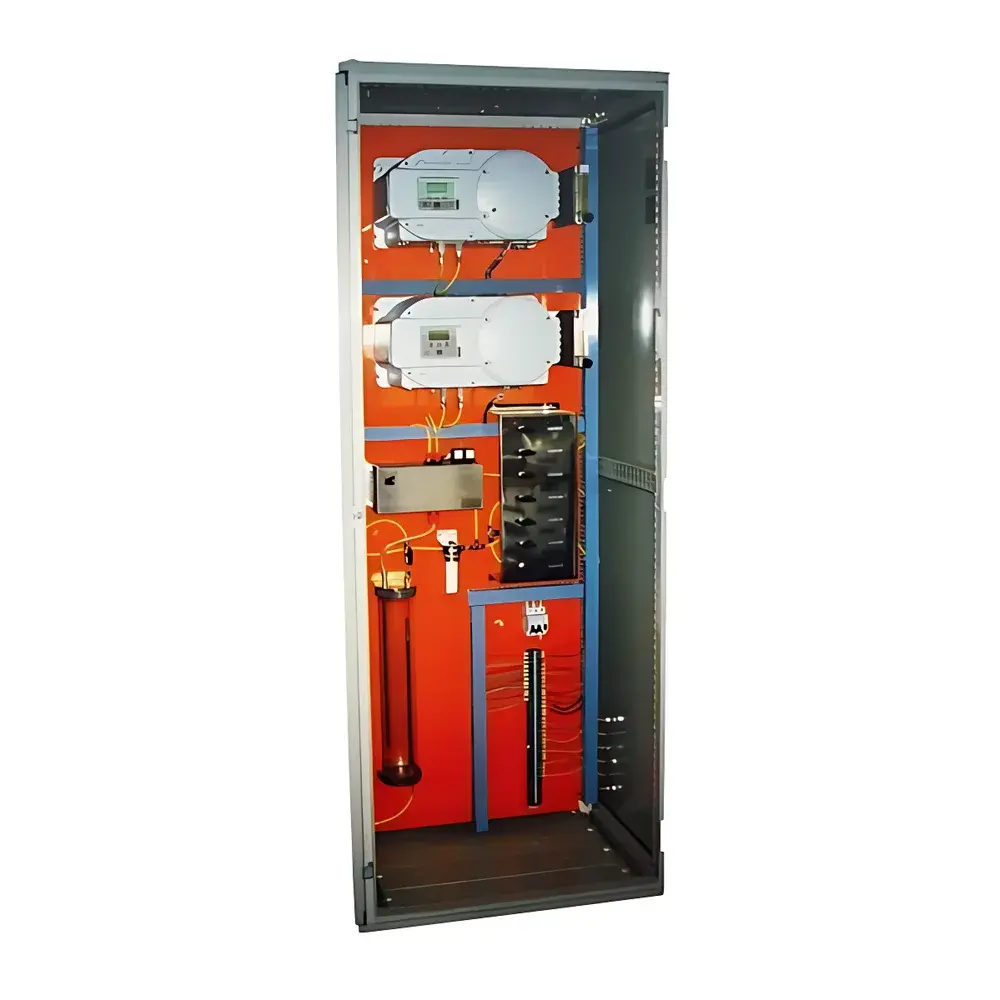
SIELINS XLZ-802 Metallurgical Process Flue Gas Continuous Emission Monitoring System (CEMS)
| Brand | SIELINS |
|---|---|
| Origin | Beijing, China |
| Model | XLZ-802 |
| Instrument Type | Continuous Emission Monitoring System (CEMS) |
| Measurement Accuracy | ±2% FS |
| Repeatability | ≤2% FS |
| Response Time | ≤90 s |
| Long-term Stability | ≤2% FS/7 days |
| Measured Gases | CO, CO₂, H₂, O₂ |
Overview
The SIELINS XLZ-802 Metallurgical Process Flue Gas Continuous Emission Monitoring System (CEMS) is an engineered solution for real-time, in-situ gas composition analysis in high-temperature, high-dust industrial metallurgical environments. Designed specifically for integration into blast furnace top gas routing, BOF (Basic Oxygen Furnace) off-gas recovery loops, pulverized coal injection lines, gravity dust collectors, and coke oven gas holders, the system employs non-dispersive infrared (NDIR) spectroscopy for CO and CO₂, thermal conductivity detection (TCD) for H₂, and paramagnetic or electrochemical sensing for O₂—configured per application-specific gas matrix requirements. Its architecture complies with the functional framework of ISO 14956:2022 (Air quality — Evaluation of air quality measurement methods) and supports alignment with China’s HJ 75–2017 and HJ 76–2017 technical specifications for CEMS operation and calibration. The XLZ-802 operates under demanding process conditions—including gas temperatures up to 180 °C (with optional inline cooling), particulate loadings up to 10 g/m³ (post-filtration), and ambient vibration typical of steel plant infrastructure—without requiring frequent recalibration.
Key Features
- Multi-gas modular sensor architecture supporting simultaneous quantification of CO, CO₂, H₂, and O₂ with independent signal conditioning and digital compensation for cross-interference
- Integrated hot-wet sampling probe with ceramic filtration, PTFE-lined sample line, and heated transport (≥120 °C) to prevent condensation and adsorption losses
- Automatic zero/span verification capability using certified reference gases (NIST-traceable), configurable for daily or shift-based cycles
- Robust enclosure rated IP65 for outdoor installation near furnace platforms or gas ducts; operating ambient temperature range: −20 °C to +50 °C
- Redundant data output interfaces: 4–20 mA analog channels (per gas), RS485 Modbus RTU, and Ethernet TCP/IP for SCADA/DCS integration
- Self-diagnostic firmware with event logging, fault code reporting (e.g., filter clogging, pressure drop anomaly, sensor drift alert), and timestamped maintenance history
Sample Compatibility & Compliance
The XLZ-802 is validated for use with raw and conditioned flue gases from ironmaking and steelmaking processes, including blast furnace top gas (BFTG), basic oxygen furnace gas (BOFG), coke oven gas (COG), and pulverized coal conveying streams. Sample conditioning includes particulate removal via sintered metal filters (5 µm rating), moisture management via thermoelectric cooler (TEC)-based dew point control (maintained at 4 °C), and pressure regulation to 100 kPa ±5 kPa. All wetted materials comply with ASTM A240/A240M for 316L stainless steel construction. The system meets electromagnetic compatibility requirements per IEC 61326-1:2020 and conforms to safety standards IEC 61010-1:2010 for measurement/control equipment used in industrial locations. Documentation packages include factory acceptance test (FAT) reports, calibration certificates traceable to CNAS-accredited laboratories, and compliance declarations aligned with GB/T 19001–2016 (ISO 9001:2015).
Software & Data Management
The embedded firmware provides local data acquisition at 1 Hz resolution with onboard storage (≥30 days of 1-minute averaged values). Optional SIELINS CEMSView™ software (Windows-based, licensed per site) enables remote configuration, trend visualization, alarm threshold setting (high/low, rate-of-change), and automated report generation compliant with HJ 75–2017 Annex D. Audit trails record all user-initiated actions—including parameter changes, calibration events, and manual overrides—with operator ID and timestamp. Data export supports CSV, PDF, and XML formats; historical datasets are exportable with ISO 8601-compliant timestamps. For regulated environments, optional 21 CFR Part 11 add-on modules provide electronic signature enforcement, role-based access control, and immutable audit logs.
Applications
- Real-time optimization of BOF gas recovery efficiency by tracking CO/CO₂ ratio dynamics during blow cycles
- Monitoring H₂ concentration in blast furnace top gas to assess coke reactivity and slag chemistry stability
- Safety-critical O₂ monitoring in coal powder silos and pneumatic conveying lines to prevent spontaneous combustion
- Process feedback control for coke oven battery heating systems using CO/CO₂ balance as a proxy for carbonization completeness
- Regulatory compliance reporting for national emissions trading schemes (ETS) and provincial environmental protection bureaus
- Integration with MES-level energy management systems for furnace-specific specific energy consumption (SEC) calculation
FAQ
What gas sampling method does the XLZ-802 use?
It uses extractive hot-wet sampling with heated probe, filtered transport line, and integrated TEC-based moisture management—no gas drying or chemical scrubbing required.
Can the system be calibrated remotely?
Yes—zero and span calibration can be initiated locally or via Modbus command; reference gas injection is automated using solenoid valves and mass flow controllers.
Is third-party certification available for regulatory submission?
Factory-calibrated units ship with CNAS-accredited calibration certificates; on-site performance qualification (PQ) support and TÜV-certified validation services are available upon request.
How is interference from SO₂ or NOₓ addressed in CO measurement?
NDIR optical filters are spectrally tuned to minimize spectral overlap; built-in multi-wavelength compensation algorithms further correct for residual cross-sensitivity in complex gas matrices.
What is the recommended maintenance interval?
Filter replacement every 3 months under typical blast furnace duty; full sensor verification annually or after 8,000 operational hours—whichever occurs first.
Related Products







