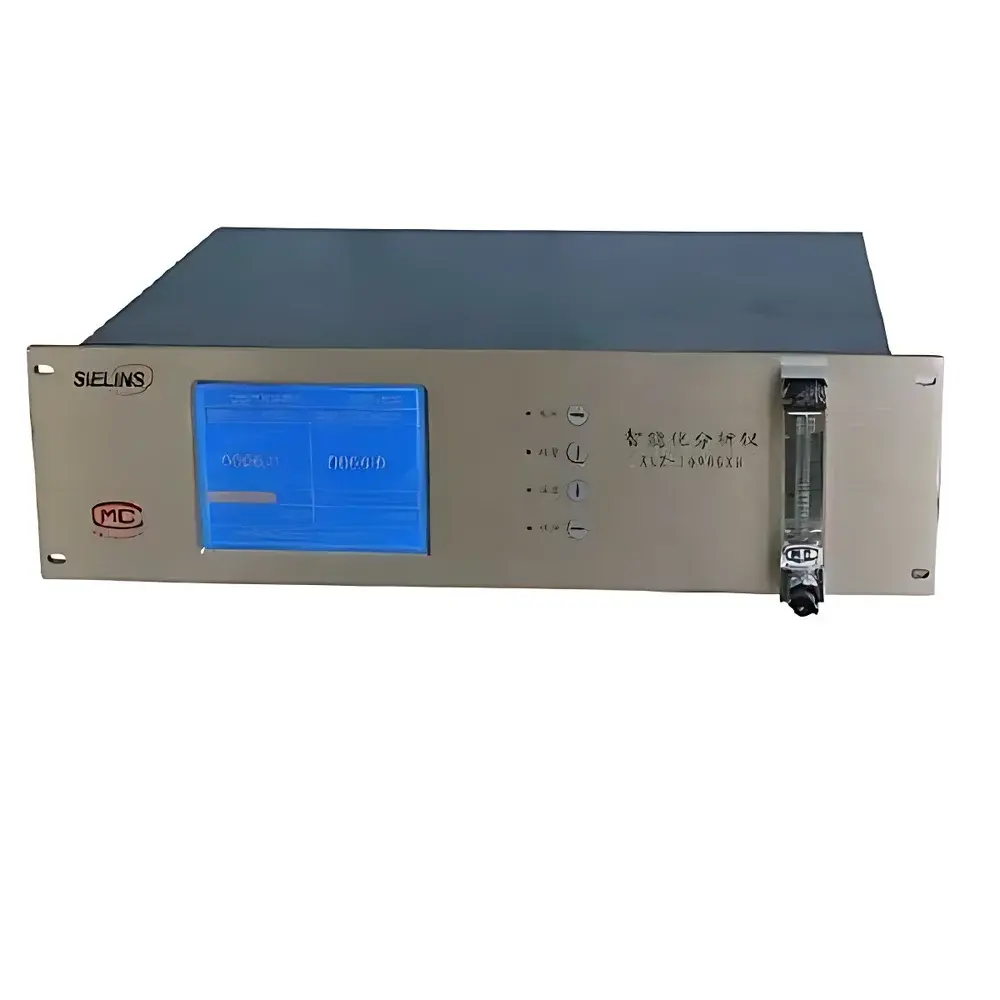
SIELINS XLZ-1090JRC Paramagnetic Oxygen Analyzer
| Brand | SIELINS |
|---|---|
| Model | XLZ-1090JRC |
| Measurement Principle | Paramagnetic Detection |
| Measurement Range | 0–100% O₂ (selectable sub-ranges: 0–2%, 0–5%, 0–10%, 0–21%, 0–50%, 0–100%) |
| Zero Drift | ±2% FS |
| Span Drift | ±2% FS/year |
| Linearity Error | ±1% FS |
| Repeatability | ≤1% FS |
| Response Time (T₉₀) | ≤40 s |
| Power Consumption | <80 W |
| Supply Voltage | 220 ± 22 VAC, 50 Hz |
| Operating Temperature | 5–45 °C |
| Relative Humidity | ≤80% RH (non-condensing) |
| Weight | ~15 kg |
| Enclosure | 19″ rack-mount chassis (4U height) |
| Output Signals | Isolated 4–20 mA (default, load ≤400 Ω) and 1–5 V DC (default, load ≥250 Ω) |
| Communication Interface | RS232 |
| Environmental Requirements | Non-corrosive atmosphere |
Overview
The SIELINS XLZ-1090JRC Paramagnetic Oxygen Analyzer is an industrial-grade, continuous gas-phase oxygen monitoring instrument engineered for high-stability, long-term operation in demanding process environments. It employs the fundamental physical property of molecular oxygen—its strong paramagnetism—to deliver precise, interference-resistant O₂ concentration measurements in binary or multi-component gas streams. Unlike electrochemical or zirconia-based sensors, this analyzer does not consume the analyte, require consumable electrolytes, or suffer from cross-sensitivity to CO₂, CO, hydrocarbons, or water vapor. Its measurement principle relies on the differential magnetic susceptibility between O₂ (χ ≈ +3,400 × 10⁻⁶ cm³/mol) and common background gases (e.g., N₂: χ ≈ −0.7 × 10⁻⁶ cm³/mol), enabling direct, absolute quantification of oxygen partial pressure without calibration drift induced by matrix composition changes. Designed for integration into distributed control systems (DCS), safety instrumented systems (SIS), and laboratory automation platforms, the XLZ-1090JRC meets the functional safety and reliability requirements of continuous emissions monitoring (CEM), combustion optimization, inerting verification, and controlled-atmosphere process validation.
Key Features
- True paramagnetic detection core with dual-chamber differential null-balance design for inherent stability and minimal zero/span drift
- Field-selectable measurement ranges: 0–2%, 0–5%, 0–10%, 0–21%, 0–50%, or 0–100% O₂ — configurable via front-panel menu or RS232 command set
- Full digital signal processing architecture with 24-bit ADC resolution and real-time temperature/pressure compensation algorithms
- 19″ rack-mount enclosure (4U height, 350 mm depth) compliant with IEC 60297-3-100 mechanical standards for panel integration
- Backlit monochrome LCD with intuitive Chinese-language interface (English firmware option available upon request) and context-sensitive operational prompts
- Isolated analog outputs: standard 4–20 mA (HART-compatible) and 1–5 V DC, both galvanically separated from power and communication circuits
- Dedicated status relay outputs for fault, alarm, calibration mode, and range-switching events — each electrically isolated per IEC 61000-4-5
- RS232 serial interface supporting Modbus RTU protocol for remote configuration, data logging, and diagnostic interrogation
- Comprehensive self-diagnostics including sensor health monitoring, flow-path integrity check, and thermal stabilization verification
Sample Compatibility & Compliance
The XLZ-1090JRC is validated for use with dry or saturated sample gases containing up to 95% relative humidity (non-condensing), provided inlet particulate filtration (≤5 µm) and coalescing pre-filtration are implemented. It exhibits negligible response to trace halogenated compounds, sulfur oxides, and nitrogen oxides under typical flue or process stream concentrations. The analyzer complies with electromagnetic compatibility (EMC) requirements per IEC 61326-1 (industrial environment), safety standards IEC 61010-1 (Pollution Degree 2, Overvoltage Category II), and RoHS Directive 2011/65/EU. While not intrinsically safe, it may be installed in Zone 2/Class I Division 2 areas when housed in an approved positive-pressure cabinet. For regulated pharmaceutical or food-grade applications, the device supports audit-trail-enabled calibration records and can be configured to meet ALCOA+ data integrity principles when paired with compliant SCADA or LIMS software.
Software & Data Management
Configuration, calibration, and diagnostics are managed through the built-in front-panel interface or optionally via the SIELINS PC Utility Suite (Windows-based, USB-to-RS232 adapter required). The utility enables secure storage of calibration certificates (including date, operator ID, span gas lot number, and deviation logs), trend export in CSV format, and firmware version verification. All analog output signals and relay states are timestamped internally at 1 Hz resolution. When integrated into a DCS or PLC environment, the analyzer supports cyclic data exchange with configurable update intervals (1–60 s). Audit trails comply with FDA 21 CFR Part 11 requirements when used with validated electronic record systems — user authentication, electronic signatures, and immutable change logs are enforced at the host system level.
Applications
- Combustion air/fuel ratio optimization in coal-fired boilers, cement kilns, and metallurgical furnaces to reduce NOₓ formation and improve thermal efficiency
- Inert gas blanketing and purge verification in chemical reactors, distillation columns, and storage tanks handling flammable or pyrophoric materials
- Controlled-atmosphere packaging (CAP) and modified-atmosphere packaging (MAP) line monitoring for food and pharmaceutical products
- Bioreactor dissolved oxygen (DO) off-gas analysis via sidestream sampling for mammalian cell culture process development
- Medical hyperbaric chamber O₂ concentration surveillance per ISO 8573-1:2010 Class 2 purity specifications
- Research applications in plant physiology (leaf respiration chambers), animal metabolism studies, and fire science combustion modeling
FAQ
What is the recommended calibration frequency for continuous industrial operation?
For critical safety or quality-critical applications, quarterly zero and span calibration using certified NIST-traceable gases is advised. In stable environments with low contamination risk, semi-annual calibration may be justified based on historical drift trending.
Can the analyzer measure oxygen in high-CO₂ streams such as biogas or flue gas?
Yes — paramagnetic detection is unaffected by CO₂ concentration, making it suitable for biogas upgrading plants, carbon capture units, and post-combustion flue gas analysis where CO₂ levels exceed 15%.
Is field replacement of the sensor module possible without factory recalibration?
The paramagnetic transducer is a sealed, factory-calibrated assembly. Replacement requires full system recalibration using certified span gas and must be documented per ISO/IEC 17025 procedures.
Does the unit support analog input for external temperature or pressure compensation?
No — internal Pt100 temperature sensing and optional integrated absolute pressure transducer (order code: XLZ-PRESS-OP) provide full compensation without external signal routing.
What maintenance intervals are specified for the sample conditioning system?
Particulate filters require inspection every 3 months; coalescing filters every 6 months; and the internal sample path should undergo ultrasonic cleaning annually or after exposure to condensable organics.
Related Products