
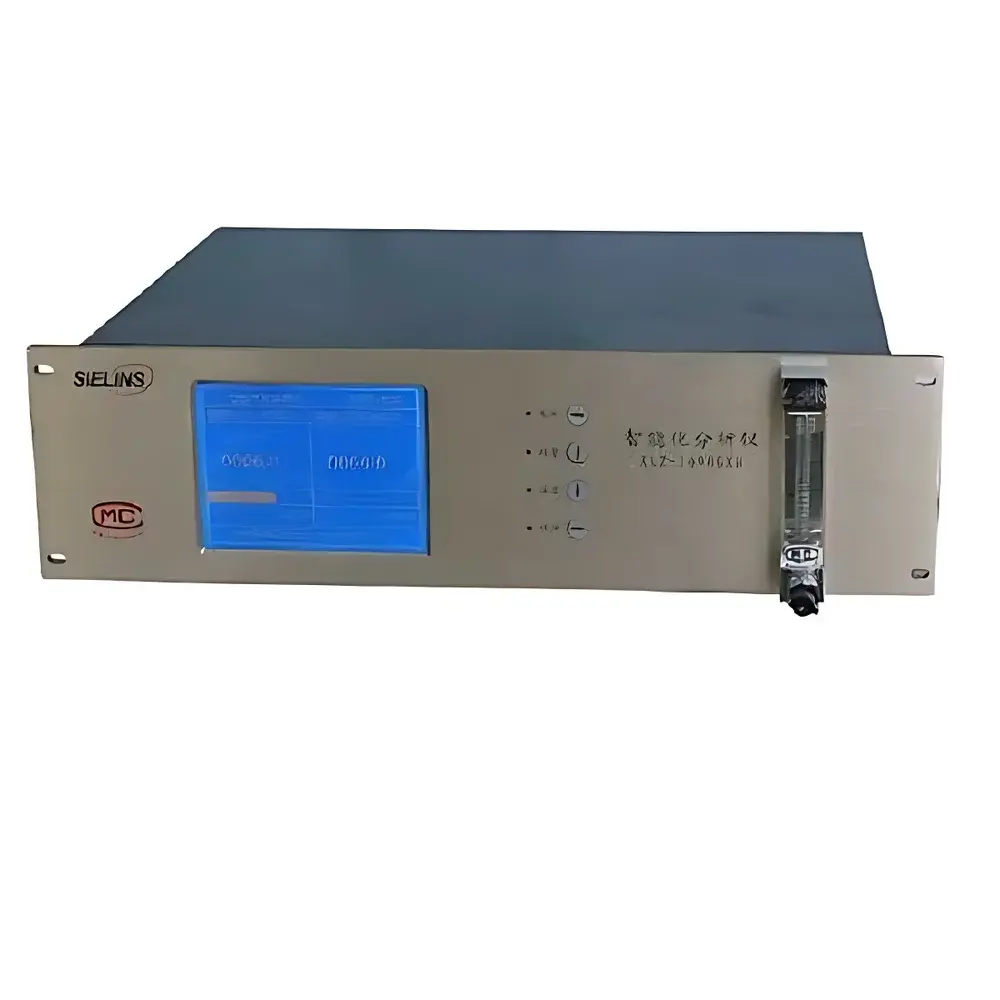
SIELINS XLZ-1090GXH Online NDIR Carbon Dioxide Analyzer
| Brand | SIELINS |
|---|---|
| Origin | Beijing, China |
| Model | XLZ-1090GXH |
| Instrument Type | Online |
| Detection Principle | Non-Dispersive Infrared (NDIR) |
| Measurement Range | 0–50 ppm (minimum selectable range) |
| Repeatability | ≤1% of full scale |
| Resolution | 0.1 ppm |
| Response Time (T90) | ≤60 s |
| Zero Drift | ≤±1% F.S./48 h (for constant-range mode) |
| Span Drift | ≤±1% F.S./48 h (for constant-range mode) |
| Linearity Error | ≤±2% F.S. |
| Output Signals | Isolated 4–20 mA (default), 0–5 V (default) |
| load impedance | ≤400 Ω for current, ≥250 Ω for voltage |
| Communication Interface | RS232 |
| Display | Backlit LCD with Chinese menu interface |
| Enclosure | 19″ rack-mountable chassis |
| Calibration | Manual and automatic zero/span calibration |
Overview
The SIELINS XLZ-1090GXH Online NDIR Carbon Dioxide Analyzer is a fixed-installation, single-component gas analyzer engineered for continuous, real-time measurement of carbon dioxide (CO₂) concentration in gaseous streams. It operates on the principle of non-dispersive infrared (NDIR) absorption spectroscopy—exploiting the characteristic fundamental vibrational absorption band of CO₂ near 4.26 µm. The instrument employs a single infrared source, a dual-compartment (half-cell) sample chamber, and a thermopile or pyroelectric detector optimized for high signal-to-noise ratio at this wavelength. This optical architecture eliminates moving parts and spectral dispersion elements, delivering inherent long-term stability and resistance to mechanical drift. Designed for unattended operation in industrial and environmental settings, the XLZ-1090GXH meets the functional requirements of continuous emission monitoring systems (CEMS), process safety interlocks, indoor air quality (IAQ) control loops, and laboratory combustion exhaust analysis.
Key Features
- Rack-mountable 19″ chassis compliant with IEC 60297-3-100 standards, enabling seamless integration into control cabinets and centralized monitoring racks
- Backlit monochrome LCD display with intuitive Chinese-language menu navigation and context-sensitive operational prompts for field technicians
- Dual-mode calibration capability: manual zero/span adjustment and automated calibration sequences triggered via front-panel button or remote command
- Configurable mid-range validation point for periodic linearity verification without full-span recalibration
- Full digital signal processing chain—from analog-to-digital conversion of detector output to temperature-compensated concentration calculation—minimizing analog drift and improving reproducibility
- Isolated analog outputs: default 4–20 mA current loop (≤400 Ω load) and 1–5 V voltage output (≥250 Ω load), both galvanically separated from internal circuitry for noise immunity
- RS232 serial interface supporting ASCII-based command protocol for integration with SCADA, DCS, or custom data acquisition software
Sample Compatibility & Compliance
The XLZ-1090GXH is intended for use with dry, non-corrosive, particle-free gas matrices. For applications involving humid or particulate-laden samples (e.g., stack gas, biogas, or HVAC duct air), external conditioning—such as Nafion™ dryers, particulate filters, and heated sample lines—is recommended prior to inlet connection. The analyzer complies with electromagnetic compatibility (EMC) requirements per GB/T 18268.1–2010 (equivalent to IEC 61326-1) and safety specifications under GB 4793.1–2007 (IEC 61010-1). While not certified to UL/CSA or ATEX/IECEx out-of-the-box, its electrical design supports adaptation to Class I, Division 2 hazardous locations when installed with appropriate barrier systems and conduit sealing. The instrument supports audit-ready operation in GLP and GMP environments through timestamped calibration logs and status flagging of zero/span events.
Software & Data Management
Data handling relies on embedded firmware rather than external PC software. All calibration actions, alarm triggers (e.g., signal loss, out-of-range reading, sensor fault), and system diagnostics are timestamped and stored in non-volatile memory for up to 30 days. The RS232 interface enables periodic dump of historical records—including raw detector voltage, temperature-corrected absorbance, calculated CO₂ concentration, and ambient temperature—for traceability. When interfaced with a validated DCS or historian system, the device supports basic 21 CFR Part 11 compliance through external user authentication, electronic signature capture, and change-control logging—provided the host system implements required audit trail and retention policies. No cloud connectivity or proprietary cloud platform is included or required.
Applications
- Continuous monitoring of CO₂ emissions from stationary combustion sources (e.g., coal-fired boilers, cement kilns, waste incinerators) in accordance with national environmental reporting frameworks
- In-process control of CO₂ concentration in fermentation tanks, modified-atmosphere packaging (MAP) lines, and greenhouse climate management systems
- Indoor air quality surveillance in office buildings, schools, hospitals, and transportation hubs where ASHRAE Standard 62.1–2022 recommends CO₂-based demand-controlled ventilation
- Verification of CO₂ scrubber efficiency in marine exhaust gas cleaning systems and carbon capture pilot plants
- Research-grade quantification of CO₂ evolution during catalytic oxidation studies, fuel combustion testing, and soil respiration experiments
FAQ
What gases can the XLZ-1090GXH measure?
It is configured exclusively for carbon dioxide (CO₂) detection using NDIR at 4.26 µm. Cross-sensitivity to other infrared-active gases (e.g., CO, CH₄, NO₂) is minimized by optical filtering but not eliminated; therefore, it is not suitable for multi-gas analysis without pre-separation.
Is the instrument suitable for outdoor installation?
The unit is rated for indoor use only (IP20 enclosure). For outdoor deployment, it must be housed in a climate-controlled, NEMA 4X-rated cabinet with stable power and filtered, conditioned sample gas supply.
How often does it require calibration?
Zero and span calibration frequency depends on application severity: quarterly for clean-room IAQ monitoring; monthly for industrial stack applications; weekly where regulatory compliance mandates stricter intervals per local CEMS guidelines.
Can the measurement range be changed in the field?
Yes—range selection (e.g., 0–100 ppm, 0–1%, 0–25%) is performed via configuration menu and requires revalidation of zero/span points; no hardware modification is needed.
Does it support Modbus RTU or Ethernet communication?
No—only RS232 ASCII protocol is provided. Integration with Modbus or TCP/IP networks requires an external protocol converter or gateway device.







