
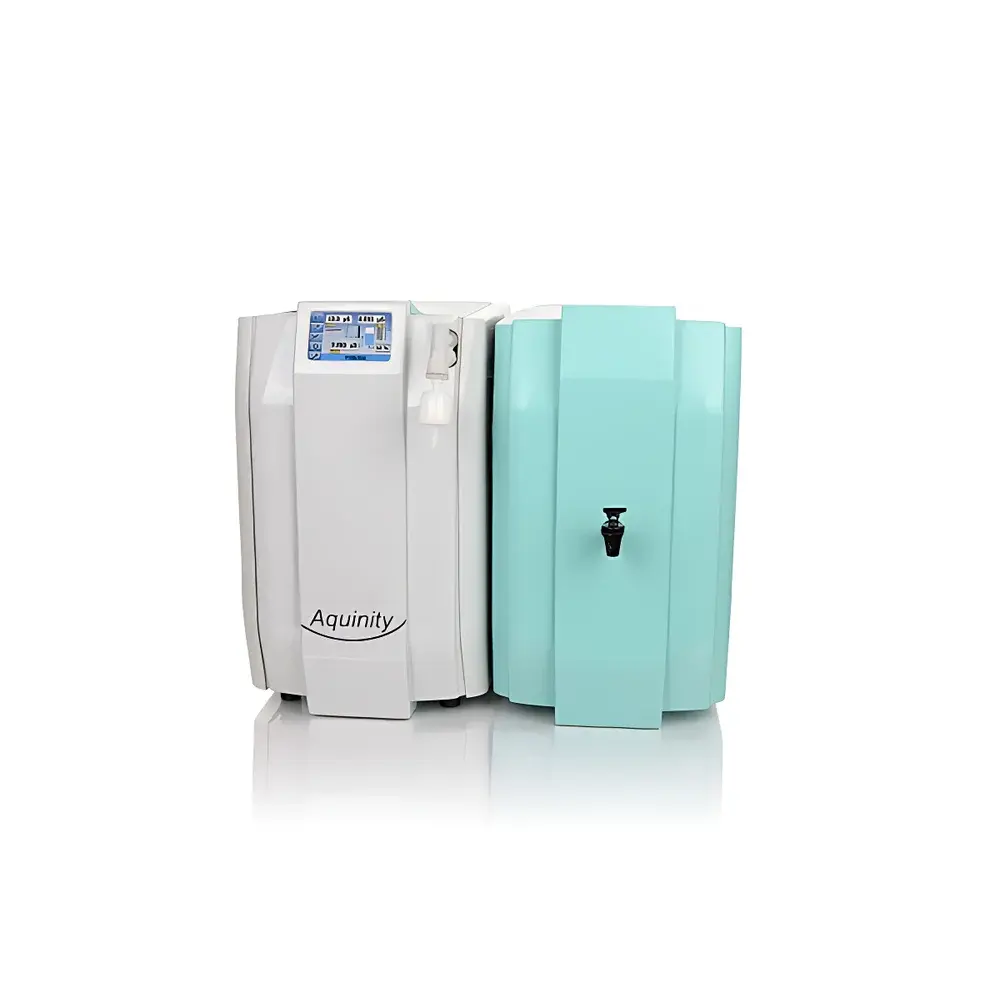
AquaRO Reverse Osmosis Ultra-Pure Water System
| Origin | Imported |
|---|---|
| Manufacturer Type | Authorized Distributor |
| Model | AquaRO |
| Output Flow Rate | 5–200 L/h |
| Pure Water Grade | ASTM Type I (ISO 3696 Class 1) |
| Resistivity | ≥18.2 MΩ·cm @ 25 °C |
| Heavy Metals & Dissolved Silica | <0.1 ppb |
| Total Organic Carbon (TOC) | <3 ppb |
| Microbial Count | <0.001 EU/mL |
| Particles (>0.1 µm) | <1 particle/mL |
| Feed Water Conductivity Reduction | >99% |
| Bacterial Reduction | >99.999% |
| Outlet Conductivity | <10 µS/cm |
| TOC in Product Water | <50 ppb |
| Noise Level | <45 dB(A) |
Overview
The AquaRO Reverse Osmosis Ultra-Pure Water System is an engineered solution for laboratories requiring continuous, on-demand production of ASTM Type I (ISO 3696 Class 1) ultrapure water directly from municipal tap feed water. It employs a multi-stage purification architecture centered on high-rejection thin-film composite (TFC) reverse osmosis membranes, followed by electrodeionization (EDI), dual-wavelength UV oxidation (185/254 nm), and final 0.1 µm ultrafiltration. This configuration ensures consistent removal of ionic contaminants, organic compounds, colloidal silica, endotoxins, and sub-micron particulates—meeting or exceeding the stringent specifications defined in ASTM D1193-20, ISO 3696:1987, and CLSI EP22-A guidelines for critical analytical and life science applications.
Key Features
- Integrated pressure buffer tank enabling high-flow dispensing (up to 2.5 L/min) without system pressure drop or flow interruption
- Under-bench modular design minimizing footprint while allowing flexible integration into existing lab infrastructure—including compatibility with optional remote dispensing stations and wall-mounted user interfaces
- Low-acoustic operation (<45 dB[A] at 1 m distance) achieved through vibration-dampened pump mounts and acoustic insulation of the RO/EDI manifold
- Real-time resistivity and TOC monitoring with automatic data logging; integrated conductivity sensor calibrated traceably to NIST standards
- Automated membrane flush cycle and programmable sanitization protocols compliant with ISO 14644-1 cleanroom maintenance requirements
- Self-diagnostic firmware with predictive maintenance alerts for cartridge life, membrane fouling index, and UV lamp intensity decay
Sample Compatibility & Compliance
The AquaRO system delivers water suitable for HPLC mobile phase preparation, LC-MS solvent formulation, cell culture media reconstitution, molecular biology assays (e.g., PCR, qRT-PCR), and trace metal analysis (ICP-MS, GF-AAS). Its output meets the purity thresholds required under USP , EP 2.2.43, and JP 17 for purified water used in pharmaceutical manufacturing. All wetted materials—including tubing, tanks, and filters—are USP Class VI-certified and non-leaching. The system supports full audit trail generation per FDA 21 CFR Part 11 when connected to validated LIMS or ELN platforms.
Software & Data Management
Equipped with embedded Ethernet and RS-485 interfaces, the AquaRO controller enables seamless integration into laboratory network environments. The web-based interface provides remote status monitoring, historical trend visualization (resistivity, TOC, flow rate, pressure differentials), and export of CSV-formatted logs compliant with GLP/GMP documentation requirements. Optional software modules support electronic signature workflows, alarm escalation via SMTP/SNMP, and automated report generation aligned with ISO/IEC 17025 quality management systems.
Applications
- Preparation of calibration standards and reference solutions for elemental analysis
- Final rinse water for semiconductor wafer cleaning and microfluidic device fabrication
- Feed water for steam generators in sterilization autoclaves (where pyrogen-free water is mandated)
- Source water for downstream ultrapure polishing systems (e.g., integrated with 0.05 µm UF or activated carbon post-filters)
- Continuous supply for multi-user core facilities including genomics, proteomics, and nanomaterial synthesis labs
FAQ
What feed water quality is required for optimal AquaRO performance?
Municipal tap water meeting WHO Guidelines for Drinking-water Quality (≤500 ppm TDS, ≤1 ppm free chlorine, ≤0.1 ppm iron) is recommended. Pre-treatment with sediment and carbon filtration is mandatory if feed water exceeds these limits.
Can the system be validated for GMP environments?
Yes—the AquaRO supports IQ/OQ/PQ protocol execution, including installation qualification checklists, operational boundary testing (flow, pressure, resistivity), and performance qualification using certified reference materials (e.g., NIST SRM 3104a for conductivity). Full validation documentation templates are available upon request.
Is remote monitoring supported out-of-the-box?
Standard Ethernet connectivity enables immediate access to real-time metrics and alarms via any modern browser. No additional gateway hardware or proprietary client software is required.
How often must consumables be replaced?
Pre-filters: every 6 months (or after 10,000 L); RO membrane: 2–3 years depending on feed water hardness and chlorine exposure; EDI stack: 3–5 years; UV lamp: annually; 0.1 µm final filter: quarterly or after 5,000 L.



