
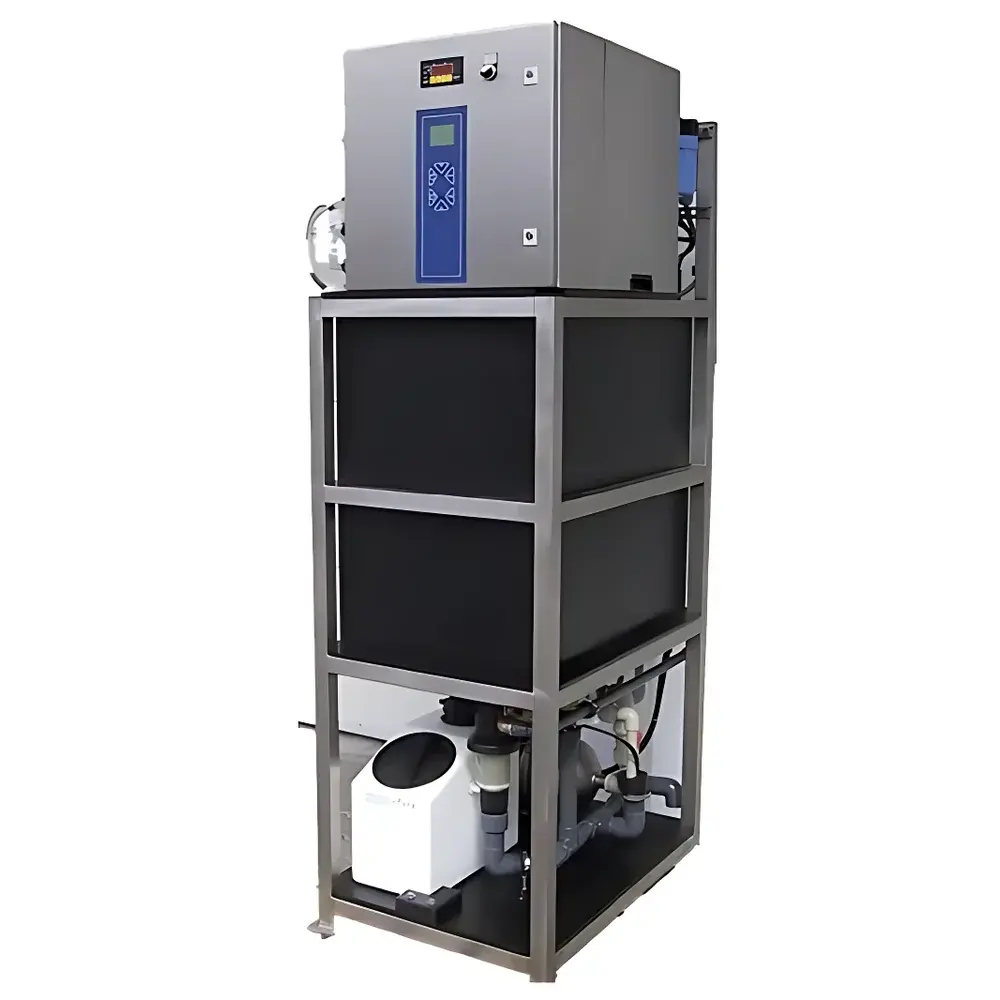
membraPure EDI-5 to EDI-310 Continuous Electrodeionization Ultra-Pure Water System
| Brand | membraPure |
|---|---|
| Origin | Germany |
| Manufacturer Type | Original Equipment Manufacturer (OEM) |
| Origin Category | Imported |
| Model Series | EDI-5, EDI-10, EDI-20, EDI-40, EDI-55, EDI-75, EDI-120, EDI-180, EDI-260, EDI-310 |
| Output Flow Rate | 5–310 L/h |
| Resistivity | ≥18.2 MΩ·cm (at 25 °C) |
| Conductivity | ≤0.5 µS/cm (Nankai University validation: 0.07–0.1 µS/cm) |
| Total Organic Carbon (TOC) | <10 ppb |
| Feed Water Requirement | Municipal tap water (pre-treated via integrated RO) |
| Configuration Options | Standalone or Centralized Distribution System |
| Regeneration | Fully automatic, continuous electrochemical regeneration — no chemical reagents or cartridge replacement required |
| Compliance | Designed to meet ASTM D1193 Type I, ISO 3696 Grade 1, and CLSI EP21-A2 specifications for clinical and research-grade ultrapure water |
Overview
The membraPure EDI series represents a fully integrated, continuous electrodeionization (EDI) ultra-pure water system engineered for laboratories requiring stable, on-demand production of Type I ultrapure water directly from municipal tap feed. Unlike conventional mixed-bed deionization systems that rely on periodic chemical regeneration or disposable cartridges, the EDI platform employs a synergistic combination of reverse osmosis (RO) pre-treatment and electrically driven ion migration across ion-selective membranes and mixed-bed resin compartments. This electrochemical process continuously removes residual ions—including Na⁺, Cl⁻, Ca²⁺, SO₄²⁻, and trace heavy metals—without interruption, ensuring uninterrupted water quality and eliminating downtime associated with resin exhaustion or manual regeneration cycles. The system is designed for both standalone benchtop deployment (models EDI-5 through EDI-75) and centralized building-wide distribution (EDI-120 through EDI-310), supporting multi-point delivery to analytical instruments, cell culture hoods, and automated synthesis platforms.
Key Features
- Integrated dual-stage purification: First-stage RO membrane removes >99% of dissolved solids, organics, colloids, and microorganisms; second-stage continuous EDI module achieves final polishing to resistivity ≥18.2 MΩ·cm at 25 °C
- Zero chemical regeneration: Electrochemical regeneration eliminates need for acid/base storage, handling, or disposal—reducing operational risk and total cost of ownership
- Modular, space-efficient architecture: Compact footprint with vertical stack design minimizes floor space requirements; suitable for under-bench, wall-mounted, or utility room installation
- Real-time water quality monitoring: Built-in conductivity and TOC sensors provide continuous feedback with digital display and configurable alarm thresholds
- Intelligent flow management: Programmable output rates (5–310 L/h) with pressure-regulated delivery and automatic low-flow recirculation to maintain system hygiene
- Full system diagnostics: Self-diagnostics for RO performance, EDI stack voltage/current stability, UV lamp intensity (if equipped), and filter service life tracking
Sample Compatibility & Compliance
The membraPure EDI system delivers water compliant with internationally recognized standards for critical laboratory applications. Its consistent output meets or exceeds ASTM D1193 Type I, ISO 3696 Grade 1, and CLSI EP21-A2 requirements for ultrapure water used in HPLC, LC-MS, ICP-MS, molecular biology, and pharmaceutical QC testing. All wetted components—including RO housings, EDI stacks, and distribution manifolds—are constructed from FDA-compliant, USP Class VI-certified materials (e.g., PVDF, PTFE, and 316L stainless steel). The system supports GLP/GMP-aligned operation through optional audit-trail logging, user access control, and electronic signature capability—fully compatible with 21 CFR Part 11 data integrity frameworks when paired with validated software modules.
Software & Data Management
Standard configuration includes an embedded industrial-grade controller with touchscreen HMI, offering real-time visualization of key parameters: feed/production conductivity, TOC concentration, RO rejection rate, EDI stack voltage, and cumulative volume dispensed. Optional Ethernet/Wi-Fi connectivity enables remote monitoring via secure web interface or integration into Lab Information Management Systems (LIMS). Data logging records all critical events—including maintenance alerts, parameter deviations, and system start/stop sequences—with timestamped, tamper-evident files stored locally and exportable in CSV or PDF format. Firmware updates are performed over-the-air with version rollback capability and cryptographic signature verification.
Applications
- HPLC and UHPLC mobile phase preparation where ionic contamination causes baseline drift or column fouling
- ICP-MS and ICP-OES sample dilution and blank preparation, demanding sub-ppt metal ion levels
- Cell culture media formulation and buffer preparation requiring endotoxin-free, low-TOC water
- Genomic applications including PCR, qPCR, and next-generation sequencing library prep
- Pharmaceutical stability testing and dissolution media preparation per USP & EP monographs
- Calibration of high-precision conductivity meters and reference electrode systems
FAQ
Does the EDI system require pretreatment beyond standard tap water?
Yes—integrated RO pre-treatment is mandatory. Feed water must meet municipal potable standards; iron, manganese, chlorine, and hardness levels should fall within RO manufacturer specifications to prevent membrane fouling.
How often does the EDI stack require maintenance?
Under normal operating conditions and with proper RO pre-treatment, the EDI stack requires no scheduled replacement. Annual inspection and cleaning of inlet filters and RO membranes are recommended per ISO 21647 maintenance guidelines.
Can the system be integrated into existing building water distribution networks?
Yes—centralized models (EDI-120 to EDI-310) include pressure-boosting pumps, loop circulation control, and sanitary tri-clamp connections compatible with 316L stainless steel piping per ASME BPE standards.
Is TOC monitoring included as standard equipment?
TOC measurement is available as a factory-installed option on all EDI-40 and larger models; smaller standalone units support add-on TOC sensor modules via standardized analog/digital I/O ports.
What cybersecurity measures are implemented for network-connected units?
All network-enabled controllers comply with IEC 62443-3-3 SL2 requirements, featuring TLS 1.2 encryption, role-based authentication, disabled default accounts, and configurable firewall rules for segmented lab network deployment.



