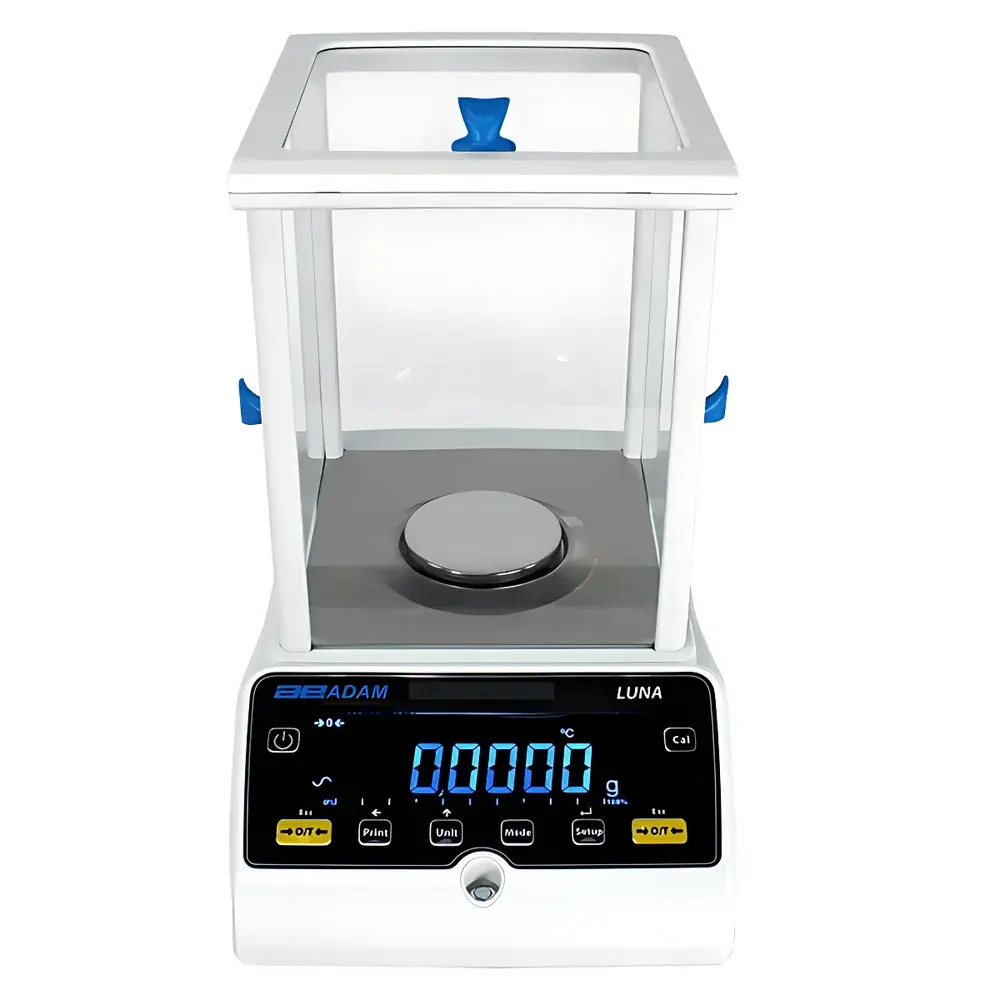
Adam Luna Series Analytical Balance
| Brand | Adam |
|---|---|
| Origin | United Kingdom |
| Manufacturer | Adam Equipment (UK) |
| Product Type | Analytical Balance |
| Model | LAB Series (e.g., LAB 214i, LAB 254e) |
| Maximum Capacity | 250 g |
| Readability | 0.0001 g |
| Repeatability | ±0.0002 g |
| Linearity Error | ±0.0003 g |
| Minimum Weight | 200 mg |
| Stabilization Time | 2 s |
| Calibration | Internal (i-models) or External (e-models) |
| Display | Backlit LCD, 24 mm digit height |
| Weighing Units | g, mg, ct, GN, N, dr, oz, ozt, dwt, mm, tl.T, tl.H, tl.S, T, user-defined |
| Interfaces | RS-232, USB |
| Operating Temperature | 15–35 °C |
| Power Supply | 18 V DC, 50/60 Hz, 830 mA adapter |
| Housing Material | ABS plastic |
| Pan Material | 304 stainless steel |
| Pan Size | 90 mm diameter |
| Draft Shield | Standard tempered glass square shield (192 × 195 × 230 mm W×D×H) |
| Dimensions (W×D×H) | 224 × 374 × 338 mm |
| Net Weight | 6.2 kg (i-models), 5.8 kg (e-models) |
| Compliance | GLP-compliant data logging, ISO/IEC 17025 support, USP Chapter 41 & 1251 compatible |
Overview
The Adam Luna Series Analytical Balance is a precision mass measurement instrument engineered for routine and regulated laboratory environments where reproducibility, traceability, and operational efficiency are critical. Based on electromagnetic force restoration (EMFR) transduction technology, the Luna delivers high-resolution static weighing with 0.0001 g readability across capacities ranging from 80 g to 250 g. Its robust mechanical architecture—featuring a 304 stainless steel weighing pan and impact-resistant ABS housing—ensures long-term stability under daily use in QC, R&D, and academic laboratories. Designed in accordance with international metrological principles, the Luna meets essential performance criteria defined in USP <41> “Balances” and <1251> “Weighing on an Analytical Balance”, supporting method validation and uncertainty budgeting workflows. The balance operates within a controlled ambient range (15–35 °C) and incorporates temperature-compensated internal calibration mechanisms in i-model variants, minimizing drift-induced error during extended sessions.
Key Features
- Backlit LCD display with 24 mm high white digits on black background—optimized for visibility under variable lighting conditions including low-illumination labs.
- Color-coded tactile keys enabling intuitive navigation without extensive operator training; function labels conform to ISO 7000 graphical symbols.
- Integrated spirit level and adjustable leveling feet ensure mechanical alignment prior to calibration—critical for achieving maximum accuracy per OIML R 76-1 requirements.
- Standard tempered glass draft shield (192 × 195 × 230 mm) provides consistent airflow management and reduces convective disturbances during microgram-level measurements.
- Sealed membrane keypad resists ingress of dust, powders, and incidental liquid splashes—enhancing durability and simplifying decontamination protocols.
- Dual communication interfaces (RS-232 and USB) support direct connection to PCs, label printers, and LIMS systems—enabling automated data capture without manual transcription.
- Programmable digital filtering improves stability when weighing dynamic or vibration-sensitive samples, such as hygroscopic materials or open-vessel reactions.
- Auto-lock and peak-hold functions allow transient readings—e.g., animal weighing or settling powder masses—to be captured and retained for documentation.
- GLP-compliant timestamped printouts include date, time, net/gross/tare values, unit, and operator ID (when configured)—supporting audit-ready recordkeeping per FDA 21 CFR Part 11 Annex 11 guidelines.
Sample Compatibility & Compliance
The Luna Series accommodates a broad spectrum of sample types—including solids, granules, powders, and small-volume liquids—in standard laboratory containers (e.g., weighing boats, crucibles, vials). Its 90 mm stainless steel pan supports ergonomic placement and cleaning between runs. All models comply with ISO 9001 quality system requirements and are designed to facilitate adherence to ISO/IEC 17025:2017 clause 6.4.1 (equipment verification). Internal calibration (i-models) uses built-in reference masses traceable to UKAS-accredited standards; external calibration (e-models) accepts Class E2 or better weights per OIML R 111. The balance’s minimum weight (200 mg at 0.0001 g readability) satisfies USP <41> threshold criteria for quantitative analytical procedures. Optional density determination kits extend functionality for solid/liquid density analysis per ASTM D792 and ISO 1183.
Software & Data Management
Data export is fully configurable via ASCII protocol over RS-232 or virtual COM port emulation over USB. Output formats include tab-delimited text and CSV-compatible streams—compatible with Excel, LabWare LIMS, and custom Python-based QA dashboards. Firmware supports user-defined data fields (e.g., batch ID, sample code) appended to each transmission. Audit trail capabilities include event logging of calibration, zeroing, and parameter changes—with timestamps stored in non-volatile memory. When connected to validated PC software (e.g., Adam’s free QuickLink 2), users can schedule automatic calibration, generate calibration certificates, and perform statistical process control (SPC) analysis on repeatability datasets. All firmware updates are digitally signed and delivered via secure HTTPS endpoints.
Applications
- Pharmaceutical formulation: active pharmaceutical ingredient (API) dispensing, excipient blending, and content uniformity testing per USP <905>.
- Chemical synthesis: stoichiometric reagent weighing, catalyst loading, and yield calculation in reaction monitoring.
- Materials science: powder characterization, coating thickness estimation via mass-thickness correlation, and composite mixture homogeneity assessment.
- Food & beverage QA: nutritional labeling compliance, moisture loss tracking, and portion control validation.
- Environmental testing: filter weighing for particulate matter (PM2.5/PM10) analysis per EPA Method 201A.
- Academic research: teaching fundamental metrology concepts, uncertainty propagation exercises, and gravimetric titration setup.
FAQ
What is the difference between internal and external calibration models?
Internal calibration (i-models) uses motor-driven, temperature-compensated reference masses activated automatically or manually via front-panel command. External calibration (e-models) require manual placement of certified weights; both configurations satisfy ISO/IEC 17025 traceability requirements when performed using accredited standards.
Does the Luna Series support GMP/GLP-compliant electronic records?
Yes—the balance generates timestamped, immutable printouts and serial data streams that meet ALCOA+ principles (Attributable, Legible, Contemporaneous, Original, Accurate). When integrated with validated software and access-controlled networks, it supports 21 CFR Part 11 compliance.
Can the Luna be used for density determination?
Yes—when paired with Adam’s optional density kit (including sinker, thermometer, and density calculation module), the Luna performs single-pan density measurements per Archimedes’ principle, compliant with ISO 1183-1 and ASTM D792.
Is the draft shield removable for cleaning?
Yes—the tempered glass shield is tool-free detachable and autoclavable up to 121 °C for sterile applications; all mounting hardware is corrosion-resistant stainless steel.
How does the Luna handle electrostatic interference during low-mass weighing?
The balance includes an optional anti-static ionizer port (available as accessory) and supports grounding via the rear-mounted terminal—reducing charge-induced drift in dry environments or with insulating samples like polymers and ceramics.