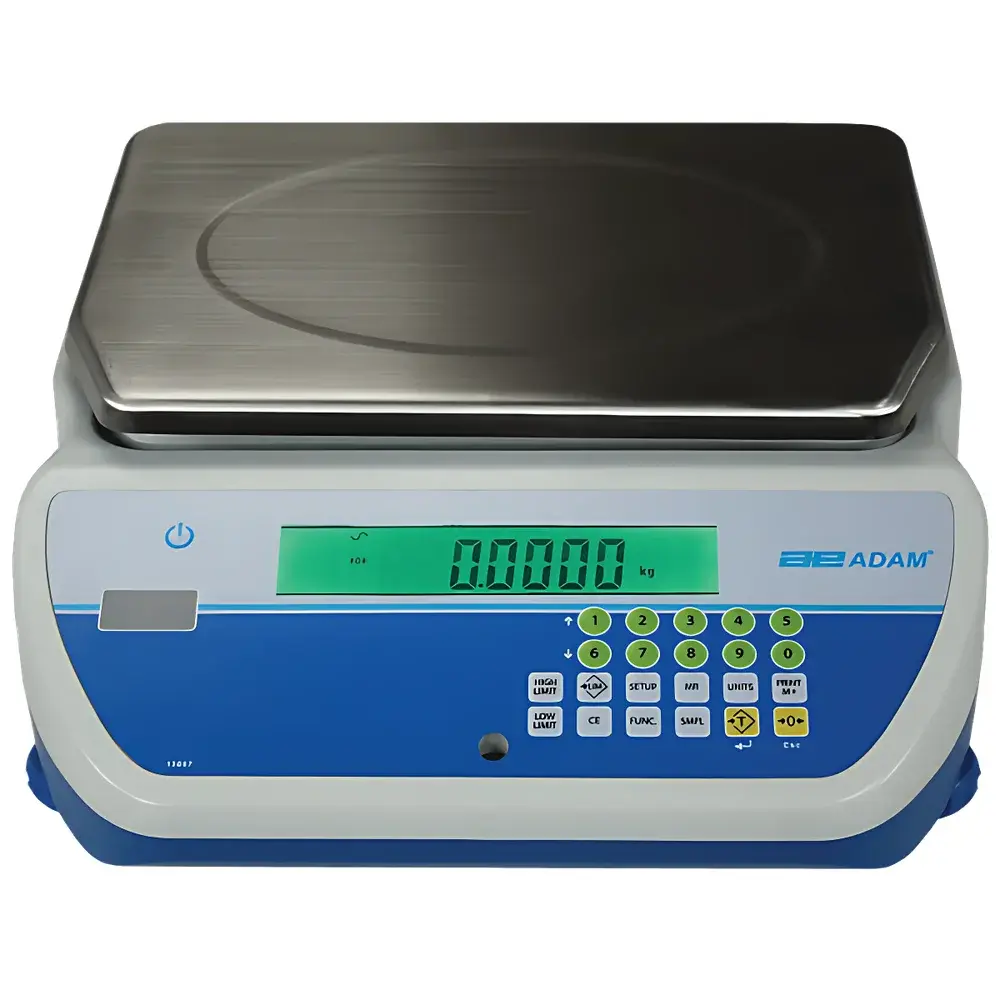
Adam Equipment Cruiser Series Checkweighing Scale CKT
| Brand | Adam Equipment |
|---|---|
| Origin | United Kingdom |
| Manufacturer Type | Direct Manufacturer |
| Origin Category | Imported |
| Model | CKT |
| Price Range | USD 1–4,999 |
Overview
The Adam Equipment Cruiser Series CKT is a purpose-engineered industrial checkweighing scale designed for high-throughput production lines, warehouse quality control, and packaging verification processes. Built on precision load cell technology with electromagnetic force compensation (EMFC) architecture, the CKT delivers stable, repeatable mass measurements under dynamic operational conditions typical of manufacturing and logistics environments. Its core function—statistical weight verification against user-defined upper and lower tolerance limits—enables real-time pass/fail assessment of individual items or batches, directly supporting lean manufacturing principles such as Just-in-Time (JIT) and Six Sigma process control. The scale operates in accordance with fundamental metrological principles defined in OIML R76-1 and ISO/IEC 17025 traceability frameworks, ensuring compliance-ready performance for regulated industries including food, pharmaceuticals, and automotive component assembly.
Key Features
- Triple-color backlit LCD display (red/amber/green) providing immediate visual feedback on weight status relative to preset limits—no interpretation required.
- 304 stainless steel weighing pan (standard size: 300 × 220 mm) with IP65-rated splash resistance and smooth, non-porous surface for rapid sanitation and GMP-compliant cleaning protocols.
- Robust ABS polymer housing with integrated anti-slip rubber feet and built-in leveling bubble + adjustable leveling feet for consistent mechanical stability across uneven concrete or metal flooring.
- RS-232 serial interface standard; optional USB-to-serial adapter available for direct connection to Windows-based PCs, PLCs, or label printers—fully compatible with common industrial SCADA and MES platforms.
- Sealed membrane keypad with tactile feedback, rated to IP65 for dust ingress protection and resistance to incidental liquid exposure during routine wipe-down procedures.
- Internal counting resolution of 1:600,000 ensures high-precision piece-counting accuracy—even for small, lightweight components such as screws, tablets, or electronic connectors.
- Overload protection up to 150% of maximum capacity safeguards the load cell from mechanical shock during accidental overloading or pallet drop events.
- Rechargeable Li-ion battery pack (up to 20 hours continuous operation) with intelligent power management and auto-shutdown after 30 minutes of inactivity.
Sample Compatibility & Compliance
The CKT accommodates a broad range of sample types—including rigid packages, flexible pouches, irregularly shaped assemblies, and bulk containers—without requiring recalibration between product changes. Its programmable PLU (Price Look-Up) memory stores up to 100 preconfigured item profiles, each containing nominal weight, tolerance band, unit count, and tare value. This enables rapid line changeovers while maintaining audit trail integrity. The scale meets CE marking requirements per EU Directive 2014/30/EU (EMC) and 2014/31/EU (Measuring Instruments Directive), and supports GLP/GMP documentation workflows through timestamped event logging (including calibration, zeroing, and limit adjustments). Optional firmware upgrades provide FDA 21 CFR Part 11-compliant electronic signature and audit trail functionality for pharmaceutical QA/QC applications.
Software & Data Management
Data export is supported via ASCII text format over RS-232 or USB virtual COM port, enabling seamless integration with Excel, SQL databases, or custom LabVIEW or Python-based data acquisition systems. Adam’s free PC Connect software (Windows-compatible) allows remote configuration, real-time data streaming, and CSV report generation—including statistical summaries (mean, SD, Cp/Cpk) for SPC charting. All weight events—including out-of-tolerance alarms, manual tare entries, and calibration actions—are time-stamped and stored locally in non-volatile memory (retains ≥10,000 records). Optional Ethernet/Wi-Fi modules (sold separately) enable networked deployment within Industry 4.0 architectures, supporting MQTT and Modbus TCP protocols for edge-to-cloud telemetry.
Applications
- Final package verification in food and beverage packing lines (e.g., checking filled cereal boxes, bottled sauces, or frozen meal trays).
- Pharmaceutical secondary packaging inspection (blister packs, vial cartons, syringe kits) prior to case packing.
- Automotive supplier PPAP submissions requiring documented weight consistency per IATF 16949 clause 8.5.1.2.
- Electronics component kitting operations where precise part counts per tray or reel are contractually mandated.
- Warehousing receiving inspection—validating vendor shipment weights against purchase order line items before inventory entry.
- Recycling facility material sorting verification—ensuring correct weight-based bale classification prior to dispatch.
FAQ
What calibration standards are required for routine verification?
A Class M2 or better certified test weight, traceable to NIST or UKAS, is recommended for daily verification. External calibration must be performed using the scale’s dedicated calibration mode with full-span loading.
Can the CKT interface with ERP systems like SAP or Oracle?
Yes—via RS-232 or USB, using configurable ASCII output formats. Integration typically requires middleware mapping (e.g., Node-RED or custom API wrapper) to match field delimiters and record structure expected by the ERP.
Is the display readable under high-bay warehouse lighting?
The high-contrast monochrome LCD with adjustable backlight intensity remains legible under ambient illumination up to 10,000 lux—verified per ISO 9241-307.
Does the scale support multiple tolerance zones (e.g., warning + reject)?
Yes—three distinct weight bands (underweight, in-spec, overweight) are independently configurable with separate audible tones and color-coded visual indicators.
How often should preventive maintenance be scheduled?
Adam recommends biannual inspection of mechanical alignment, load cell integrity, and cable harness continuity—documented per ISO 5725-2 repeatability verification protocol.