
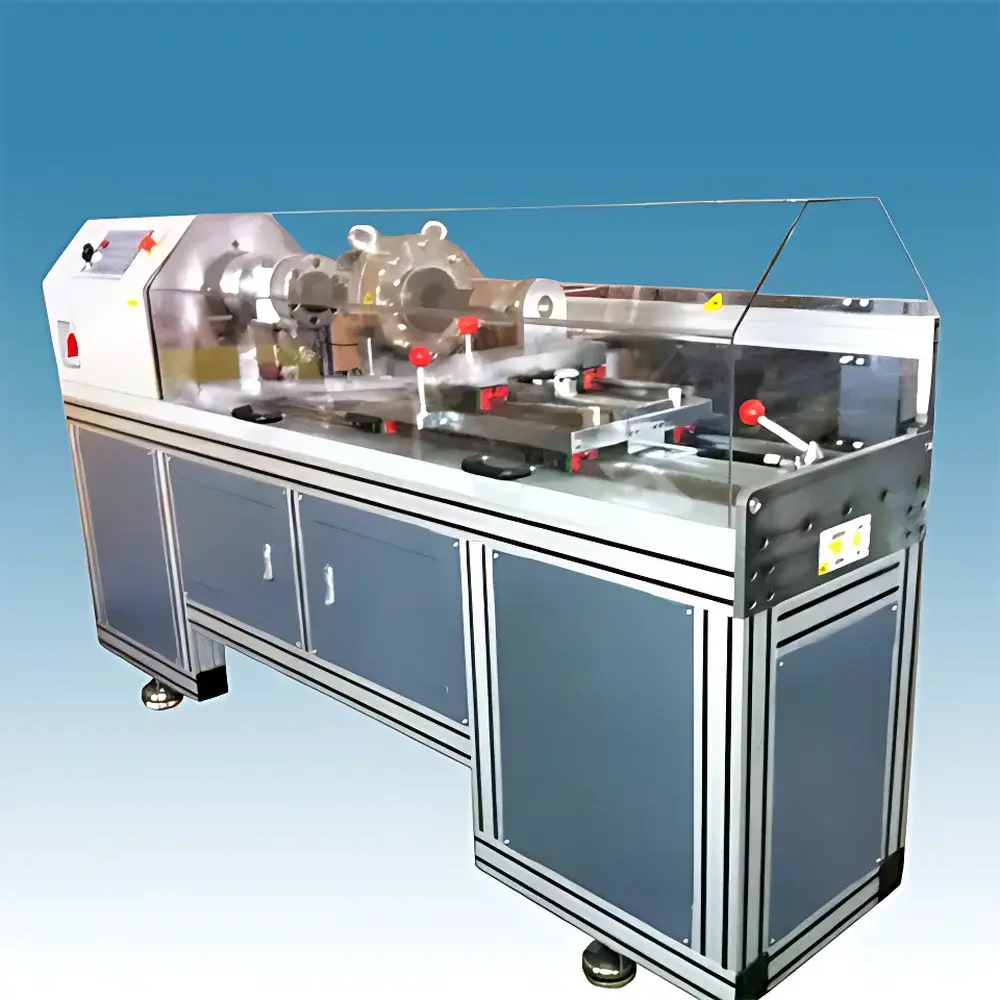
Hengyi HY-2000N.M High-Precision Fastener Friction Coefficient & Torsion Testing System
| Brand | Hengyi |
|---|---|
| Origin | Shanghai, China |
| Manufacturer Type | Direct Manufacturer |
| Model | HY-2000N.MYUH |
| Max Torque | 2000 N·m |
| Torque Measurement Range | 2–2000 N·m |
| Torque Resolution | 1/50000 |
| Torsion Angle Range | 0–100000° |
| Motor Power | 5 kW |
Overview
The Hengyi HY-2000N.M is a high-precision, dual-sensor torsion testing system engineered for the quantitative mechanical characterization of threaded fasteners—including bolts, screws, studs, and nuts—under controlled tightening conditions. It operates on the principle of simultaneous, synchronized measurement of axial clamping force (tensile load) and three distinct torque components: total input torque, thread torque, and bearing surface torque. This triaxial force-torque acquisition enables calculation of critical fastener performance parameters per internationally recognized mechanical standards, including ISO 16047, ISO 2320, GB/T 3098.9–2010, GB/T 16823.3–2010, EN 14399-1:2005, and ISO 898-1:1999. The system employs a robust servo-electromechanical architecture with closed-loop control, ensuring stable low-speed torque application (5–40 rpm, extendable to 200 rpm), minimal speed fluctuation (<±0.5% error), and absence of stick-slip behavior—even at sub-rpm rates. Its structural rigidity (1800 kg mass, reinforced steel frame) and precision angular encoder (0–100000° range, ±0.5% accuracy) support repeatable, high-fidelity data capture across full tightening curves—from elastic engagement through yield and into plastic deformation.
Key Features
- Dual-load-path sensing: Independent high-stiffness load cell (5–500 kN axial force range) and coaxial torque transducer (2–2000 N·m, ±0.5% accuracy) enable decoupled measurement of clamping force and torque components.
- Triple-torque resolution: Real-time separation of total torque, thread torque, and bearing surface torque via calibrated sensor geometry and signal conditioning—essential for calculating individual friction coefficients (µthread, µbearing, µtotal) and K-factor.
- High-resolution angular feedback: Optical encoder with 0–100000° rotation range and <0.01° repeatability supports precise turn-angle tracking during yield detection, proof loading, and failure analysis.
- Modular test fixture design: Adjustable jaw spacing (up to 1000 mm) and interchangeable chucks accommodate fasteners from M10 to M30; custom tooling available for non-standard geometries.
- Industrial-grade controller: HYtest proprietary real-time controller with 10 kHz sampling rate, deterministic PID loop execution, and hardware-based overload protection (torque, force, angle).
- Thermal management: Integrated air-cooled 5 kW servo motor with dynamic thermal derating ensures sustained torque output without drift over extended test cycles.
Sample Compatibility & Compliance
The HY-2000N.M is validated for mechanical testing of metallic threaded fasteners per ISO 898-1 (carbon steel), ISO 3506-1 (stainless steel), and ASTM F568M (metric fasteners). It supports both bolt-nut assemblies and screw-in-place configurations, with clamping length adaptability up to 1000 mm. All measurement algorithms and calibration protocols comply with ISO/IEC 17025 traceability requirements when used with accredited calibration services. The system meets functional safety requirements per IEC 61508 SIL1 for industrial laboratory environments and supports audit-ready documentation per GLP and GMP frameworks—including electronic signature capability and 21 CFR Part 11–compliant audit trails when deployed with optional software modules.
Software & Data Management
The HYtest v8.2 testing software provides a modular, Windows-based interface for test method definition, real-time curve visualization (force vs. torque, torque vs. angle, coefficient evolution), and automated report generation. It includes preconfigured test templates aligned with ISO 16047 Annex A (K-factor determination), Annex B (friction coefficient decomposition), and Annex C (yield point identification). Raw data is stored in HDF5 format with embedded metadata (operator ID, calibration timestamp, environmental conditions). Export options include CSV, PDF (with digital signature), and XML for LIMS integration. Software validation documentation (IQ/OQ/PQ protocols) is provided upon request for regulated industries.
Applications
- Quantitative validation of lubricant efficacy on threaded surfaces under production-relevant tightening profiles.
- Development and qualification of self-locking fasteners (e.g., nylon-insert, distorted-thread, chemical coatings).
- Root-cause analysis of joint loosening in automotive powertrain, wind turbine nacelles, and rail vehicle underframes.
- Calibration and verification of torque-controlled assembly tools against fastener-specific K-factor baselines.
- Research into preload scatter reduction strategies in high-reliability aerospace bolting applications (per SAE AS9100D Clause 8.5.1.2).
- Third-party certification testing for ISO 4762 (socket head cap screws) and DIN 933 (hex bolts) compliance verification.
FAQ
What standards does the HY-2000N.M directly support for friction coefficient reporting?
It fully implements ISO 16047:2005 procedures for µthread, µbearing, and µtotal derivation, with built-in calculation logic matching Clauses 6.3–6.5 and Annexes A–C.
Can the system measure yield point and ultimate failure parameters?
Yes—real-time derivative analysis of torque-angle and force-angle curves enables automatic detection of yield onset (0.2% offset method), proof load attainment, and rupture criteria per ISO 898-1 Annex D.
Is remote operation and data export compatible with enterprise quality systems?
The system supports OPC UA server mode for MES/SCADA integration and exports ASCII-compliant CSV files with column headers mapped to ASTM E1447 terminology.
What maintenance intervals are recommended for long-term metrological stability?
Annual recalibration of load cell and torque transducer is advised; encoder verification every 6 months; servo motor thermal sensor validation per manufacturer’s service bulletin HY-MNT-2023-04.
Does the system support custom test sequences beyond standard methods?
Yes—HYtest software allows scripting of multi-step protocols (e.g., stepwise torque ramp + dwell + relaxation + reverse torque) using Python-based automation API (included in Advanced License tier).



