
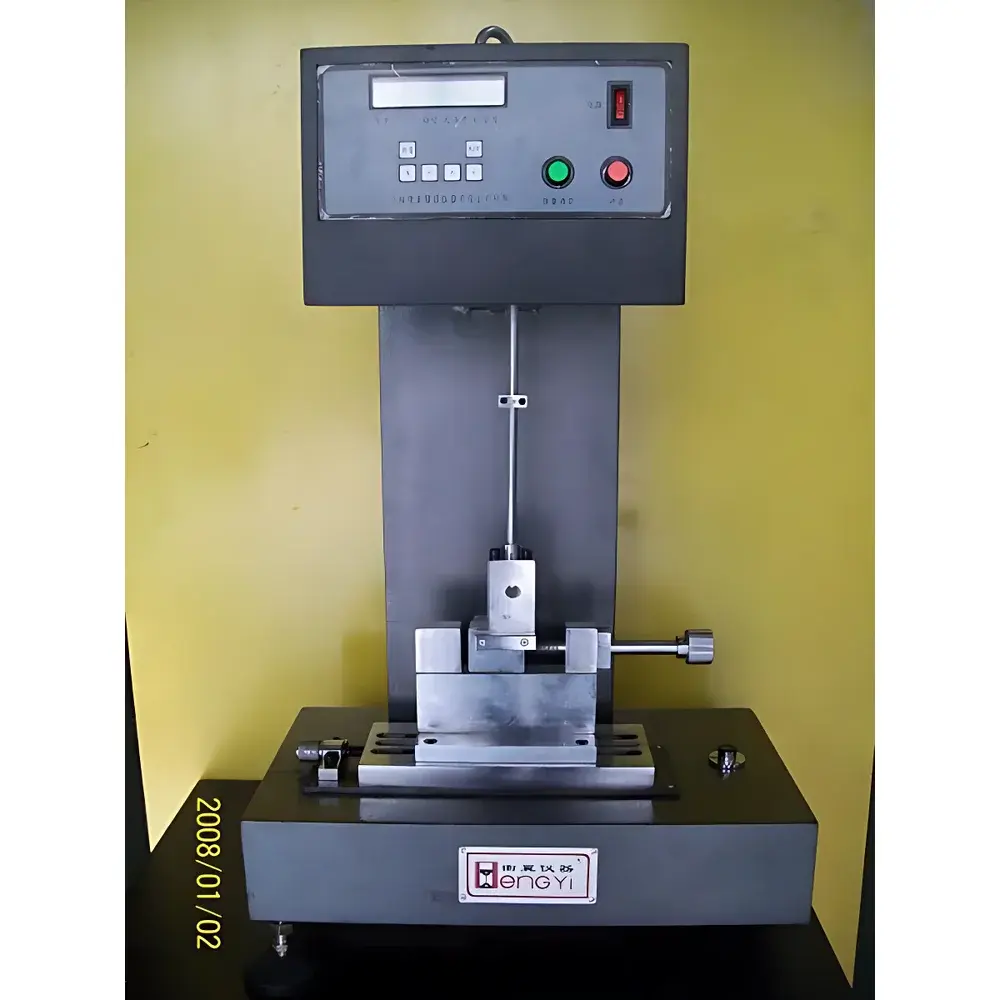
Hengyi HY(JX)WF Digital Display Charpy/Izod Impact Testing Machine
| Brand | Hengyi |
|---|---|
| Origin | Shanghai, China |
| Manufacturer Type | Direct Manufacturer |
| Country of Origin | China |
| Model | HY(JX)WF |
| Price Range | USD 1,400 – 2,800 |
| Impact Velocity (Charpy) | 2.9 m/s |
| Impact Velocity (Izod) | 3.5 m/s |
| Charpy Energy Levels | 1.0 J, 2.0 J, 4.0 J, 5.0 J |
| Izod Energy Levels | 2.75 J, 5.5 J, 11 J, 22 J |
| Pendulum Pre-lift Angle | 150° |
| Strike Center Distance (Charpy) | 230 mm |
| Strike Center Distance (Izod) | 335 mm |
| Notch Tip Radius (Charpy) | R 0.5 mm |
| Notch Tip Radius (Izod) | R 0.8 ± 0.2 mm |
| Distance from Blade Edge to Clamp Top (Izod) | 22 ± 0.2 mm |
| Pendulum Torques | 0.5359 N·m (2.75 J), 1.4737 N·m (5.5 J), 2.9474 N·m (11 J), 5.8949 N·m (22 J), 11.7898 N·m (22 J) |
| Anvil Span Options (Charpy) | 40 mm, 60 mm, 62 mm, 70 mm |
| Encoder | Panasonic Optical Rotary Encoder |
| Display System | Integrated LCD Control & Measurement Unit |
Overview
The Hengyi HY(JX)WF Digital Display Charpy/Izod Impact Testing Machine is a dual-mode mechanical impact tester engineered for standardized determination of notched and unnotched impact resistance in non-metallic materials. It operates on the classical pendulum principle—measuring energy loss during fracture via calibrated gravitational potential-to-kinetic energy conversion—enabling precise quantification of impact toughness under controlled Charpy (simply supported beam) and Izod (cantilever beam) configurations. Designed for compliance with international material testing standards, the system delivers repeatable, traceable results essential for quality assurance in polymer formulation, composite development, and regulatory submission workflows. Its rigid cast-iron frame, precision-machined anvil and clamp assemblies, and dynamically balanced pendulum ensure minimal energy dissipation outside specimen deformation—critical for maintaining ASTM E23 and ISO 148/ISO 180 measurement integrity.
Key Features
- Dual-standard capability: Configurable for both ISO 179 (Izod) and ISO 148 (Charpy) test geometries without mechanical reconfiguration—only tooling and fixture selection required.
- Modular pendulum system: Interchangeable hammers with certified energy ratings (Charpy: 1.0–5.0 J; Izod: 2.75–22 J), each individually calibrated and traceable to national metrology institutes.
- High-fidelity angular measurement: Panasonic optical rotary encoder (1024 PPR) captures real-time pendulum angular displacement with sub-degree resolution, enabling direct calculation of absorbed energy per ISO 148-1 Annex B.
- Integrated LCD control unit: Displays impact energy, pendulum angle pre-release and post-fracture, test mode, and error diagnostics—no external PC required for basic operation.
- Compliance-grade fixtures: Precision-ground anvils with 40/60/62/70 mm span options (Charpy) and adjustable clamping height (Izod) meet dimensional tolerances specified in GB/T 1043, ISO 179-1, and ASTM D256.
- Mechanically damped release mechanism: Ensures consistent pendulum initiation velocity (2.9 m/s for Charpy, 3.5 m/s for Izod) within ±0.05 m/s tolerance across all energy levels.
Sample Compatibility & Compliance
The HY(JX)WF accommodates standard rectangular bars (e.g., 80 × 10 × 4 mm for Izod; 55 × 10 × 10 mm for Charpy) and supports notched specimens prepared per ISO 2818 or ASTM D6110 milling protocols. It is validated for use with thermoplastics (PP, PE, ABS, PC), thermosets (epoxy, phenolic), fiber-reinforced composites (GFRP, CFRP), ceramics, and electrical insulating materials. The instrument conforms to the mechanical and procedural requirements of GB/T 1043, ISO 179-1:2010, ISO 148-1:2016, ASTM D256, DIN 53453, and DIN 8078. All critical dimensions—including blade radius (R = 0.8 ± 0.2 mm for Izod), anvil radius (R = 1.0 mm), and support span tolerances—are verified during factory calibration and documented in the supplied Certificate of Conformance.
Software & Data Management
While the base configuration operates autonomously via its embedded LCD interface, optional USB-connected PC software (Hengyi IMPACTSuite v3.2) enables GLP-compliant data capture, statistical reporting (mean, SD, CV%), pass/fail thresholding per specification, and audit-trail generation. The software supports 21 CFR Part 11–ready user authentication, electronic signatures, and immutable test record archiving. Raw encoder pulse data and time-stamped energy values are exportable in CSV and PDF formats compatible with LIMS integration. Calibration history, operator ID, environmental conditions (optional external sensor input), and specimen ID fields are embedded in every exported report.
Applications
This impact tester serves as a core evaluation tool in R&D laboratories assessing polymer blend compatibility, plasticizer efficacy, filler dispersion effects, and thermal aging degradation. In QC environments, it supports incoming raw material verification (e.g., resin lot acceptance), in-process monitoring of extrusion parameters, and final product release testing per IEC 60695-1-20 (fire safety) or UL 94 HB/V classification prerequisites. Academic users apply it to structure-property correlation studies—linking molecular weight distribution (via GPC), crystallinity (DSC), and fracture morphology (SEM) to macroscopic toughness behavior. Its robustness and ease of maintenance make it suitable for high-throughput testing in third-party certification labs accredited to ISO/IEC 17025.
FAQ
What standards does the HY(JX)WF explicitly support?
It is configured and verified for GB/T 1043, ISO 179-1, ISO 148-1, ASTM D256, and DIN 53453. Full compliance documentation—including dimensional verification reports and energy calibration certificates—is provided with shipment.
Can the same specimen be tested in both Charpy and Izod modes?
No. Specimen geometry, notch orientation, and support conditions differ fundamentally between the two methods. Separate specimens cut and notched per respective standard requirements must be used.
Is periodic recalibration required?
Yes. Annual recalibration of pendulum energy, encoder linearity, and anvil/clamp geometry is recommended. Hengyi provides certified recalibration services with NIST-traceable reference hammers and dimensional standards.
Does the system meet ISO/IEC 17025 traceability requirements?
All delivered units include factory calibration certificates referencing CNAS-accredited standards. For full accreditation, users must implement documented procedures for equipment verification, environmental monitoring, and operator competency assessment per Clause 6.4 and 6.5 of ISO/IEC 17025:2017.
What maintenance is required for long-term accuracy?
Monthly visual inspection of blade edge wear (regrind when radius exceeds R 0.85 mm), biannual lubrication of pivot bearings with ISO VG 32 mineral oil, and annual torque verification of clamp fasteners using a calibrated torque wrench (5.0 ± 0.2 N·m).



