
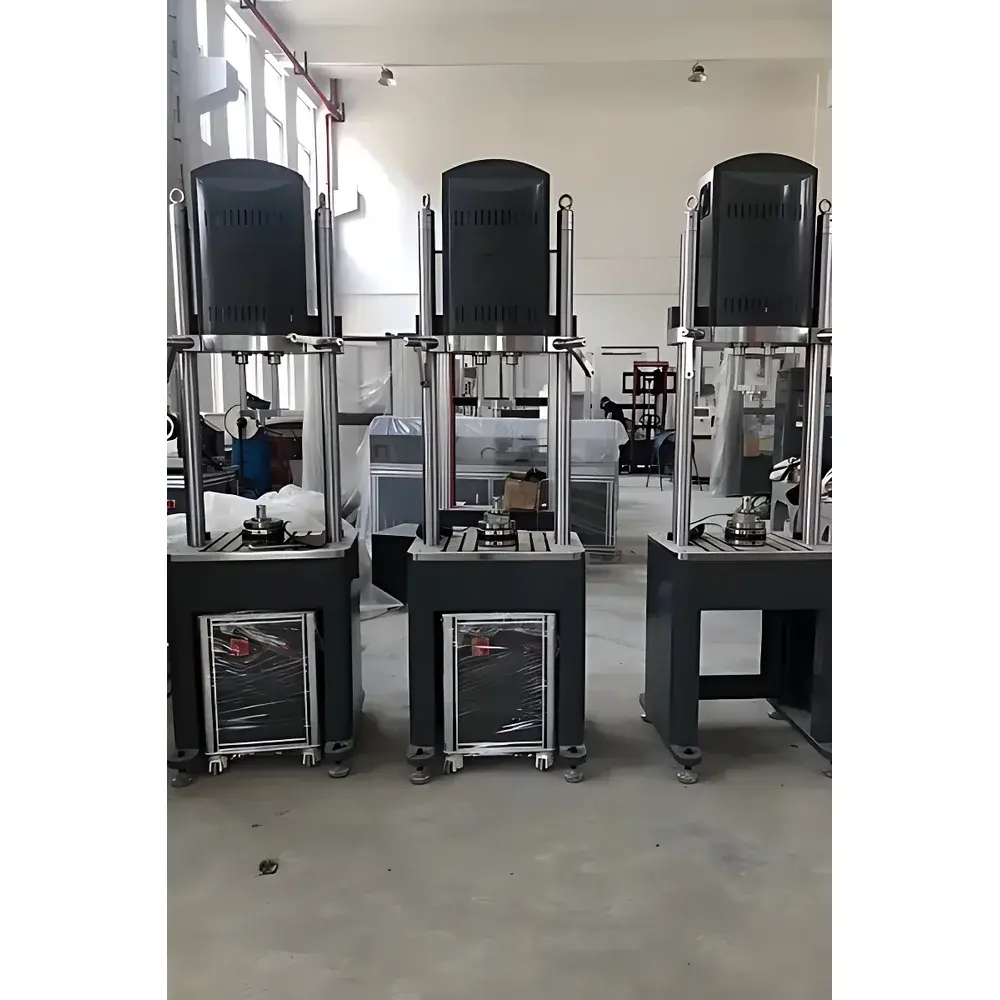
Hengyi HY(DP)5020WE Microcomputer-Controlled Electromechanical Tension-Compression Fatigue Testing Machine
| Brand | Hengyi |
|---|---|
| Origin | Shanghai, China |
| Manufacturer Type | Direct Manufacturer |
| Product Category | Domestic |
| Model | HY(DP)5020WE |
| Instrument Type | High-Frequency Electromechanical Fatigue Tester |
| Maximum Test Load | ±5000 N |
| Frequency Range | 0–30 Hz |
| Actuator Stroke | 0–200 mm (or ±100 mm) |
| Force Resolution | 0.01 N |
| Force Accuracy | Class 1 (±1% of reading) |
| Displacement Accuracy | Class 1 (±1% of full scale) |
| Displacement Resolution | 0.01 mm |
| Control Accuracy | ±1% |
| Waveform Options | Sine, Cosine, Square, Triangle, Sawtooth |
| Horizontal Test Space | 450 mm |
| Vertical Test Height | 500 mm |
| Tensile Test Space | 300 mm |
| Compressive Test Space | 500 mm |
| Dimensions (L×W×H) | ≈680 × 700 × 2500 mm |
| Power Supply | 380 V AC, 5 kW |
| Net Weight | 600 kg |
| Host Weight | 850 kg |
Overview
The Hengyi HY(DP)5020WE Microcomputer-Controlled Electromechanical Tension-Compression Fatigue Testing Machine is a precision-engineered electromechanical fatigue system designed for controlled cyclic loading under uniaxial tension and compression. It operates on servo-controlled linear actuation principles, delivering repeatable sinusoidal, cosine, square, triangular, and sawtooth waveforms across a frequency range of 0–30 Hz. Unlike hydraulic systems, this electromechanical platform eliminates fluid leakage risks, reduces maintenance overhead, and ensures high positional fidelity and force linearity—particularly critical in low-to-moderate load regimes (50–5000 N). The machine is optimized for biomedical component evaluation—including femoral head prostheses, orthopedic screws, bone cement interfaces—and for mechanical characterization of polymers, composites, and thin metallic specimens where high-frequency, low-displacement cycling is required. Its rigid frame architecture (850 kg total mass) minimizes resonance interference and supports stable dynamic testing up to 30 Hz without active damping compensation.
Key Features
- Electromechanical actuation with brushless servo motor and precision ball-screw transmission, enabling high-resolution displacement control (0.01 mm) and force resolution (0.01 N)
- Class 1 force and displacement accuracy per ISO 7500-1 and ASTM E4 standards, verified over the full operational range (50–5000 N; 0–200 mm stroke)
- Real-time closed-loop control of load, displacement, or strain with ±1% control accuracy and <1% relative error in force indication
- Configurable waveform generation—including programmable multi-segment sine sweeps, dwell-integrated cycles, and asymmetric tension-compression profiles
- Modular fixture interface compatible with standard M12 and M16 threaded mounting points, supporting custom夹具 design for ASTM F2118, ISO 14879-1, and GB/T 228.1-compliant specimen geometries
- Integrated safety interlocks: overload cutoff, thermal shutdown, emergency stop circuitry compliant with IEC 60204-1
Sample Compatibility & Compliance
The HY(DP)5020WE accommodates specimens requiring axial fatigue assessment under physiological or quasi-static loading conditions. Its 450 mm horizontal clearance and 500 mm vertical test height support standard ASTM F2118 femoral head test fixtures, as well as custom-designed clamping assemblies for cylindrical, rectangular, or threaded components. The system meets mechanical verification requirements outlined in ISO 7500-1 (static calibration), ISO 4965 (dynamic force measurement), and ASTM E466 (constant-amplitude axial fatigue testing). While not inherently FDA 21 CFR Part 11-compliant out-of-the-box, its software architecture supports audit-trail-enabled data logging when paired with validated third-party acquisition modules—a common configuration for GLP/GMP-regulated orthopedic device validation labs.
Software & Data Management
The system operates via Hengyi’s proprietary Windows-based control software, supporting real-time parameter monitoring, multi-channel data acquisition (load, displacement, cycle count, time), and post-test analysis including S–N curve generation, hysteresis loop plotting, and cycle-by-cycle stiffness degradation tracking. Raw data exports to CSV and ASCII formats; optional MATLAB® and Python API integration enables automated batch processing and statistical modeling (e.g., Weibull fatigue life estimation). All test files include embedded metadata: operator ID, calibration certificate ID, environmental timestamp, and hardware configuration hash—facilitating traceability in ISO/IEC 17025-accredited laboratories.
Applications
- Fatigue life evaluation of hip joint prostheses per ISO 14879-1 and ASTM F2118
- Cyclic compressive strength testing of bone cements and calcium phosphate scaffolds
- Dynamic mechanical analysis (DMA) of thermoplastic elastomers and hydrogels under low-strain amplitude
- Validation of additive-manufactured titanium lattice structures for implant applications
- Quality assurance testing of miniature fasteners, micro-springs, and MEMS packaging substrates
- Research-grade fatigue crack initiation studies in polymer matrix composites (PMCs) using load-controlled protocols
FAQ
What is the maximum achievable frequency at full 5000 N load?
At rated load (±5000 N), the system maintains stable operation up to 20 Hz. Frequencies between 20–30 Hz are supported at reduced load amplitudes (<2000 N), consistent with electromechanical actuator thermal and inertial limits.
Can the machine perform push-pull (tension-compression) tests with zero-mean loading?
Yes—the control software allows user-defined mean load offset, enabling fully reversed (R = –1), pulsating (R = 0), or arbitrary R-ratio waveforms across all supported waveform types.
Is third-party calibration certification included with delivery?
A factory calibration report per ISO 7500-1 is supplied. Full traceable calibration to national metrology institutes (e.g., NIM, NIST) requires on-site service by accredited providers—recommended annually or after major mechanical intervention.
Does the system support ASTM E466-compliant constant-amplitude testing?
Yes—both force-controlled and displacement-controlled constant-amplitude modes are implemented, with automatic cycle counting, load amplitude regulation, and runout detection per Section 7.2 of ASTM E466.
What are the environmental requirements for installation?
Ambient temperature: 10–35 °C; relative humidity: ≤80% non-condensing; floor vibration isolation recommended (ISO 2372 Grade A); dedicated 380 V / 5 kW three-phase supply with earth-ground resistance <4 Ω required.



