
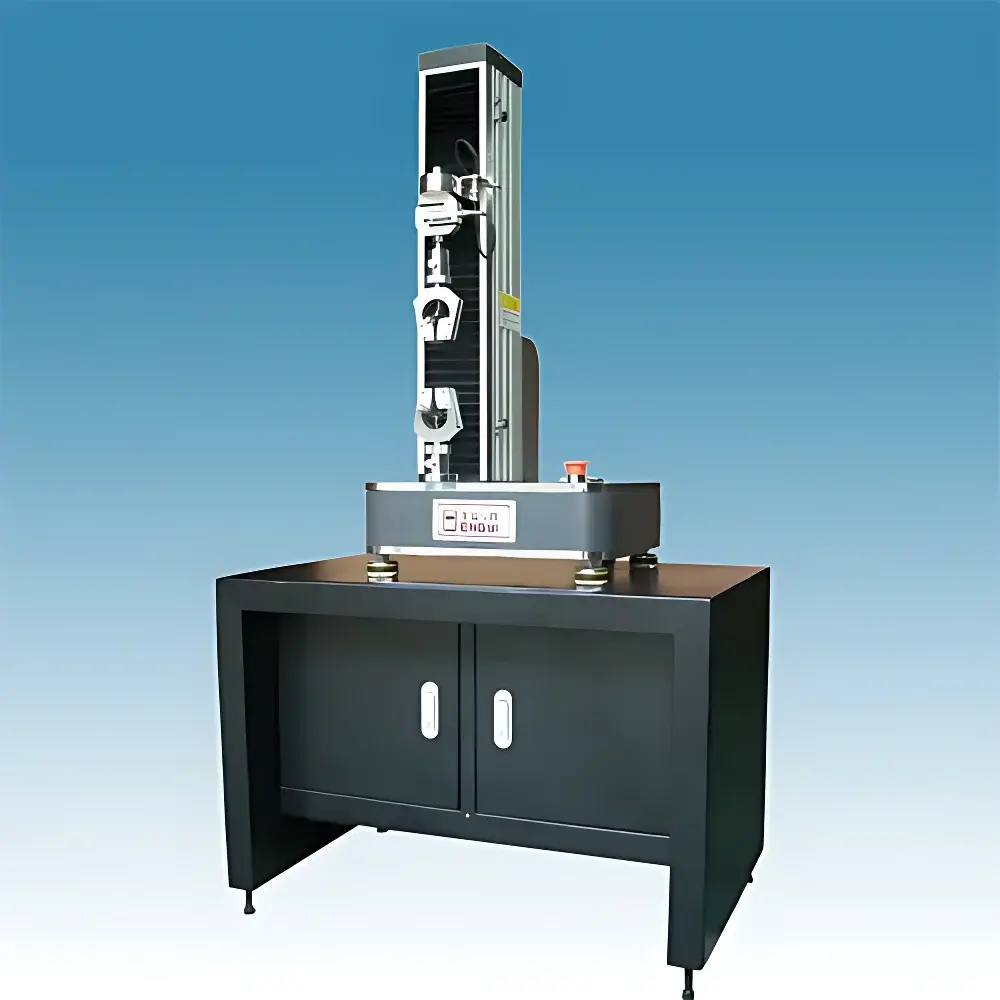
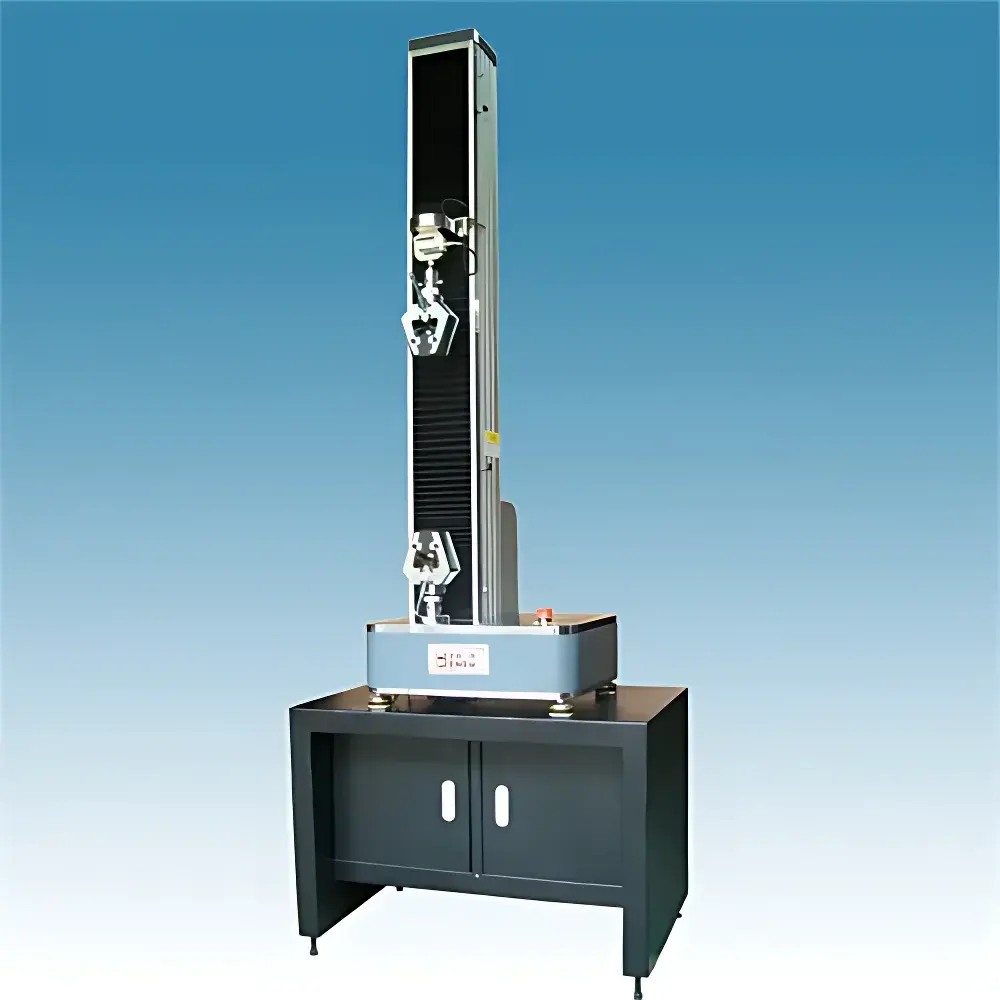
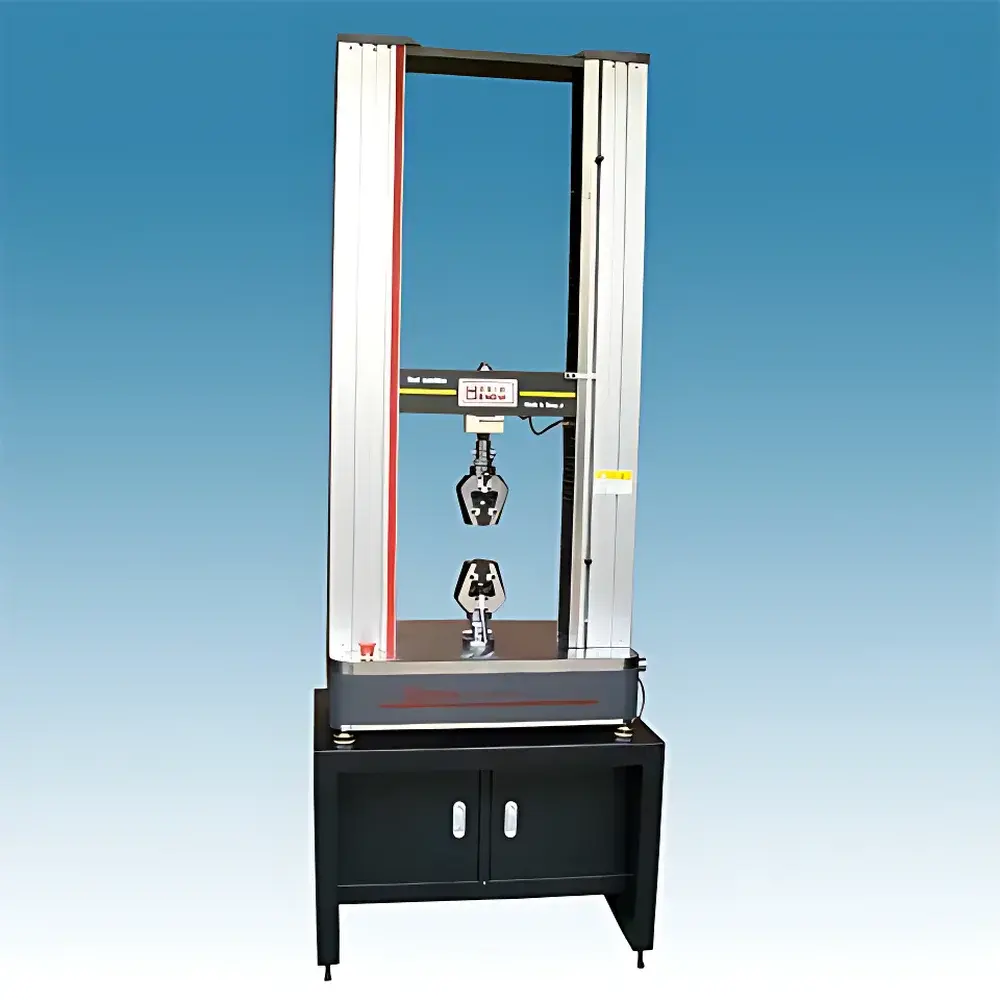
Hengyi HY-0580UIKMM Single-Column Micro-Force Tensile Testing Machine
| Brand | Hengyi |
|---|---|
| Origin | Shanghai, China |
| Manufacturer Type | Direct Manufacturer |
| Product Category | Domestic |
| Model | HY-0580UIKMM |
| Instrument Type | Electromechanical Tensile Tester |
| Max Test Load | 5 kN |
| Force Measurement Range | 0.1–100% of Full Scale |
| Force Accuracy Class | 0.5 |
| Test Stroke | 800 mm |
| Displacement Resolution | 0.001 mm |
| Load Cell Capacity | 1 N (with extended range up to 5 kN) |
| Effective Test Width | 120 mm |
| Speed Range | 0.001–500 mm/min |
| Speed Accuracy | ±0.5% of indicated value |
| Displacement Accuracy | ±0.5% of indicated value |
| Stress/Strain Control Rate Range | 0.002–6 %FS/s |
| Constant-Load/Displacement/Deformation Control Range | 0.5–100% FS |
| Power Supply | 220 V AC, 50 Hz, 750 W |
| Dimensions (W×D×H) | 470 × 400 × 1510 mm |
| Weight | 100 kg |
Overview
The Hengyi HY-0580UIKMM is a precision-engineered single-column electromechanical tensile testing machine designed for micro-force mechanical characterization of low-stiffness and low-load materials. It operates on the principle of controlled displacement actuation via a high-resolution servo-motor-driven lead screw system, coupled with real-time force feedback from a calibrated load cell. The instrument delivers traceable force measurement down to 1 N full-scale (with optional calibration traceability to national metrological standards), making it suitable for evaluating delicate specimens where conventional universal testers lack resolution or introduce excessive inertial loading. Its modular architecture supports both static and quasi-static mechanical tests—including tension, compression, bending, peel (90° and 180°), shear, tear, and adhesion—across a wide spectrum of compliant and quasi-brittle materials.
Key Features
- Single-column rigid frame with optimized stiffness-to-weight ratio, minimizing parasitic deflection during sub-newton force measurements
- High-resolution displacement encoder (0.001 mm resolution) and dual-range load sensing (1 N base capacity, scalable to 5 kN) enabling seamless transition from micro-force to medium-force testing
- Wide speed range (0.001–500 mm/min) with closed-loop velocity control accuracy of ±0.5% of setpoint, supporting both creep and high-strain-rate protocols
- Integrated electronic limit protection, emergency stop circuitry, and automatic overload shutdown (>110% FS) compliant with IEC 61000-4 electromagnetic compatibility requirements
- Modular fixture interface (ISO 2041-compliant mounting pattern) allowing rapid interchange of grips, peel fixtures, puncture probes, and custom tooling without recalibration
- Real-time stress/strain rate control modes with programmable ramp-hold profiles, supporting ASTM D882 (thin plastics), ISO 527-3 (films), and USP (adhesive tapes) test sequences
Sample Compatibility & Compliance
The HY-0580UIKMM accommodates specimens ranging from ultra-thin polymer films (<5 µm), electrospun nanofibers, biomedical hydrogels, and adhesive-coated substrates to flexible printed electronics and textile yarns. Its 120 mm effective test width and 800 mm vertical travel enable standardized specimen geometries per ISO 527-2 Type 1BA, ASTM D638 Type IV, and JIS K7113. The system meets mechanical safety requirements per EN ISO 12100 and incorporates hardware-based interlocks aligned with CE Machinery Directive 2006/42/EC. Software-generated test reports include audit trails, user authentication logs, and timestamped raw data files—supporting GLP/GMP environments and FDA 21 CFR Part 11 compliance when deployed with validated software configuration.
Software & Data Management
Bundled Hengyi TestSuite v4.2 provides intuitive test method creation, real-time parameter monitoring, and automated curve annotation (load vs. displacement, stress vs. strain, modulus derivation). All acquired data are stored in vendor-neutral CSV and XML formats, with embedded metadata including calibration certificate IDs, environmental conditions (temperature/humidity timestamps), and operator credentials. The software supports batch processing of multiple specimens under identical protocols, statistical summary generation (mean, SD, CV%), and export to LIMS-compatible schemas. Optional API integration enables direct data ingestion into enterprise quality management systems (QMS) such as TrackWise or MasterControl.
Applications
- Mechanical validation of medical device components: suture tensile strength, catheter kink resistance, hydrogel swelling modulus
- Quality control of packaging materials: peel adhesion of laminated pouches, seal integrity of blister foils, puncture resistance of stretch films
- R&D of advanced textiles: yarn elongation at break, woven fabric tensile anisotropy, nonwoven bond strength
- Nanomaterial characterization: CNT/polymer composite film fracture toughness, graphene oxide membrane tensile yield behavior
- Electronics manufacturing: solder joint shear strength, flexible PCB bend endurance, conductive ink line integrity
- Academic research: viscoelastic modeling of biopolymers, time-dependent deformation of soft robotics actuators, interfacial delamination kinetics
FAQ
What is the minimum resolvable force for this system?
The base configuration includes a 1 N load cell with 500,000-count internal resolution, yielding theoretical force resolution of 2 µN. Actual usable resolution depends on environmental noise floor and specimen gripping stability.
Can the system perform cyclic loading tests?
Yes—TestSuite v4.2 supports multi-segment waveform programming, including sinusoidal, triangular, and trapezoidal load/displacement cycles with dwell periods, peak amplitude control, and cycle termination conditions (e.g., stiffness degradation >15%).
Is third-party calibration certification available?
Hengyi provides NIST-traceable calibration certificates (ISO/IEC 17025 accredited labs) for force, displacement, and speed subsystems, with optional on-site verification services.
Does the machine support ASTM D3479 (adhesive peel testing)?
Yes—the standard 90° and 180° peel fixtures are included, and the software contains preconfigured methods referencing ASTM D3479, ISO 8510-2, and FINAT FTM 1.
What maintenance intervals are recommended?
Lubrication of the lead screw assembly every 6 months; annual verification of encoder linearity and load cell hysteresis; biannual inspection of grip jaw wear surfaces and alignment tolerances per ISO 7500-1 Annex B.



