
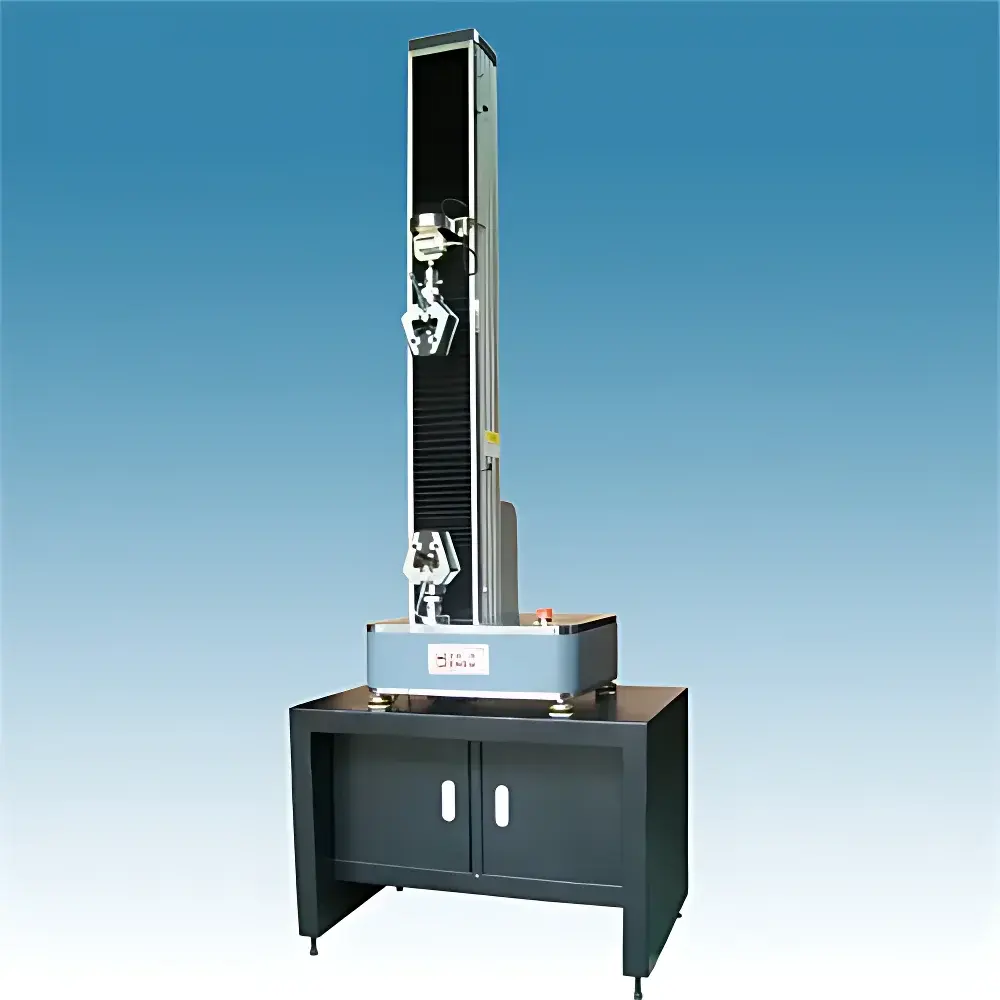
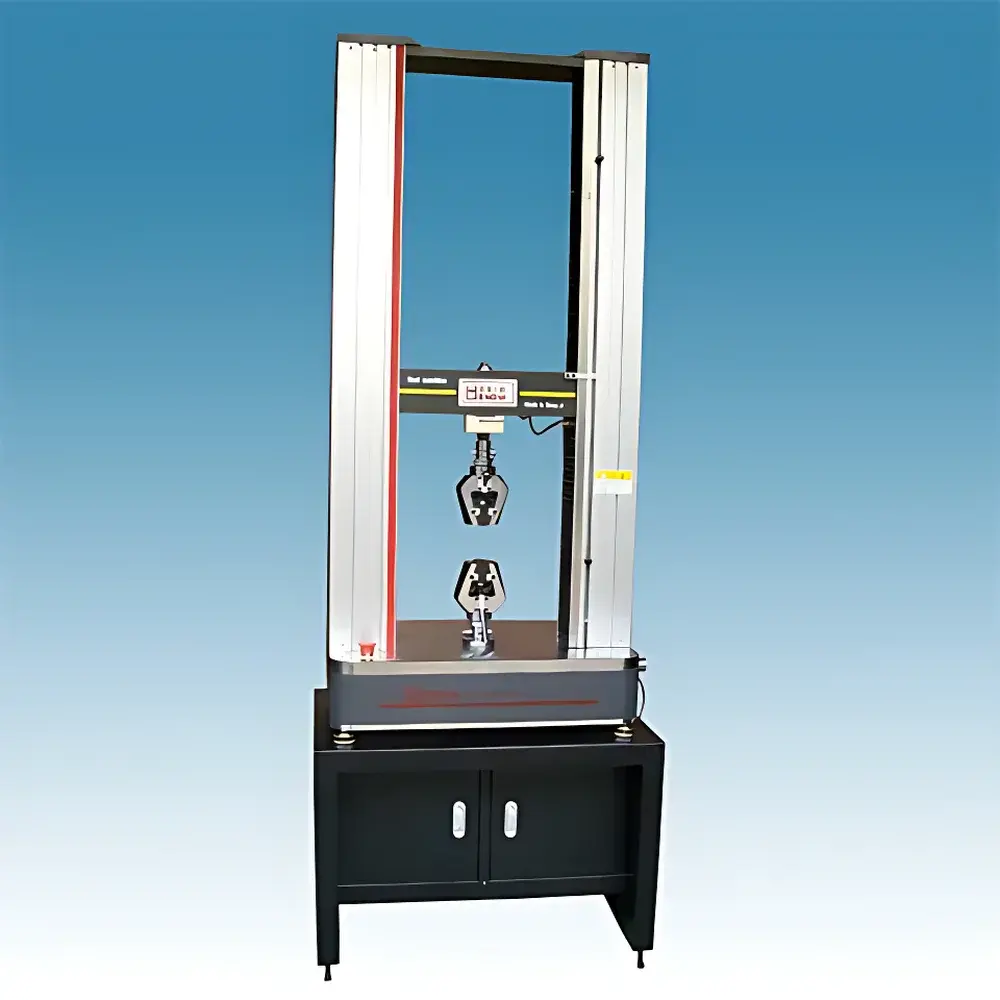
Hengyi HY-0580ERT High-Precision Electronic Universal Testing Machine
| Brand | Hengyi |
|---|---|
| Origin | Shanghai, China |
| Manufacturer Type | Direct Manufacturer |
| Regional Category | Domestic (China) |
| Model | HY-0580ERT |
| Instrument Type | Electronic Universal Testing Machine |
| Load Capacity Options | 1 N to 5000 N (interchangeable load cells) |
| Accuracy Class | ≤0.5% of full scale |
| Effective Test Width | 120 mm |
| Effective Vertical Travel | 800 mm |
| Speed Range | 0.001–500 mm/min (adjustable) |
| Speed Accuracy | ±0.5% of indicated value |
| Displacement Measurement Accuracy | ±0.5% of indicated value |
| Strain Measurement Accuracy | ±0.5% of indicated value |
| Stress/Strain Control Rate Range | 0.002–6% FS/s |
| Load Resolution | ±500,000 counts (full-scale, no range switching) |
| Power Supply | 220 V AC, single-phase, 750 W |
| Net Weight | 95 kg |
| Dimensions (W×D×H) | 470 × 400 × 1510 mm |
Overview
The Hengyi HY-0580ERT is a high-precision electronic universal testing machine engineered for static mechanical characterization of metallic, polymeric, composite, and biological materials under tension, compression, bending, shear, peel, tear, creep, stress relaxation, and cyclic loading conditions. Based on servo-controlled electromechanical actuation and high-fidelity force-displacement transduction, the system complies with fundamental principles defined in ISO 7500-1 (static calibration of force-proving instruments), ASTM E4 (load verification of testing machines), and ISO 5893 (tensile testing machine verification). Its modular architecture supports interchangeable load cells (1 N to 5000 N), enabling traceable measurement across six orders of magnitude without range switching—critical for validating low-force hydrogels and high-strength metallic foils within a single platform. The machine operates under closed-loop control of stress, strain, or displacement rates per ISO 6892-1 and ASTM D638/D790/D3410 standards, delivering reproducible data required for regulatory submissions in medical device, pharmaceutical packaging, and renewable energy applications.
Key Features
- 0.5-class accuracy certified per ISO 7500-1, with force resolution up to 1 part in 500,000 full-scale counts—ensuring high signal-to-noise ratio even at sub-newton loads.
- Wide speed range (0.001–500 mm/min) with ±0.5% speed fidelity, supporting quasi-static biomaterial testing and rapid industrial QA screening.
- Dual-mode motion control: fast manual positioning (for setup) and precision programmable traversal (for test execution), both governed by integrated electronic limit protection.
- Auto-return functionality—configurable to return to home position either manually at high speed or automatically post-test—minimizing operator intervention.
- Comprehensive safety architecture: overload cutoff at 110% FS, real-time diagnostic monitoring of drive voltage/current, thermal status, and encoder feedback integrity.
- Modular fixture interface compatible with pneumatic, hydraulic, and manual grips—including specialized fixtures for thin films, fine wires (down to 50 µm diameter), photovoltaic ribbons, and soft hydrogels.
Sample Compatibility & Compliance
The HY-0580ERT accommodates diverse specimen geometries and mechanical behaviors—from ultra-soft hydrogels (G′ ≈ 0.1–10 kPa) and elastomeric adhesives to high-modulus copper foils (E > 100 GPa) and sintered metal components. Validated sample categories include: biomedical hydrogels, polymer films (<100 µm), rubber compounds, aluminum/copper foils, photovoltaic interconnect ribbons, solar cell laminates, surgical staples, infusion tubing, foam cores, paperboard, wood veneers, textile fibers, and composite laminates. All test protocols align with mandatory compliance frameworks including ISO 179 (impact), ISO 527 (tensile), ASTM D882 (thin plastics), ASTM D3763 (high-speed impact), USP (package integrity), and ISO 10993-12 (biomaterial extraction testing). Data acquisition meets ALCOA+ criteria for auditability, with optional 21 CFR Part 11-compliant software modules available for GxP environments.
Software & Data Management
HYtest v5.2 software provides multi-axis real-time plotting (load vs. displacement, stress vs. strain, stress vs. time, strain vs. time), with overlay capability for up to eight curves using user-defined color mapping. The analysis engine calculates standardized mechanical parameters—including ReH, ReL, Rp0.2, Rm, E, A%, Z%, and modulus gradients—directly referencing ISO 6892-1, ASTM E8/E9, and GB/T 228.1. Curve annotation tools allow manual or algorithmic identification of yield points, necking onset, fracture thresholds, and hysteresis loops. Raw data exports to CSV, XML, and PDF formats preserve metadata (operator ID, timestamp, calibration certificate ID, environmental conditions). Audit trails log all parameter modifications, test aborts, and recalibrations—fully compliant with GLP and GMP documentation requirements.
Applications
- Biomedical R&D: Mechanical validation of injectable hydrogels, tissue-engineered scaffolds, and wound dressings per ISO 10993-14.
- Photovoltaic Manufacturing: Tensile strength and elongation-at-break testing of solder-coated Cu ribbons and encapsulant adhesion per IEC 61215.
- Pharmaceutical Packaging: Peel strength of blister lidding foils, seal integrity of pouches, and puncture resistance of IV bags per ASTM F88/F1140.
- Advanced Materials: Interlaminar shear strength (ILSS) of carbon fiber prepregs, tensile modulus of nanocomposite films, and cyclic fatigue of shape-memory alloys.
- Quality Assurance Labs: Routine verification of incoming raw materials (e.g., polymer granules, metal strips) against internal specifications and supplier certificates.
FAQ
What load cell options are supported?
The HY-0580ERT accepts interchangeable load cells ranging from 1 N to 5000 N, all calibrated to ISO 376 and traceable to national metrology institutes.
Is the system compatible with third-party environmental chambers?
Yes—the machine features standardized mounting interfaces and analog/digital I/O ports for synchronization with temperature-humidity chambers (–70 °C to +250 °C) and liquid immersion stages.
Can test methods be exported and shared across laboratories?
Test method files (.hym) include full control logic, sampling rates, stop conditions, and calculation definitions—enabling cross-site method harmonization and inter-laboratory comparison studies.
Does the system support ASTM E23 standard for notch toughness testing?
While primarily configured for uniaxial tests, optional pendulum adapters and specialized fixtures enable Charpy/Izod impact mode per ASTM E23 when integrated with external drop-weight systems.
How is calibration maintained over time?
Built-in self-diagnostic routines verify encoder linearity, amplifier offset drift, and motor torque response daily; annual third-party verification follows ISO/IEC 17025 procedures.



