
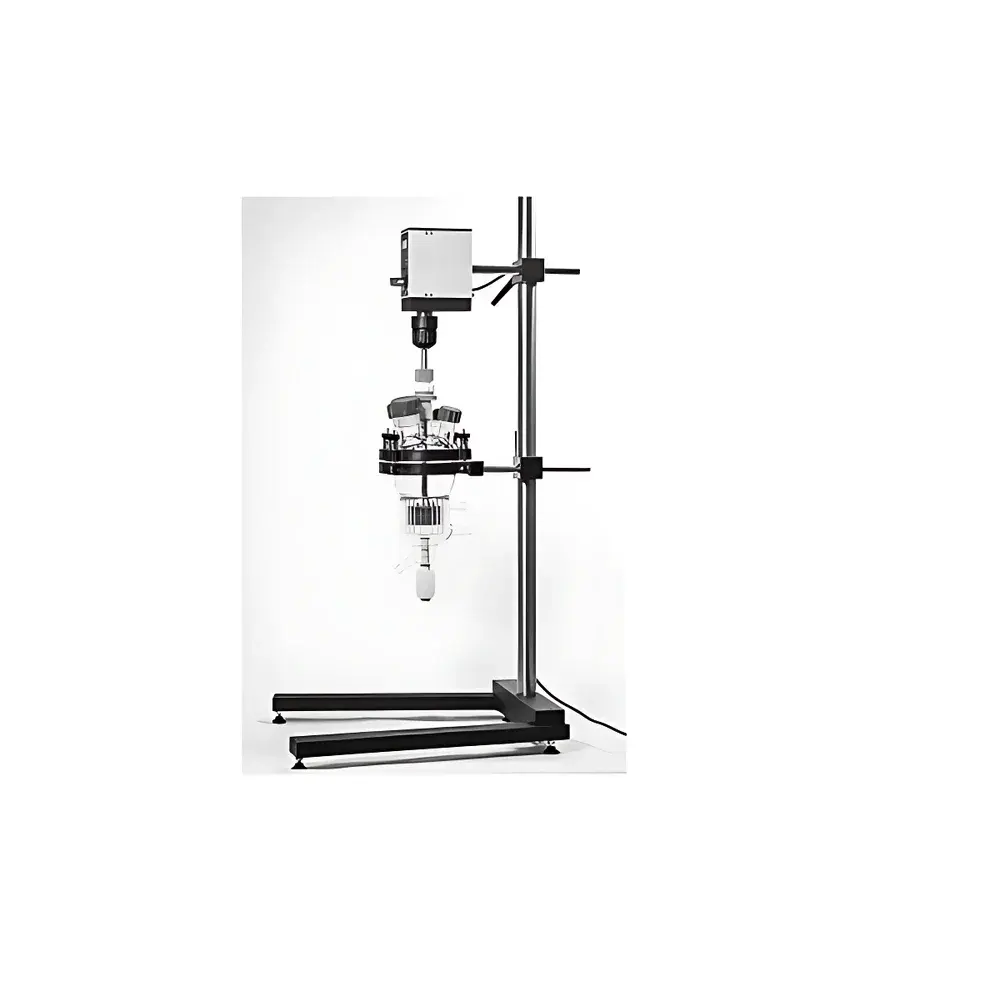
SpinChem S2 Mechanical Rotating Bed Enzyme Reactor
| Brand | SpinChem |
|---|---|
| Origin | Sweden |
| Model | S2 |
| Construction Material | Stainless Steel |
| Working Pressure | Medium-Pressure |
| Volume Capacity | 100–500 mL |
| Rotating Bed Dimensions | Ø45 mm × 30 mm (H), Volume: 28 mL, Mesh Pore Size: 104 µm, Shaft Length: 38 cm, Shaft Diameter: 10 mm, Net Weight: 85 g (317 g with shaft) |
| Rotation Direction | Clockwise |
| Speed Range | 300–1000 rpm (up to 500 rpm with shaft guide) |
| Vacuum Compatibility | 10–40 MPa (custom configuration required) |
Overview
The SpinChem S2 Mechanical Rotating Bed Enzyme Reactor is an engineered platform for heterogeneous biocatalytic and chemocatalytic reactions under controlled laboratory conditions. Based on the rotating bed reactor (RBR) principle, the S2 system enables efficient mass transfer between immobilized solid-phase catalysts—such as enzyme-loaded resins, cross-linked cells, ion-exchange media, or heterogeneous catalysts—and liquid-phase substrates without requiring filtration or centrifugation post-reaction. Its core mechanism relies on hydrodynamic circulation: as the stainless-steel rotating bed spins within a standard reaction vessel, solution is drawn radially inward through the porous wall (104 µm pore size), percolates through the packed solid phase, and is expelled outward by centrifugal force—establishing continuous, uniform contact between phases. This design eliminates stagnant zones and minimizes shear stress on sensitive biocatalysts while delivering high reproducibility in kinetic profiling and parameter screening.
Key Features
- Modular stainless-steel rotating bed (Ø45 mm × 30 mm H, 28 mL internal volume) with precisely engineered 104 µm mesh for optimal flow resistance and particle retention.
- Four independent compartments within the rotating bed allow parallel evaluation of multiple catalysts, supports, or reaction conditions in a single run.
- Compatible with standard cylindrical glass or stainless-steel reactors (100–500 mL volume), enabling seamless integration into existing lab workflows.
- Direct coupling to commercial overhead stirrers via standardized 10 mm shaft; operational speed range 300–1000 rpm (500 rpm maximum when using shaft guide for enhanced stability).
- No post-reaction solid–liquid separation required—catalyst remains fully contained within the rotating bed, permitting rapid sampling and uninterrupted reaction monitoring.
- Designed for medium-pressure operation and compatible with vacuum-assisted configurations (10–40 MPa range, subject to custom engineering review and safety validation).
Sample Compatibility & Compliance
The S2 reactor accommodates a broad spectrum of solid-phase biocatalysts and adsorbents, including epoxy-activated methacrylate resins (hydrophilic/hydrophobic variants), amino-functionalized carriers, octadecyl-modified matrices, macroporous styrene–divinylbenzene (DVB) copolymers, and microencapsulated whole-cell systems. All contact surfaces are electropolished 316 stainless steel, compliant with ISO 8502-3 for surface cleanliness and suitable for GMP-aligned process development. While the S2 itself is not certified to specific regulatory standards, its modular, traceable construction supports audit-ready documentation for GLP/GMP environments—particularly when paired with validated stirring systems and calibrated temperature control units. The absence of moving seals or dynamic gaskets enhances long-term reliability and simplifies cleaning validation protocols.
Software & Data Management
The S2 is a hardware-only platform and does not include embedded electronics or proprietary software. It is intended for use with third-party laboratory infrastructure: programmable stirrers with speed logging, external temperature controllers with RS-232/USB output, and digital sampling interfaces. Reaction data—including time-stamped sampling points, pH/conductivity readings, and offline analytical results (e.g., HPLC, UV-Vis)—can be aggregated in LIMS or ELN systems compliant with 21 CFR Part 11 requirements when integrated with audit-trail-enabled instruments. SpinChem provides detailed mechanical specifications, dimensional drawings (STEP/IGES), and application notes to support IQ/OQ protocol development for regulated laboratories.
Applications
The S2 reactor serves as a scalable tool for early-stage reaction engineering across enzymology, synthetic biology, and fine chemical synthesis. Typical use cases include: optimization of immobilized enzyme activity vs. pH, temperature, and substrate concentration; comparative screening of carrier chemistries (e.g., epoxy vs. amino vs. hydrophobic acrylate resins); kinetic modeling of solid–liquid interfacial reactions; continuous-flow mode adaptation using recirculating pump configurations; ion-exchange equilibrium studies under dynamic conditions; and multi-step cascade reactions where compartmentalized catalysts prevent mutual deactivation. Its small footprint and low reagent consumption (100–500 mL batch volume) make it especially valuable for high-value substrate screening and DOE-based experimental design.
FAQ
Can the S2 rotating bed be autoclaved?
Yes—the stainless-steel body and shaft are autoclavable at 121 °C, 2 bar for 20 minutes. Resin or enzyme loading must be performed post-sterilization.
Is the 104 µm pore size fixed, or can alternative meshes be supplied?
The standard S2 uses a laser-cut 104 µm mesh. Custom pore sizes (e.g., 50 µm or 200 µm) are available upon request, subject to mechanical integrity verification.
What torque requirements apply when operating at 1000 rpm?
A minimum torque of 0.5 N·m is recommended for stable rotation at ≥800 rpm; consult your stirrer manufacturer’s specifications for compatibility.
How is leakage prevented at the shaft–vessel interface?
The S2 operates without a sealed feedthrough; the shaft rotates freely through the vessel opening. For vacuum or pressurized operation, a custom-machined flange with Viton O-ring seal is required and must be specified during ordering.
Does SpinChem provide application support for method development?
Yes—SpinChem offers technical documentation, peer-reviewed case studies, and remote consultation for experimental design, though instrument commissioning and validation remain the responsibility of the end user.
Related Products



