
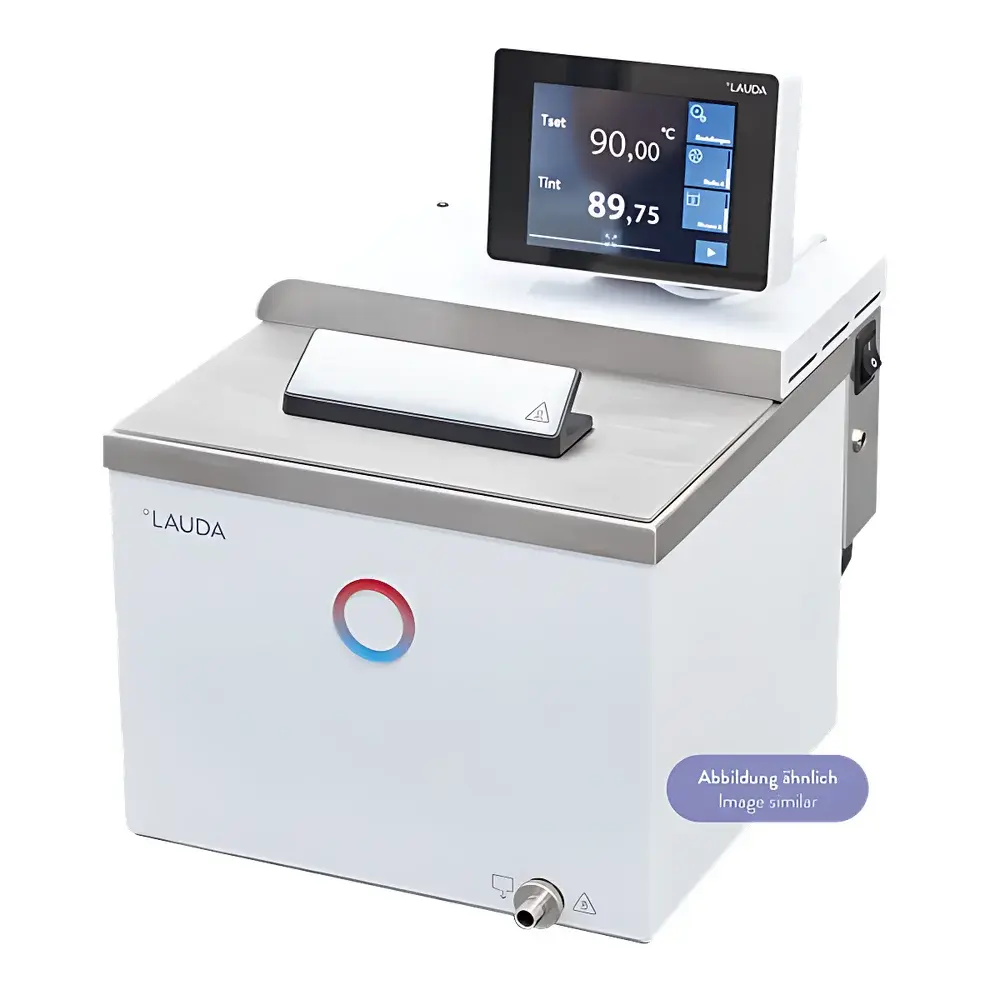
LAUDA PRO P 20 C Heated Circulating Bath (35–250 °C, ±0.01 °C Stability)
| Brand | LAUDA |
|---|---|
| Origin | Germany |
| Model | P 20 C |
| Bath Volume | 20.0 L |
| Temperature Range | 35–250 °C |
| Temperature Stability | ±0.01 °C |
| Circulation | Internal & External |
| Cooling Coil | Integrated |
| Controller | Detachable 5.7″ Multi-Touch Color Display |
| Power Supply | 100–120 V, 50/60 Hz |
| Max. Heating Power | 1.85 kW |
| Bath Dimensions (W×D×H) | 300 × 290 × 200 mm |
| Overall Dimensions (W×D×H) | 350 × 475 × 415 mm |
| Weight | 20 kg |
| Compliance | CE, RoHS, IEC 61010-1 |
Overview
The LAUDA PRO P 20 C is a high-precision, microprocessor-controlled heated circulating bath engineered for demanding laboratory and industrial applications requiring stable thermal environments from 35 °C to 250 °C. Unlike conventional immersion baths, the P 20 C employs a fully electronic PID controller with dual-loop capability—supporting both internal bath temperature regulation and external process temperature control via integrated Pt100 sensor inputs. Its stainless-steel insulated bath (300 × 290 × 200 mm) holds up to 20.0 L of heat-transfer fluid—including Therm 250 oil—and features a built-in Varioflex circulation pump with eight adjustable flow stages, enabling precise delivery of thermally conditioned fluid to external reactors, jacketed vessels, or analytical instrumentation. The system’s ±0.01 °C temperature stability—verified under steady-state conditions at mid-range setpoints—is achieved through adaptive power management (PowerAdapt), real-time thermal load compensation, and an integrated cooling coil that permits extended low-end operation down to 20 °C when paired with an external chiller. Designed for continuous duty in controlled environments (5–40 °C ambient), the unit complies with IEC 61010-1 for electrical safety and carries CE and RoHS markings.
Key Features
- Detachable 5.7-inch multi-touch color display with 360° rotational mounting—enables ergonomic access and remote panel placement without signal degradation
- Full-featured programmable controller supporting up to 100 multi-segment protocols (50 segments per program), including ramp-soak-hold profiles and time-based event triggers
- Built-in cooling coil compatible with external chillers for expanded operational range (20–250 °C) and enhanced thermal recovery performance
- Varioflex circulation pump with eight discrete flow-rate settings and pressure-independent output—optimized for variable head losses in complex external loops
- User management system supporting up to 20 distinct operator profiles with role-based access control for critical functions (e.g., parameter modification, calibration override)
- Dual communication architecture: standard Ethernet (TCP/IP) and USB 2.0 for data logging, firmware updates, and remote monitoring; optional field-upgradable interfaces include RS232/485, Profibus DP, EtherCAT, analog I/O, and dry-contact modules
- Comprehensive safety suite: adjustable low-temperature overheat protection with audible alarm, automatic self-diagnostic routines, and fail-safe shutdown on sensor disconnect or thermal runaway detection
- Stainless-steel bath with insulated walls, ergonomic handles, drain valve, and two G3/8″ threaded ports (10 mm bore) for seamless integration into closed-loop systems
Sample Compatibility & Compliance
The P 20 C accommodates a broad spectrum of heat-transfer media—including water, silicone oils, glycols, and high-temperature synthetic fluids such as Therm 250—subject to flash point and viscosity constraints defined in LAUDA’s Fluid Compatibility Guidelines. Its sealed bath design and non-sparking electronics meet requirements for use with flammable liquids under Class I, Division 2 hazardous location recommendations (per NEC Article 500). All firmware and controller logic are developed in accordance with IEC 62304 for medical device software lifecycle management. While not certified for FDA 21 CFR Part 11 out-of-the-box, audit-ready data export (CSV, XML) via USB/Ethernet supports GLP/GMP-aligned documentation workflows. The unit conforms to ISO/IEC 17025 metrological traceability principles when operated with calibrated Pt100 sensors and validated against NIST-traceable references.
Software & Data Management
The embedded controller provides native support for time-stamped temperature logging at user-defined intervals (1 s to 60 min), with up to 16,000 data points stored internally. Export is performed via USB mass-storage mode or Ethernet FTP/SFTP—preserving full metadata (setpoint, actual value, pump speed, alarm status, timestamp, user ID). Optional LAUDA LabSoft software (Windows-based) enables real-time graphical monitoring, multi-device synchronization, automated report generation (PDF/Excel), and integration with LIMS platforms via OPC UA or Modbus TCP. All configuration changes, parameter edits, and alarm events are recorded in a non-volatile audit trail compliant with ALCOA+ principles—supporting retrospective review during regulatory inspections.
Applications
- Calibration of temperature-sensitive instrumentation (e.g., IR thermometers, RTD probes, thermocouple simulators) across extended ranges
- Thermal conditioning of spectrophotometer cells, viscometers, and differential scanning calorimeters (DSC)
- Controlled heating of jacketed glass reactors in synthetic chemistry and polymerization studies
- Stability testing of pharmaceutical formulations per ICH Q1A(R3) guidelines using accelerated aging protocols
- Material testing per ASTM D5215 (viscosity of asphalt binders) and ISO 3219 (rheological behavior of polymer solutions)
- Pre-conditioning of samples prior to mechanical testing (e.g., tensile, impact) in accordance with ASTM D638 and ISO 527
FAQ
Can the P 20 C operate with water above 100 °C?
Yes—when used under sealed, pressurized external loop conditions or with deaerated, inhibited water formulations; however, LAUDA recommends Therm 250 or equivalent high-boiling synthetic fluids for sustained operation above 100 °C.
Is external cooling required to reach the minimum operating temperature of 20 °C?
Yes—the integrated cooling coil must be connected to a recirculating chiller or tap-water source to achieve sub-ambient temperatures; the base unit alone supports 35–250 °C.
Does the detachable controller retain settings when removed?
Yes—all configuration parameters, programs, and user profiles are stored in non-volatile memory on the main controller board—not the display unit.
What is the maximum allowable backpressure for external circulation?
The Varioflex pump delivers up to 1.2 bar (17 psi) maximum static pressure at lowest flow setting; system design must account for total dynamic head, including tubing length, fittings, and heat exchanger resistance.
How often does the system require recalibration?
LAUDA recommends annual verification using a NIST-traceable reference thermometer; field calibration of the internal Pt100 sensor can be performed via the service menu using a certified secondary standard.



