
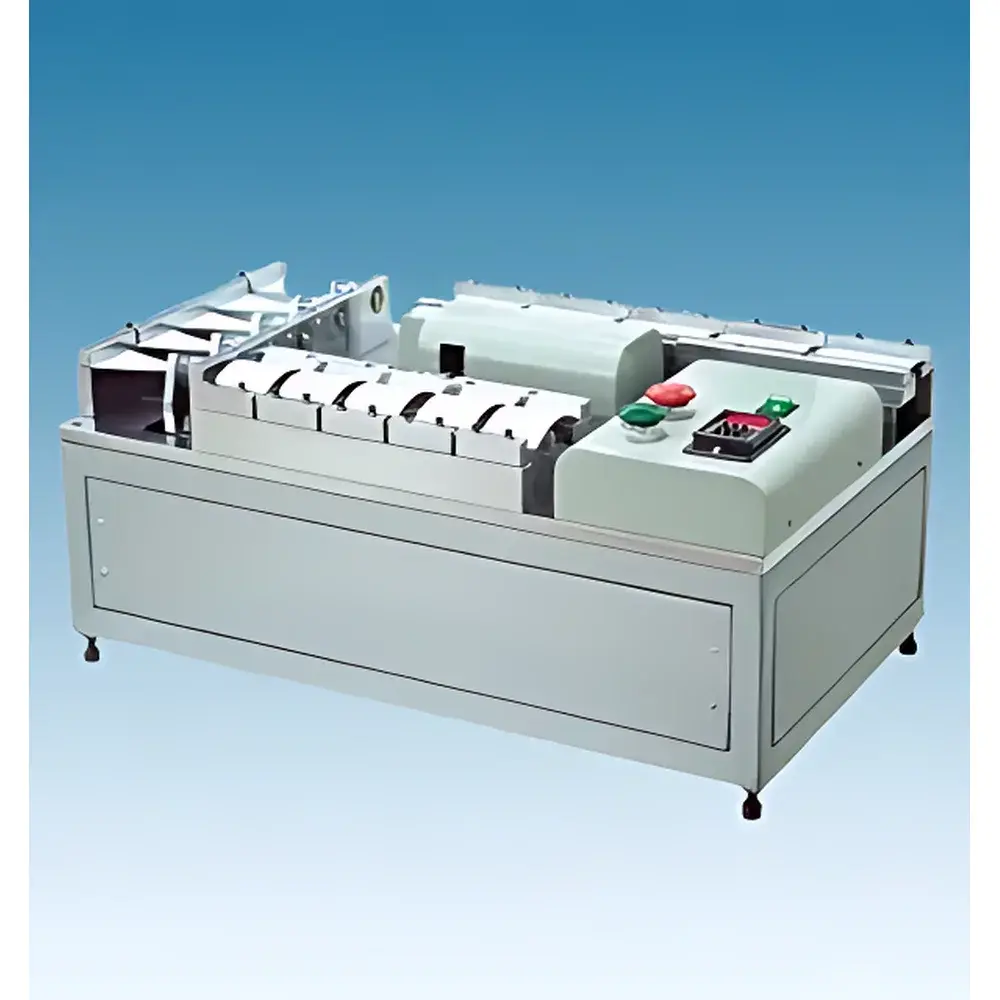
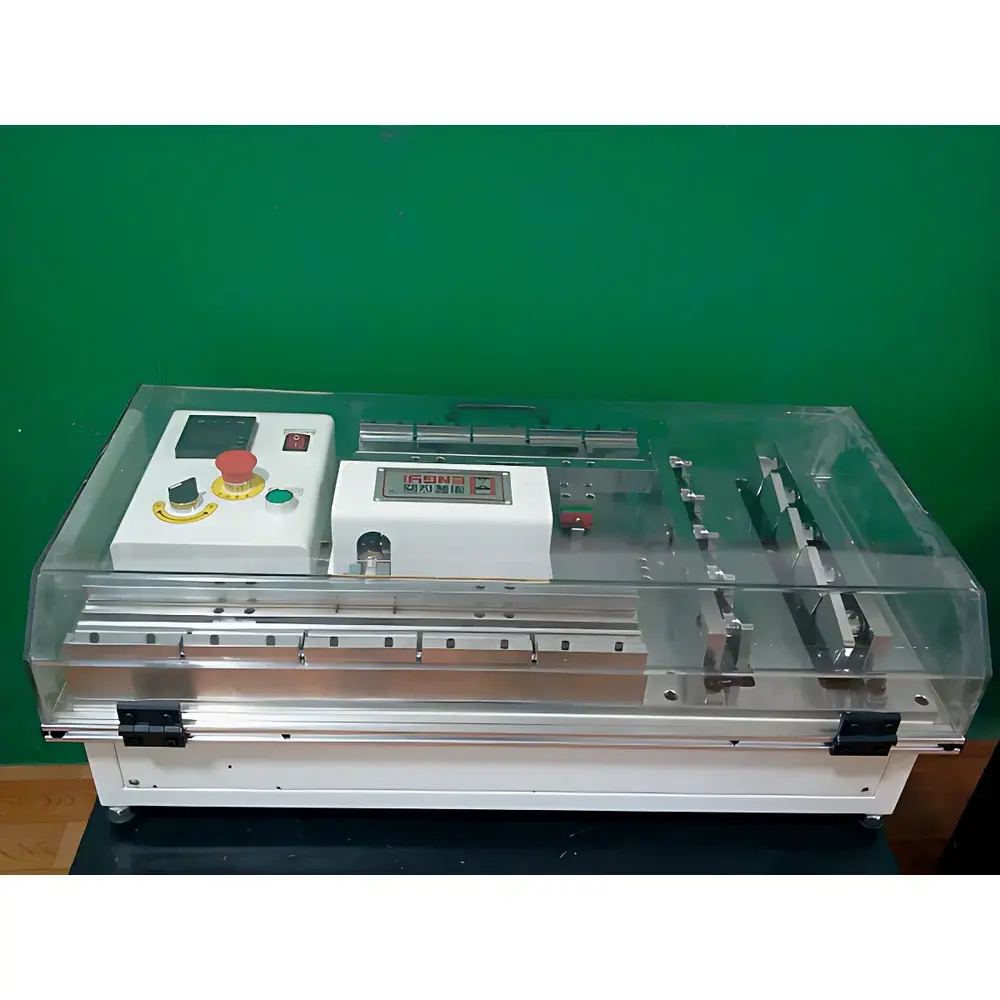
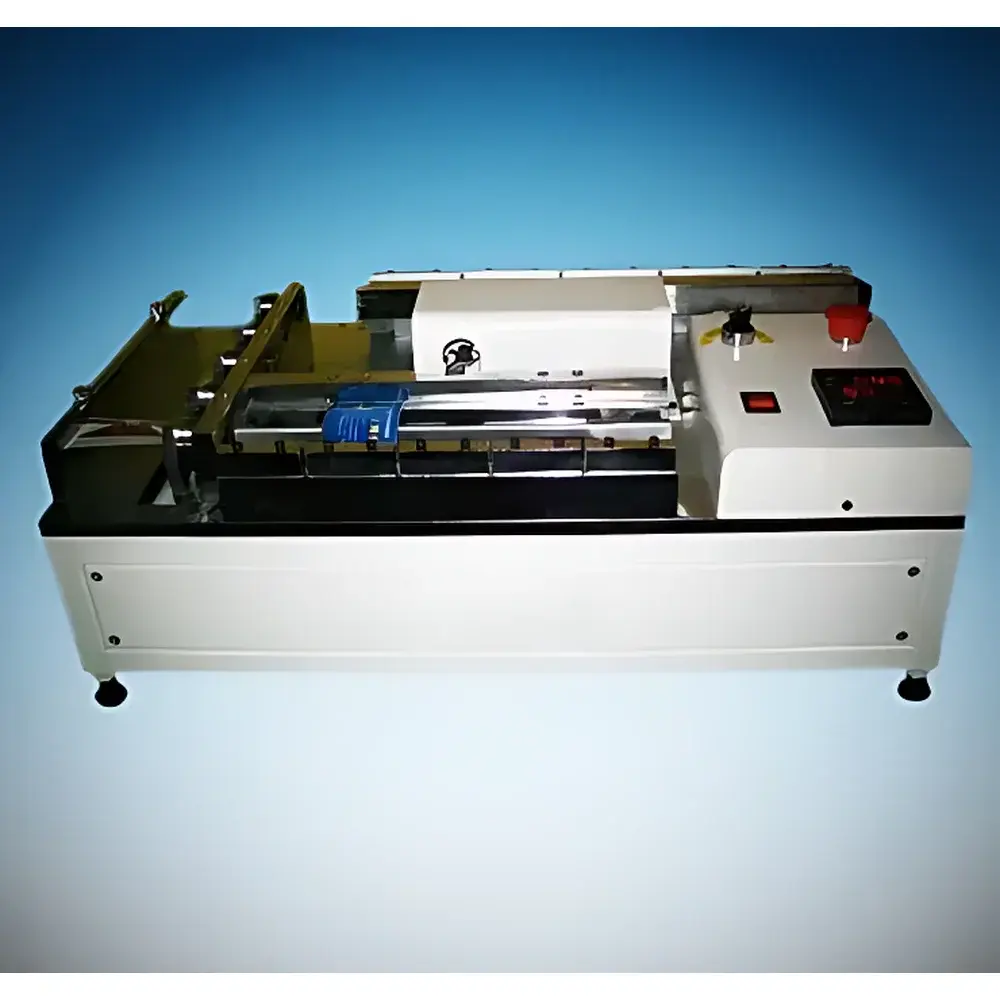
Hengyi HY(IC)E Dynamic Bending and Torsion Fatigue Testing Machine for Smart Cards
| Brand | Hengyi |
|---|---|
| Origin | Shanghai, China |
| Manufacturer Type | Direct Manufacturer |
| Country of Origin | China |
| Model | HY(IC)E |
| Price Range | USD 1,400 – 2,800 (FOB Shanghai) |
| Max Torque | 1 N·m |
| Torque Measurement Range | 0.1–1 N·m |
| Torque Resolution | 0.01 N·m |
| Torsion Angle Range | ±15° (±1° accuracy), total angular displacement 30° |
| Motor Power | 0.35 kW |
| Test Speed | Bending/Torsion at 30 rpm or 0.5 Hz |
| Cycle Count Range | 1–9999 cycles |
| Long-edge Displacement | 20 mm (−1.0 / +0.0 mm), minimum 2.0 ± 0.5 mm |
| Short-edge Displacement | 10 mm (−1.0 / +0.0 mm), minimum 1.0 ± 0.5 mm |
| Fixture Mounting | Fully compliant with GB/T 16649.1, GB/T 17554.1–2006, ISO/IEC 10373, and ISO/IEC 7816-1:1998 |
| Dimensions (L×W×H) | 670 × 380 × 220 mm |
| Weight | 70 kg |
| Input Voltage | AC 220 V ±5% |
| Power Consumption | 35 W |
Overview
The Hengyi HY(IC)E Dynamic Bending and Torsion Fatigue Testing Machine is a purpose-built electromechanical test system engineered to evaluate the mechanical durability of contact and contactless integrated circuit (IC) cards—commonly referred to as smart cards—under repeated bending and torsional stress. Designed in strict accordance with international and national standards including ISO/IEC 7816-1:1998 (Identification cards — Integrated circuit cards — Part 1: Physical characteristics), ISO/IEC 10373 (Test methods for identification cards), GB/T 16649.1 (Identification cards — Integrated circuit cards — Part 1: Physical characteristics), and GB/T 17554.1–2006 (Identification cards — Test methods — Part 1: Mechanical characteristics), this machine replicates real-world handling conditions that induce fatigue failure in card substrates, embedded antennas, and silicon die interconnects. Its dual-axis actuation architecture applies controlled, synchronized bending (long-edge displacement) and torsion (angular twisting about the card’s longitudinal axis) in cyclic mode, enabling quantitative assessment of structural integrity over defined service lifetimes.
Key Features
- High-fidelity dual-motion actuation: Independent yet coordinated control of bending displacement (0–20 mm, resolution ±0.5 mm) and torsional angle (±15°, accuracy ±1°), ensuring traceable compliance with ISO/IEC 10373 Clause 7 (Bending) and Clause 8 (Torsion).
- Programmable cycle control: Adjustable test count from 1 to 9999 cycles, with built-in counter logging and automatic termination upon completion or failure detection.
- Precision motion subsystem: Equipped with a Taiwan-made STK AC servo motor (0.35 kW) coupled to a high-ratio planetary gear reducer and optical encoder feedback loop, delivering stable 0.5 Hz sinusoidal or stepwise motion profiles.
- Standardized fixture interface: Card-holding jaws and support anvils conform precisely to dimensional requirements specified in GB/T 17554.1–2006 Annex A, eliminating setup variability across laboratories.
- Low-power, compact benchtop design: 35 W nominal consumption, 70 kg mass, and footprint of 670 × 380 × 220 mm enables integration into QA labs, R&D cleanrooms, and certification testing facilities without dedicated power infrastructure.
Sample Compatibility & Compliance
The HY(IC)E accommodates standard ID-1 format cards (85.6 × 53.98 × 0.76 mm) per ISO/IEC 7810, including magnetic stripe cards, contact IC cards (e.g., EMV-compliant payment cards), contactless RFID cards (13.56 MHz), and hybrid dual-interface cards. All test protocols are fully aligned with the mechanical stress verification procedures mandated by global payment schemes (EMVCo), national identity programs (e.g., China’s PKI-based e-ID), and transportation smart card consortia (e.g., CEN TC224). The system supports audit-ready documentation required under ISO/IEC 17025 accredited testing environments and satisfies preliminary mechanical qualification per ISO/IEC 15408 (Common Criteria) for secure element robustness.
Software & Data Management
While the HY(IC)E operates via hardware-integrated digital controls (no PC dependency), it provides TTL-level output signals for external data acquisition systems. Cycle count, motor status, and limit-switch triggers are accessible via DB9 I/O port for integration with LabVIEW, Python-based test orchestration platforms, or MES/QMS systems. Optional firmware upgrade enables timestamped event logging (start/stop/failure) compatible with GLP/GMP traceability requirements. All calibration parameters—including torque zero offset, angular encoder linearity, and displacement sensor gain—are stored in non-volatile memory and subject to periodic verification per ISO/IEC 17025 Clause 6.5.
Applications
- Pre-certification validation of smart cards prior to submission to national accreditation bodies (e.g., China National Accreditation Service for Conformity Assessment, CNAS).
- Comparative fatigue analysis of PVC, PETG, polycarbonate, and composite card substrates under identical bending-torsion load spectra.
- Failure mode investigation of delamination, antenna trace fracture, or chip detachment under accelerated mechanical aging.
- Supplier qualification testing for card personalization bureaus and secure printing facilities.
- Research on substrate–laminate interface adhesion strength and thermal-mechanical coupling effects during environmental cycling.
FAQ
Does the HY(IC)E support automated pass/fail evaluation based on physical deformation thresholds?
No—the system performs mechanical actuation and cycle counting only; visual or dimensional inspection post-test remains operator-dependent per ISO/IEC 10373 guidelines.
Can the bending and torsion motions be decoupled for independent testing?
No—its design enforces synchronized biaxial loading to replicate realistic handheld manipulation; separate uniaxial modes are not implemented.
Is calibration certification included with shipment?
A factory calibration report (traceable to Chinese national metrology standards) is supplied; ISO/IEC 17025 calibration must be arranged separately through authorized third-party labs.
What maintenance intervals are recommended for long-term reliability?
Lubrication of gear reducer every 12 months and verification of photoelectric counter alignment every 6 months are advised per the maintenance logbook provided.
Are custom fixtures available for non-ID-1 card formats (e.g., SIM-sized or wearable tokens)?
Yes—Hengyi offers OEM fixture redesign services under NDA, subject to mechanical feasibility review and lead-time confirmation.



