
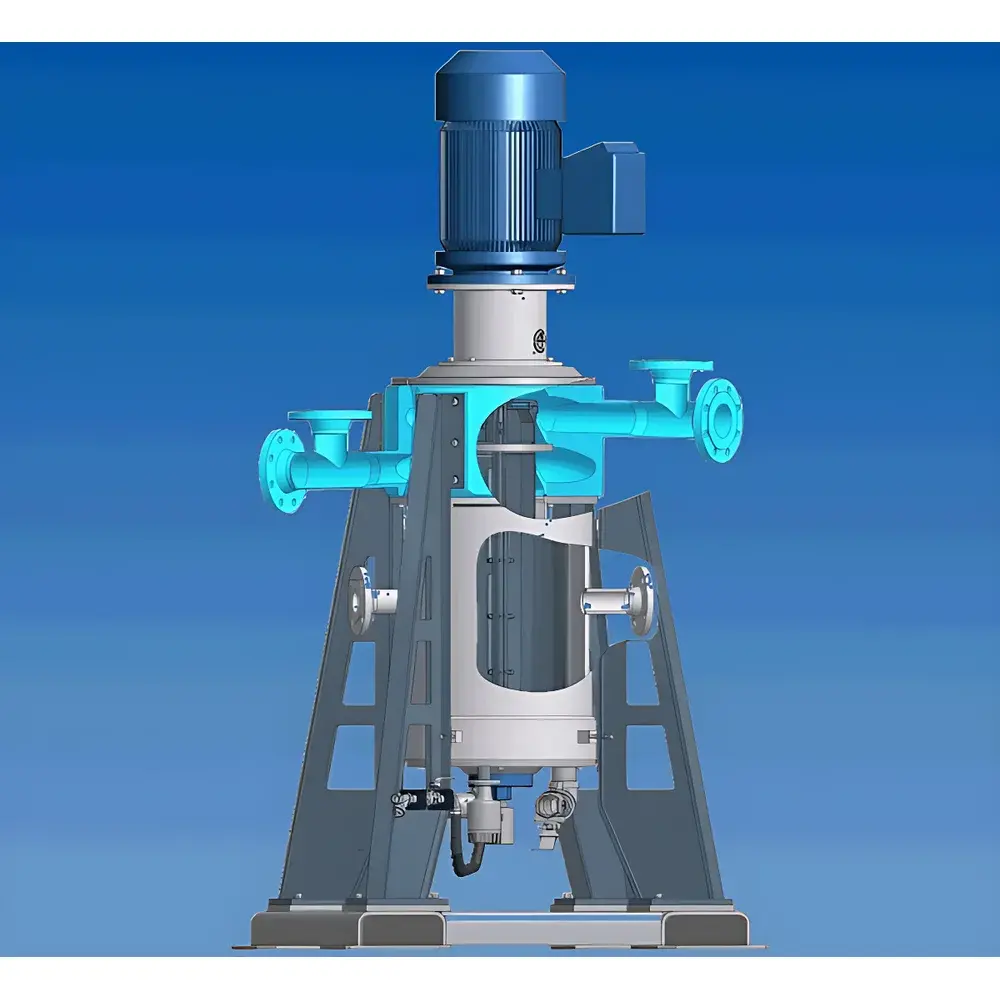
CINC V02/CS50 Annular Gap Centrifugal Extractor
| Brand | CINC (Germany) |
|---|---|
| Origin | Germany |
| Model | V02 / CS50 |
| Construction Material Options | AISI 316L stainless steel, Hastelloy C-276 |
| Flow Rate Range | 0–4000 L/h (lab rental unit), up to 30,000 L/h (industrial scale) |
| Operating Principle | Continuous annular-gap mixing + high-G centrifugal phase separation |
| Max Centrifugal Force | ≥1,000 × g |
| Compliance | ATEX Category 1D/2D (Zone 21/22), cGMP-compliant surface finish (Ra ≤ 0.4 µm), FDA 21 CFR Part 11–ready software architecture |
| Cleaning & Sterilization | Integrated CIP (Clean-in-Place) and SIP (Steam-in-Place) capability |
| Modular Configuration | Single-stage (1 theoretical plate) or multi-stage counter-current/cross-flow cascade (up to 5+ stages) |
| Temperature Control | Optional jacketed housing with heating/cooling utility connections |
Overview
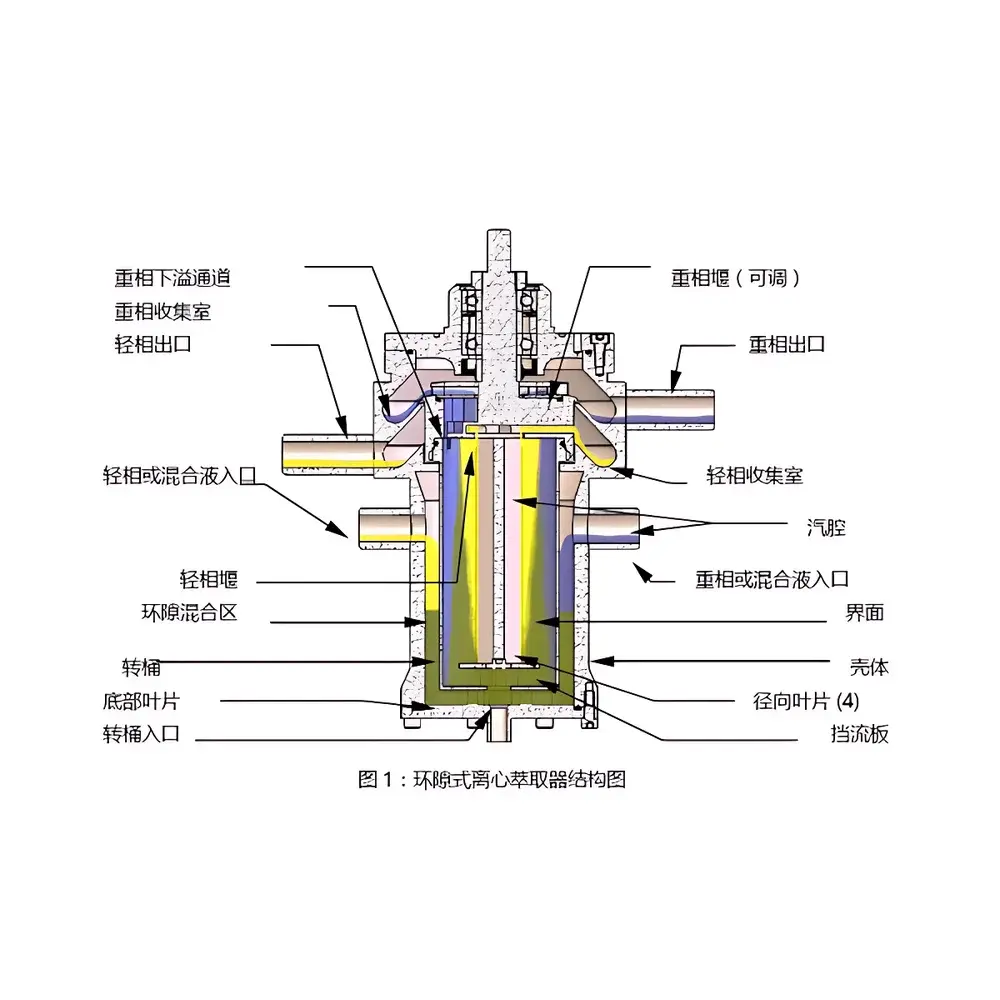
The CINC V02/CS50 Annular Gap Centrifugal Extractor is a continuous, high-intensity liquid–liquid processing system engineered for simultaneous extraction, washing (neutralization), and phase separation in a single compact unit. Unlike gravity-dependent settling or static mixer–settler systems, this device leverages controlled hydrodynamics within an annular gap—located between the rotating drum and stationary housing—to achieve rapid mass transfer, followed by immediate centrifugal separation under forces exceeding 1,000 × g. This dual-function architecture eliminates intermediate holding tanks, reduces solvent inventory by up to 40%, and cuts residence time from hours to seconds. The unit operates on the principle of Couette–Taylor flow in the mixing zone, where precisely engineered vane geometry induces turbulent yet reproducible interfacial contact; separation then occurs radially inside the drum via density-driven stratification, with phase interface position dynamically stabilized by adjustable weirs. Designed for scalability from lab-scale process development (V02) to pilot and industrial deployment (CS50), it supports direct technology transfer without re-optimization—provided physical property data (interfacial tension, density difference, viscosity ratio) are accurately characterized during bench testing.
Key Features
- Annular gap mixing zone enabling 95% theoretical stage efficiency per unit
- Modular drum design allowing configuration as extractor, washer, or pure separator via inlet port re-routing (patented flow-path switching)
- AISI 316L stainless steel construction standard; optional Hastelloy C-276 for aggressive chemistries (e.g., HCl, HF, oxidizing media)
- Electropolished internal surfaces (Ra ≤ 0.4 µm) compliant with ISO 13485 and FDA guidance for pharmaceutical manufacturing environments
- Integrated CIP/SIP manifolds with validated temperature ramp profiles (121°C, 30 min) and conductivity-based endpoint detection
- ATEX-certified explosion protection (Directive 2014/34/EU, Category 1D/2D) for Zone 21/22 dust and vapor atmospheres
- Variable-speed drive (0–6,000 rpm) with torque monitoring for real-time detection of emulsion formation or solids accumulation
Sample Compatibility & Compliance
The V02/CS50 accommodates immiscible liquid pairs with density differences as low as 0.02 g/cm³ and interfacial tensions ranging from 0.5 to 50 mN/m—including challenging systems such as aqueous–organic (e.g., phosphoric acid–kerosene), molten salt–metal, or bio-derived ester–water mixtures. It is routinely deployed in applications governed by ASTM D1298 (density), ISO 638 (viscosity), and USP (analytical instrument qualification). Full traceability is maintained through 21 CFR Part 11–compliant audit trails for all operational parameters (flow rates, rpm, temperature, pressure differentials), and validation packages include IQ/OQ protocols aligned with GAMP 5. Surface finish certification, material test reports (MTRs), and weld maps are supplied with each unit to support GMP regulatory submissions.
Software & Data Management
CINC’s proprietary EXTRACTOR CONTROL SUITE (ECS) provides deterministic real-time control via EtherCAT fieldbus integration. The system logs timestamped datasets at 10 Hz resolution—including differential pressure across the drum, phase interface level (via capacitance probe), and motor load—enabling post-run analysis of mass transfer kinetics and phase inversion thresholds. Batch records are digitally signed and archived in encrypted SQLite databases with SHA-256 hashing. Remote diagnostics and firmware updates are supported over TLS 1.3–secured connections. For clients requiring full ALCOA+ compliance, optional add-ons include electronic signatures, role-based access control (RBAC), and automated report generation in PDF/A-2b format.
Applications
- Pharmaceutical: Continuous purification of monoclonal antibody harvest streams using caprylic acid precipitation followed by centrifugal clarification and solvent extraction
- Nuclear fuel reprocessing: Selective U/Pu separation from nitric acid leachates using TBP/kerosene systems under remote-handling constraints
- Biofuels: Glycerol removal from biodiesel (FAME) via water-washing with <0.1% residual glycerol specification
- Hydrometallurgy: Solvent extraction of cobalt/nickel from sulfate leach solutions using D2EHPA extractants
- Agrochemical formulation: Removal of unreacted chlorpyrifos precursor from dichloromethane–water systems with <5 ppm aqueous carryover
FAQ
Can the V02 be directly scaled to CS50 without re-optimization?
Yes—provided physical property data (density, viscosity, interfacial tension) are measured under representative conditions and fed into CINC’s scale-up correlation toolkit, which applies dimensionless numbers (Weber, Froude, Reynolds) to preserve hydrodynamic similarity.
Is third-party validation support available for FDA submission?
CINC provides vendor-qualified IQ/OQ documentation and participates in joint PQ protocols with client QA teams; full validation lifecycle management is offered as a consultancy service.
What maintenance intervals are recommended for continuous 24/7 operation?
Main bearing inspection every 8,000 operating hours; seal replacement every 16,000 hours; full CIP cycle required after each batch or every 72 hours of continuous run time.
Does the system support hazardous area installation in Zone 1?
No—the V02/CS50 is certified only for Zone 21/22 (dust) and Zone 2 (vapor); for Zone 1, pneumatic actuation and intrinsically safe instrumentation must be integrated externally.
Can temperature-sensitive biologics be processed without denaturation?
Yes—jacketed housing with ±0.5°C PID control and low-shear annular mixing enables processing of labile proteins at 4–15°C while maintaining >98% activity recovery.



