
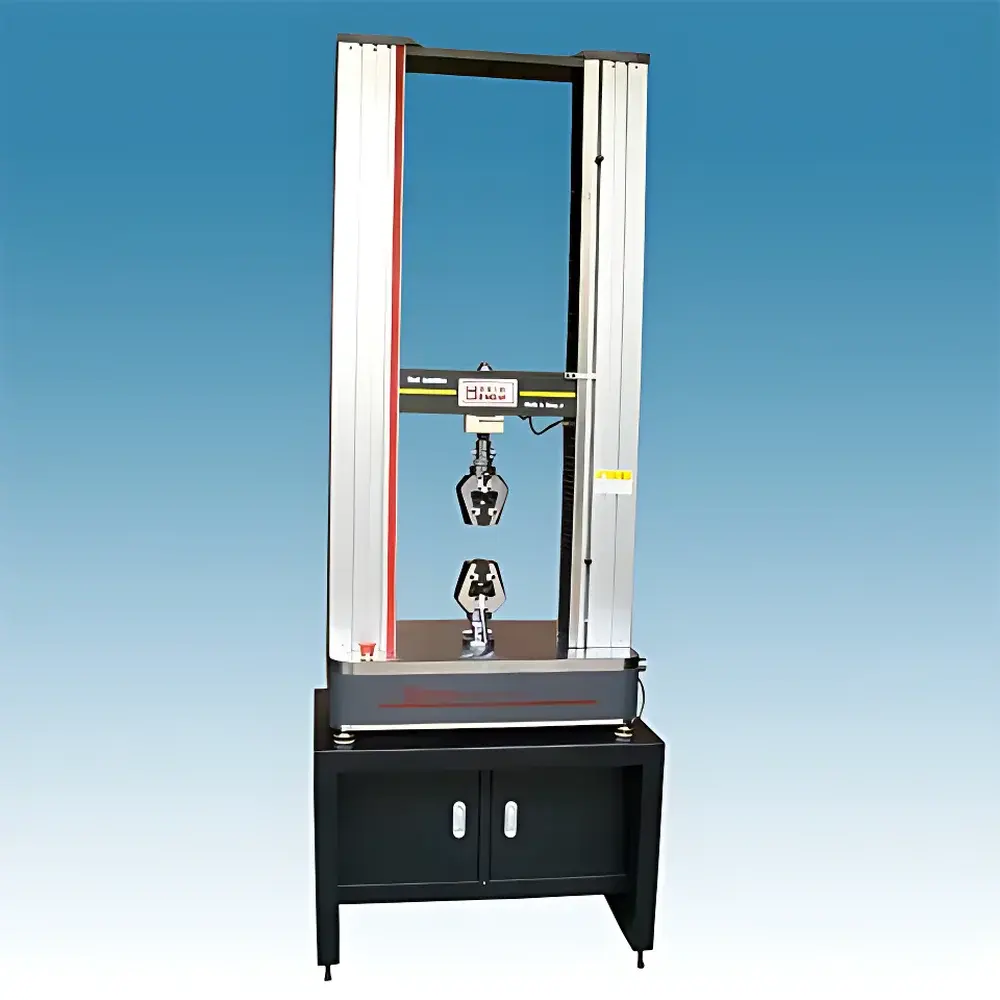
Hengyi HY-3080A Ceramic Capacitive Pressure Transducer-Based Universal Testing Machine
| Brand | Hengyi / Hengyitest |
|---|---|
| Origin | Shanghai, China |
| Manufacturer Type | Direct Manufacturer |
| Regional Category | Domestic (China) |
| Model | HY-3080A |
| Instrument Type | Electromechanical Universal Testing Machine |
| Maximum Test Load | 30 kN |
| Force Measurement Range | 0.001–100% FS |
| Force Accuracy | ±0.5% of reading |
| Test Stroke | 800 mm |
| Displacement Resolution | 0.001 mm |
| Speed Range | 0.001–500 mm/min |
| Speed Accuracy | ±0.5% of set value |
| Displacement Measurement Accuracy | ±0.5% of reading |
| Strain Control Rate Range | 0.002–6 %FS/s |
| Stress Control Rate Range | 0.005–6 %FS/s |
| Load Cell Resolution | ±500,000 counts (full-scale, no range switching) |
| Effective Test Width | 380 mm (expandable) |
| Power Supply | 220 V AC, 0.75 kW |
| Machine Weight | 210 kg |
| Dimensions (W×D×H) | 700 × 420 × 1600 mm |
Overview
The Hengyi HY-3080A is a dual-column, electromechanical universal testing machine engineered for high-reproducibility static mechanical characterization of materials across tension, compression, bending, shear, peel, tear, puncture, and cyclic loading modes. Unlike piezoresistive or strain-gauge-based systems, this instrument integrates a ceramic capacitive pressure transducer within its load cell architecture—offering enhanced long-term stability, minimal thermal drift, and immunity to electromagnetic interference in laboratory and production QA/QC environments. Designed to ASTM E4, ISO 7500-1, and GB/T 228.1 compliance frameworks, the HY-3080A delivers traceable force measurement from 1 N up to 30 kN with full-scale resolution of 1 part in 500,000 and linearity maintained across the entire dynamic range. Its rigid龙门 (gantry) frame construction—fabricated from precision-machined steel with preloaded ball-screw actuation—ensures axial alignment tolerance ≤0.02 mm/m and minimizes parasitic bending moments during high-force testing.
Key Features
- Ceramic capacitive sensing technology for force measurement: superior zero-point stability (<0.05% FS/°C), 10 million cycle fatigue life
- Full-range, single-scale load measurement: no manual range switching required; maintains ±0.5% accuracy from 0.001% to 100% FS
- Programmable crosshead speed: 0.001–500 mm/min with closed-loop servo control and real-time velocity feedback
- High-resolution displacement tracking: 0.001 mm resolution via optical encoder with ±0.5% accuracy over 800 mm travel
- Dual-mode control architecture: supports stress-rate, strain-rate, and displacement-rate control per ISO 6892-1 and ASTM D638 protocols
- Integrated safety subsystems: electronic limit switches, overload cutoff (>110% FS), automatic return-to-home, and self-diagnostic firmware monitoring for drive, sensor, and power circuits
- Modular extensometer interface: compatible with clip-on, video, and non-contact digital image correlation (DIC) systems for localized strain analysis
Sample Compatibility & Compliance
The HY-3080A accommodates specimens ranging from sub-millimeter filaments (e.g., suture threads, PVDF piezoelectric fibers) to structural composites (e.g., CFRP laminates, ceramic matrix tiles). Standard fixtures include wedge-action tensile grips, compression platens (100 mm diameter), three/four-point bend assemblies, peel test jigs, and puncture anvils compliant with ISO 8510-2, ASTM D1876, and YY/T 0681.15. The system meets mechanical verification requirements per ISO 7500-1 Class 0.5 and is routinely validated using NIST-traceable deadweight standards. For regulated environments—including pharmaceutical packaging (USP ), medical device component validation (ISO 14971), and aerospace fastener qualification (SAE AMS 2300)—the machine supports audit-ready operation under 21 CFR Part 11-compliant software configurations with user-level access control, electronic signatures, and immutable audit trails.
Software & Data Management
HYtest V7.0 is a multi-language (English, German, French, Spanish, Japanese, Korean, Russian, Portuguese, Chinese), platform-independent test control and analysis suite built on VB.NET and SQL Server Compact. It provides real-time synchronized acquisition of force, displacement, large/small deformation, and time-stamped environmental metadata. All raw data are stored in encrypted .hdb binary format with embedded calibration coefficients and instrument configuration snapshots. The software enables automated method execution per ISO 527-2, ASTM D790, or custom-defined test sequences—including ramp-hold-relax cycles, creep tests, and staircase fatigue protocols. Post-test analysis includes modulus calculation (secant, tangent, chord), yield point detection (0.2% offset, maximum slope), elongation at break, and energy absorption (area under curve). Export options include CSV, PDF reports with embedded graphs, and XML files compatible with LIMS and ELN platforms.
Applications
This system serves as a primary mechanical test platform in accredited laboratories conducting routine QC for polymer films (ASTM D882), elastomeric seals (ISO 37), battery electrode coatings (ASTM F3048), orthopedic biomaterials (ISO 5832-3), photovoltaic interconnect ribbons (IEC 61215-2 MQT 16), and ceramic capacitors (IEC 60384-14). It is widely deployed in R&D settings for constitutive modeling of viscoelastic polymers, fracture toughness assessment of thin-film adhesives, and accelerated aging studies of foam cushioning materials. Universities utilize it for undergraduate mechanics labs and graduate-level finite element model validation, while regulatory bodies reference its output in technical dossiers submitted to FDA, CE Notified Bodies, and CNAS-accredited certification bodies.
FAQ
What standards does the HY-3080A comply with for force calibration and verification?
It conforms to ISO 7500-1:2018 Class 0.5 for static force measurement systems and supports verification using Class M1 or better deadweight standards per OIML R113.
Can the system perform closed-loop strain-controlled testing?
Yes—via optional extensometer input or digital image correlation (DIC), supporting strain rate control from 0.002 to 6 %FS/s per ISO 6892-1 Annex A.
Is 21 CFR Part 11 compliance available out-of-the-box?
Yes—the HYtest V7.0 software offers configurable Part 11 mode with role-based permissions, electronic signatures, and tamper-evident audit logs meeting ALCOA+ principles.
What is the maximum specimen height accommodated without modification?
Standard vertical clearance is 800 mm between upper and lower platens; extended columns (up to 1200 mm) are available as factory options.
Does the ceramic capacitive load cell require periodic recalibration?
Calibration interval is recommended annually or after 10,000 test cycles—whichever occurs first—using certified reference loads traceable to national metrology institutes.



