
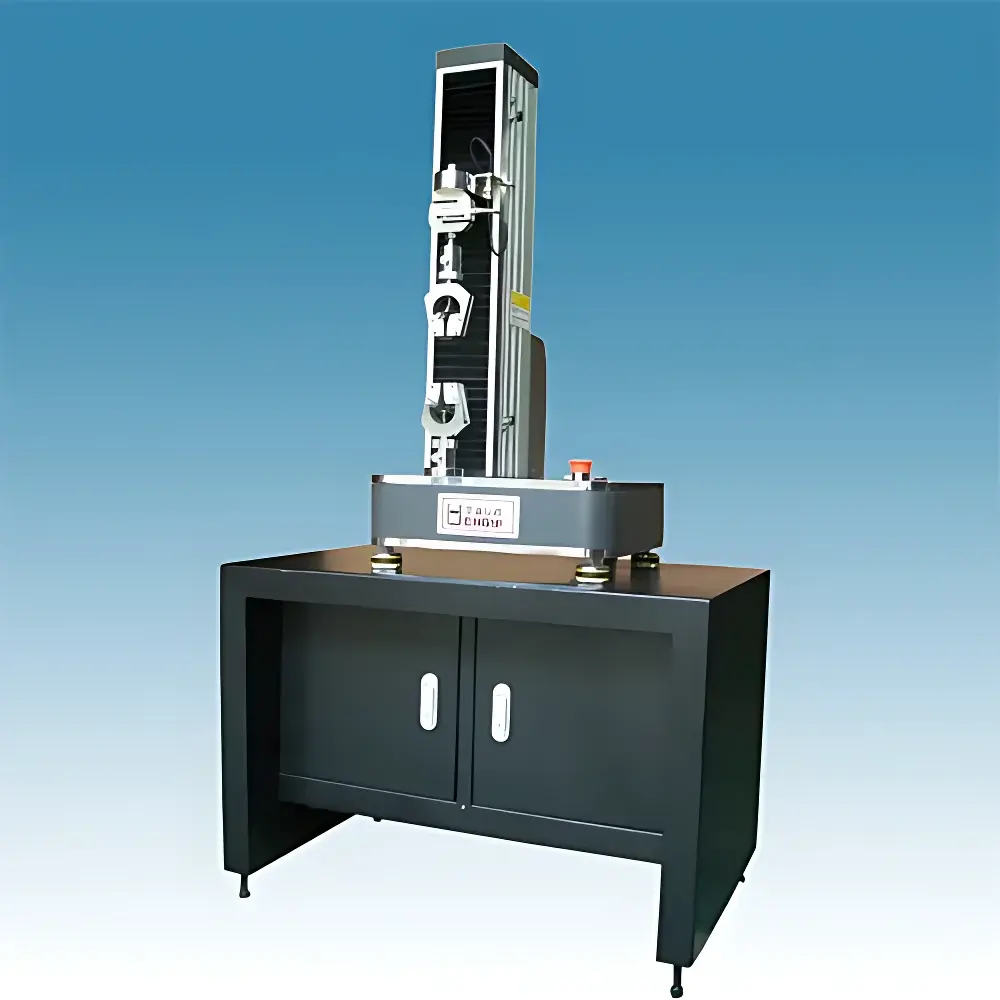
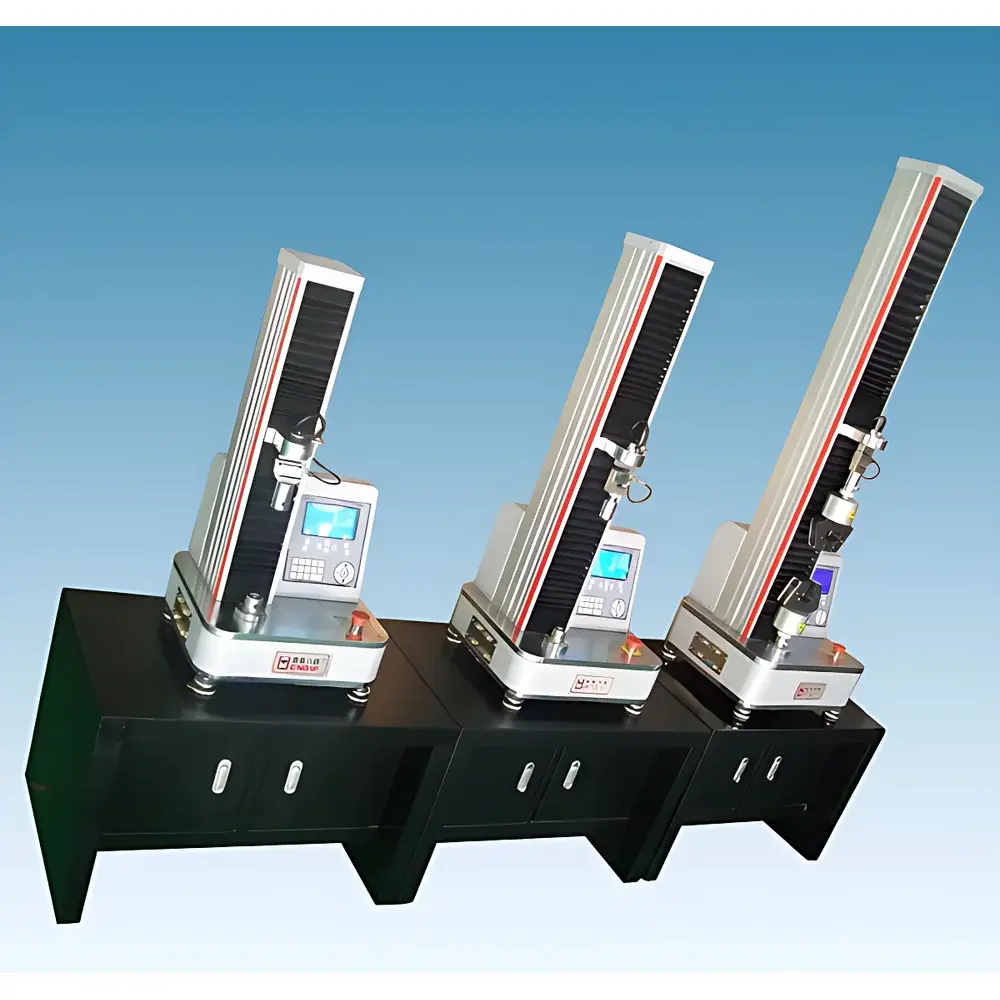
Hengyi HY-035055 Electronic Universal Testing Machine
| Brand | Hengyi |
|---|---|
| Origin | Shanghai, China |
| Manufacturer Type | Direct Manufacturer |
| Model | HY-035055 |
| Max Load Capacity | 3000 N |
| Load Accuracy Class | 0.5 |
| Effective Test Width | 120 mm |
| Effective Test Height | 500 mm |
| Speed Range | 0.001–300 mm/min |
| Speed Accuracy | ±0.5% of reading |
| Displacement Accuracy | ±0.5% of reading |
| Strain Measurement Accuracy | ±0.5% of reading |
| Force Resolution | ±500,000 counts (full-scale, no range switching) |
| Power Supply | 220 V AC, 400 W |
| Net Weight | 75 kg |
| Dimensions (W×D×H) | 440 × 380 × 1100 mm |
| Compliance | ISO 7500-1, ASTM E4, ASTM E8/E21, GB/T 228.1 |
Overview
The Hengyi HY-035055 Electronic Universal Testing Machine is a precision-engineered static mechanical testing system designed for tensile, compression, flexural, peel, puncture, and shear characterization of metallic, polymeric, composite, and elastomeric materials. It operates on the principle of servo-controlled electromechanical actuation, where a high-fidelity load cell—calibrated to ISO 7500-1 Class 0.5 accuracy—measures force response while optical encoders and digital signal processing ensure traceable displacement and strain acquisition. Unlike legacy hydraulic or manual systems, this machine integrates real-time closed-loop control of stress, strain, and displacement rates per ASTM E4 and ISO 5893, enabling reproducible execution of standardized test methods including ASTM E8 (tensile metals), ASTM D638 (plastics), ISO 527, and GB/T 228.1. Its modular architecture supports both routine QC verification and R&D-grade material property derivation—including Young’s modulus (E), yield strength (Rp0.2), ultimate tensile strength (UTS), elongation at break, compressive yield, and secant modulus—within a single platform.
Key Features
- Servo-motor-driven crosshead with dual-speed (fast/slow) jog control and electronic limit protection for operator safety and specimen integrity
- Full-scale force resolution of ±500,000 digital counts—no internal range switching—ensuring consistent resolution across 0.1% to 100% of full scale (10 N to 3000 N)
- Adjustable test speed from 0.001 to 300 mm/min, with speed accuracy maintained within ±0.5% of setpoint per ISO 5893
- Real-time synchronized acquisition of force, displacement, and extensometer-derived strain; all data logged at user-defined sampling intervals
- Integrated overload protection: automatic shutdown at 110% of maximum rated load (3300 N), plus hardware-level overvoltage, overcurrent, and thermal fault monitoring
- Auto-return function—programmable to return to origin post-test or via manual override at maximum traverse speed
- Multi-condition termination logic: programmable stop triggers based on time, load, displacement, or deformation thresholds
- Self-diagnostic firmware that continuously verifies sensor linearity, amplifier gain stability, and motion controller responsiveness during idle and active states
Sample Compatibility & Compliance
The HY-035055 accommodates specimens up to 120 mm wide and 500 mm tall, supporting standard test geometries per ASTM, ISO, and GB standards—including dog-bone tensile bars, rectangular compression blocks, three-point bending beams, and peel-adhesion coupons. Its open-frame design permits easy integration of environmental chambers (−70 °C to +300 °C), video extensometers, and acoustic emission sensors for advanced failure analysis. The system complies with ISO 7500-1 (static calibration), ISO 5893 (dynamic performance), ASTM E4 (load verification), and GB/T 228.1 (metallic tensile testing). While not pre-certified for FDA 21 CFR Part 11, its audit-ready data structure—including timestamped raw channel logs, operator ID tagging, and immutable test method files—supports GLP/GMP validation when deployed with validated third-party software.
Software & Data Management
Built-in LCD interface enables standalone operation with real-time curve plotting (force vs. displacement, stress vs. strain), auto-scaling axes, and on-screen parameter configuration. For laboratory integration, the machine communicates via USB 2.0 or RS-232 to Windows-based control software written in VB.NET with SQL Server backend—ensuring ACID-compliant data storage, role-based user access, and export to CSV, PDF, or XML formats compliant with LIMS requirements. All test reports include metadata (operator, date/time, calibration certificate ID, environmental conditions), raw waveform traces, and calculated metrics (e.g., Rp0.2, E-modulus, % elongation) with uncertainty propagation per GUM guidelines. Custom test methods can be defined using conditional logic and mathematical expressions—enabling automated calculation of non-standard parameters such as tangent modulus or creep compliance.
Applications
- Mechanical QA/QC of incoming raw materials (metals, thermoplastics, elastomers, composites)
- R&D evaluation of new formulations—including biodegradable polymers, hydrogels, and fiber-reinforced laminates
- Validation of weld integrity, adhesive bond strength, and coating adhesion per ASTM D1002 or ISO 4587
- Biomedical device testing: suture tensile strength, stent radial force, catheter kink resistance
- Automotive component qualification: gasket compression set, bushing shear stiffness, seat belt webbing elongation
- Academic research requiring high-fidelity stress–strain mapping under controlled strain-rate protocols
FAQ
What standards does the HY-035055 comply with for force calibration?
It meets ISO 7500-1 Class 0.5 requirements, verified using traceable deadweight standards accredited to ISO/IEC 17025.
Can the system support extensometer-based strain measurement?
Yes—both contact clip-on and non-contact video extensometers can be integrated via analog voltage input or digital trigger synchronization.
Is the software compatible with networked lab environments?
The control software supports UNC path mapping and SQL Server remote instances, enabling centralized database deployment and multi-station data aggregation.
What maintenance is required during the first year of operation?
No scheduled maintenance is required; however, quarterly verification of load cell linearity and encoder zero offset is recommended per ISO 7500-1 Annex B.
Does the machine support cyclic or fatigue testing?
The base configuration is optimized for static tests; low-cycle fatigue (≤10⁴ cycles) is possible with optional waveform generator modules and enhanced thermal management—consult technical specifications for duty cycle limitations.



