
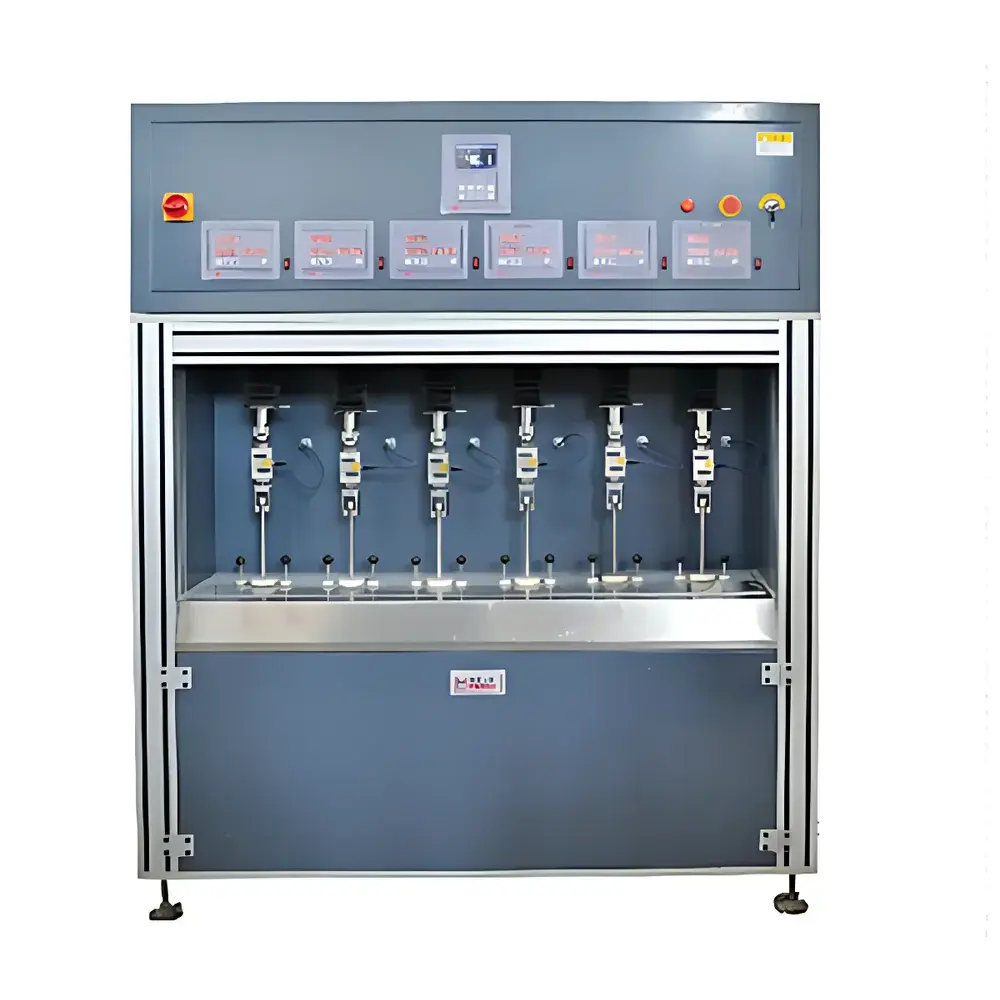
Hengyi HY-QKRBUI Full-Notch Creep Testing Machine
| Brand | Hengyi / Hengyitest |
|---|---|
| Origin | Shanghai, China |
| Manufacturer Type | Direct Manufacturer |
| Region Classification | Domestic (China) |
| Model | HY-QKRBUI |
| Pricing | Upon Request |
| Load Capacity | 2000 N (interchangeable load cells available below 2000 N |
| Force Measurement Range | 0.4–100% of full scale |
| Force Accuracy | Class 0.5 |
| Effective Test Width | 120 mm |
| Effective Test Height | 200 mm |
| Test Speed Range | 0.001–100 mm/min (adjustable in real time) |
| Speed Accuracy | ±1% of indicated value |
| Displacement & Strain Measurement Accuracy | ±1% of indicated value |
| Test Stations | 6 or 12 independent stations |
| Temperature Control Bath Range | Ambient to 95 °C |
| Temperature Stability | ±0.5 °C |
| Control Interface | PC-based software (bilingual: English & Chinese) |
| Power Requirement | 220 V AC, 10 kW |
| Unit Dimensions | 1620 × 850 × 1750 mm |
| Net Weight | 850 kg |
| Compliance Standards | GB/T 15820–1995, GB/T 11546, GB/T 32682–2016, ISO 16770, ISO 899-1, ISO 3501 |
Overview
The Hengyi HY-QKRBUI Full-Notch Creep Testing Machine is an engineered solution for standardized environmental stress cracking (ESC) and long-term creep behavior evaluation of thermoplastic polymers—particularly polyethylene (PE) pipe materials, fittings, and composite systems. It implements the full-notch creep test (FNCT) method as defined in ISO 16770 and GB/T 32682–2016, where specimens are pre-notched to introduce a controlled stress concentration, then subjected to constant tensile load within a temperature-controlled liquid medium (typically detergent solution or surfactant bath). This accelerates ESC initiation and propagation under static mechanical stress, enabling quantitative assessment of material resistance to slow crack growth under service-relevant conditions. The system supports three primary test modes: uniaxial tensile creep (ISO 899-1), full-notch creep testing (FNCT), and pull-out strength testing for pipe joint integrity (GB/T 15820). Its modular architecture with up to 12 independent test stations allows parallel execution of replicate or multi-condition experiments—critical for statistical reliability in certification and R&D workflows.
Key Features
- Modular multi-station design: 6 or 12 fully independent test units, each with dedicated load application, displacement sensing, and thermal environment control—eliminating cross-talk and ensuring measurement integrity across all channels.
- Electromechanical loading system with high-resolution digital force control, supporting precise static load application from 0.4% to 100% of full-scale capacity (2000 N nominal); optional interchangeable load cells enable optimized resolution for low-force applications.
- Integrated thermostatic bath with PID-controlled heating and circulation, maintaining temperature stability within ±0.5 °C across the full operating range (ambient to 95 °C).
- Real-time closed-loop speed control: adjustable test velocity from 0.001 to 100 mm/min, with accuracy maintained at ±1% of setpoint—enabling both ultra-slow creep monitoring and rapid qualification screening.
- Robust mechanical frame and elastic isolation mounts minimize structural coupling between stations, ensuring long-term repeatability and compliance with GLP-aligned operational rigor.
- Comprehensive self-diagnostic firmware with over-travel, overload, temperature deviation, and communication fault detection—ensuring safe unattended operation during extended tests (up to 10,000+ hours).
Sample Compatibility & Compliance
The HY-QKRBUI accommodates standard FNCT specimens per ISO 16770 (80 × 10 × 4 mm rectangular bars with 1-mm full-depth notch) and ASTM D1693-type geometries. It also supports custom specimen holders for pipe pull-out testing (per GB/T 15820) and tensile creep bars (ISO 899-1). All mechanical and thermal subsystems are validated against national and international metrological requirements. The instrument meets traceability criteria for ISO/IEC 17025-accredited laboratories and supports audit-ready documentation including calibration certificates, uncertainty budgets, and maintenance logs. Its test methodology aligns with regulatory expectations for PE pressure pipe certification under EN 1555, ASME B31.4, and CSA Z245.11—where FNCT results serve as key input for lifetime prediction models and failure mode analysis.
Software & Data Management
The bundled Windows-based control software provides bilingual (English/Chinese) interface with role-based access control, electronic signature support, and full 21 CFR Part 11 compliance—including audit trail logging, user authentication, and immutable data archiving. Real-time acquisition captures force, displacement, time, and bath temperature at configurable intervals (down to 100 ms). Automated calculation modules generate time-to-failure (TTF), creep strain rate, and critical stress thresholds. Export formats include CSV, PDF test reports, and XML for LIMS integration. Curve-fitting tools support Larson–Miller parameter derivation and power-law creep modeling. All raw datasets are stored with metadata (operator ID, calibration status, environmental conditions), satisfying GLP/GMP record retention mandates.
Applications
- Environmental stress cracking resistance (ESCR) ranking of HDPE resins used in gas/water distribution piping.
- Quality assurance of fusion-jointed PE pipe systems via standardized pull-out strength verification (GB/T 15820).
- Comparative evaluation of antioxidant package efficacy under accelerated aging conditions.
- Validation of material substitution in regulated infrastructure projects requiring ISO 16770-compliant ESC data.
- Supporting ISO 9001 and IATF 16949 process validation through statistically robust creep dataset generation.
- Academic research on viscoelastic fracture mechanics in semi-crystalline polymers.
FAQ
What standards does the HY-QKRBUI fully support for FNCT testing?
It complies with ISO 16770, GB/T 32682–2016, and ISO 899-1 for creep and ESC evaluation, with hardware and software validated for conformance.
Can the system operate unattended for multi-week tests?
Yes—integrated safety interlocks, thermal redundancy, and continuous diagnostics enable reliable 24/7 operation with minimal supervision.
Is third-party calibration and certification available?
Hengyi provides factory calibration with NIST-traceable standards; optional UKAS/DAkkS-certified calibration services are available upon request.
How is data integrity ensured during long-duration tests?
The software enforces write-once archival, timestamped audit trails, and automatic backup to network drives—meeting FDA 21 CFR Part 11 and ISO/IEC 17025 data governance requirements.
What maintenance intervals are recommended for sustained accuracy?
Load cell recalibration every 12 months, bath fluid replacement every 6 months, and annual mechanical inspection of drive trains and thermal sensors are advised per the operator manual.



