
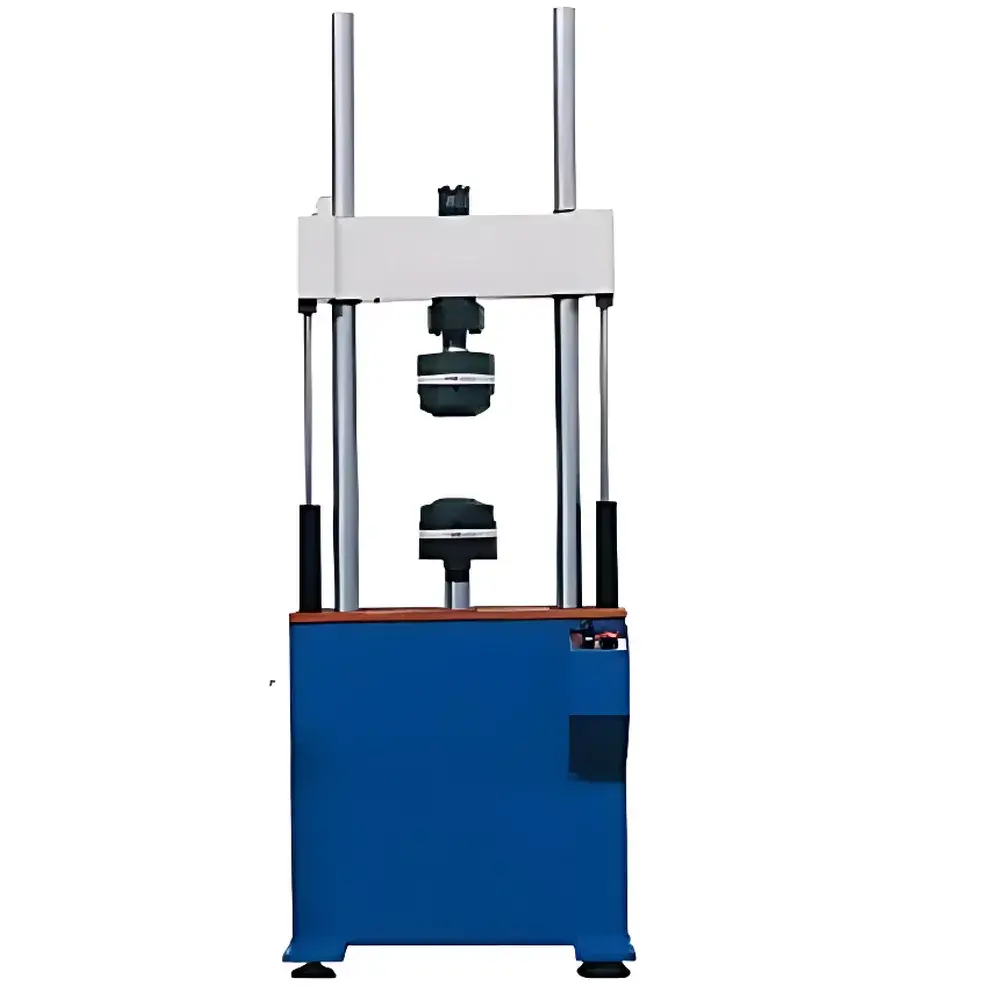
Hengyi HY-0580(PL) Computer-Controlled Electro-Hydraulic Servo Fatigue Testing Machine for Elastomers
| Brand | Hengyi |
|---|---|
| Origin | Shanghai, China |
| Manufacturer Type | Direct Manufacturer |
| Model | HY-0580(PL) |
| Max Test Force | 5 kN (static & dynamic ±5 kN) |
| Force Accuracy | ±0.5% of reading (full range, unsegmented) |
| Force Resolution | 1/30,000 (constant across full range) |
| Effective Force Range | 0.05–5 kN |
| Max Displacement | ±50 mm |
| Displacement Accuracy | ±0.5% of reading |
| Displacement Resolution | 1/30,000 |
| Function Generator Frequency Range | 0.001–100 Hz |
| Waveform Options | Sine, Triangle, Rectangle, Ramp, and User-Defined |
| System Frequency Response | 0.01–20 Hz |
| Continuous Operating Frequency | 20 Hz |
| Cycle Counter Capacity | 999,999,999 (presettable) |
| Control Modes | Force and Displacement, with seamless in-test switching |
| Effective Test Space | 800 mm |
| Column Spacing | 600 mm |
| Frame Height | 1900 mm |
| Frame Stiffness | 1.7 × 10⁸ N/mm |
| Hydraulic Power Unit | Flow 80 L/min, Pressure 25 MPa |
| Motor Speed | 1450 rpm |
| Actuator | Dual-Rod F150 mm |
| Load Cell | 5 kN (Transducer Technologies or equivalent imported brand) |
| LVDT Displacement Sensor | 100 mm range |
| Clamping System | Tensile fixture set |
| Control System | Full-digital DSP-based servo controller |
| Software | Hengyi Proprietary Fatigue Test Suite (Windows-based, GLP-compliant data logging) |
| Host Weight | 1500 kg |
Overview
The Hengyi HY-0580(PL) Computer-Controlled Electro-Hydraulic Servo Fatigue Testing Machine is a high-stiffness, closed-loop system engineered for precise, long-duration cyclic loading of elastomeric materials—including natural rubber, synthetic elastomers, thermoplastic vulcanizates (TPVs), and rubber-composite laminates. Based on electro-hydraulic servo actuation, the system applies controlled dynamic loads via a dual-rod F150 mm actuator driven by a high-bandwidth D760-series servo valve and a 80 L/min, 25 MPa hydraulic power unit. Its rigid frame—stiffness rated at 1.7 × 10⁸ N/mm—minimizes parasitic deflection during high-frequency testing, ensuring measurement integrity across the operational bandwidth of 0.01–20 Hz. Designed for compliance with ASTM D4482 (Standard Test Method for Determining Dynamic Properties of Vulcanized Rubber), ISO 4664-1 (Rubber—Dynamic properties—Part 1: General guidance), and GB/T 16825.1 (Metallic materials—Verification of static uniaxial testing machines), the HY-0580(PL) delivers traceable, reproducible fatigue data under force-, displacement-, or hybrid-controlled conditions.
Key Features
- Full-digital DSP-based servo control architecture enabling real-time waveform synthesis and adaptive feedback correction
- High-resolution force measurement (±0.5% accuracy, 1/30,000 constant resolution) using a calibrated 5 kN load cell from Transducer Technologies or equivalent ISO 17025-accredited supplier
- Non-contact LVDT displacement sensing (100 mm range, ±0.5% accuracy) integrated into the actuator housing to eliminate mechanical play errors
- Multi-waveform function generator supporting sine, triangle, rectangle, ramp, and user-defined waveforms with frequency programmability from 0.001 Hz to 100 Hz
- Seamless in-test transition between force-control and displacement-control modes without cycle interruption or data loss
- Robust structural design: 1500 kg monolithic base, 600 mm column spacing, and 800 mm vertical test space accommodate custom fixtures and environmental chambers
- GLP-compliant software architecture with audit-trail-enabled data logging, electronic signatures, and 21 CFR Part 11-ready configuration options
Sample Compatibility & Compliance
The HY-0580(PL) accommodates standard dumbbell-shaped, ring, and strip specimens per ASTM D412, ISO 37, and GB/T 528. Optional high-temperature grips (up to 150 °C), low-temperature cryo-chambers (−70 °C), and humidity-controlled enclosures enable accelerated aging studies under combined thermal-mechanical stress. All hardware and firmware comply with CE machinery directive 2006/42/EC, EMC directive 2014/30/EU, and RoHS 2011/65/EU. Calibration certificates are provided with NIST-traceable reference standards; annual verification protocols align with ISO/IEC 17025 requirements for accredited laboratories.
Software & Data Management
Hengyi’s proprietary fatigue test software runs on an embedded研祥 industrial PC under Windows OS, featuring a modular GUI with real-time oscilloscope-style waveform visualization, multi-channel synchronized acquisition (force, displacement, time, cycle count), and automatic hysteresis loop extraction. Raw data is saved in ASCII-compatible .csv and binary .hdf5 formats; metadata includes operator ID, calibration date, environmental conditions, and test parameters—all timestamped and digitally signed. Export modules support direct integration with LIMS platforms and statistical analysis tools (e.g., JMP, Minitab). Audit trails record all parameter changes, file modifications, and user logins with immutable timestamps—fully compliant with FDA 21 CFR Part 11 when configured with electronic signature and role-based access controls.
Applications
- Dynamic modulus and loss tangent (tan δ) mapping of rubber compounds across temperature and frequency sweeps
- High-cycle fatigue life assessment of rubber bushings, engine mounts, and anti-vibration isolators
- Cyclic tensile/compression testing per ISO 6943 (Rubber—Determination of fatigue life under repeated deformation)
- Crack growth rate quantification using crack-tip opening displacement (CTOD) methods with optional video extensometry
- Viscoelastic characterization for finite element model validation in automotive NVH simulation workflows
- Quality assurance testing of incoming raw materials and final cured parts in Tier-1 rubber manufacturing facilities
FAQ
What is the maximum continuous operating frequency for fatigue testing?
The system is rated for sustained operation at 20 Hz with full ±5 kN dynamic load amplitude and thermal management enabled via the integrated hydraulic cooling circuit.
Can the machine perform tests under elevated temperature conditions?
Yes—when equipped with optional heated grips or environmental chambers, it supports testing from −70 °C to +150 °C while maintaining force and displacement fidelity.
Is the software compatible with third-party data analysis platforms?
All test data exports in standardized ASCII (.csv) and HDF5 formats, enabling direct ingestion into MATLAB, Python (Pandas/HDF5 libraries), and commercial CAE tools.
Does the system meet regulatory requirements for pharmaceutical or medical device material qualification?
When configured with 21 CFR Part 11 add-ons (electronic signatures, audit trail, user permissions), it satisfies GMP/GLP documentation requirements for elastomeric components used in Class II/III medical devices.
What maintenance intervals are recommended for the hydraulic power unit?
Hydraulic oil and filter replacement is required every 2,000 operating hours or annually—whichever occurs first—using ISO 4406 Class 16/14/11 certified fluid.
Related Products



