
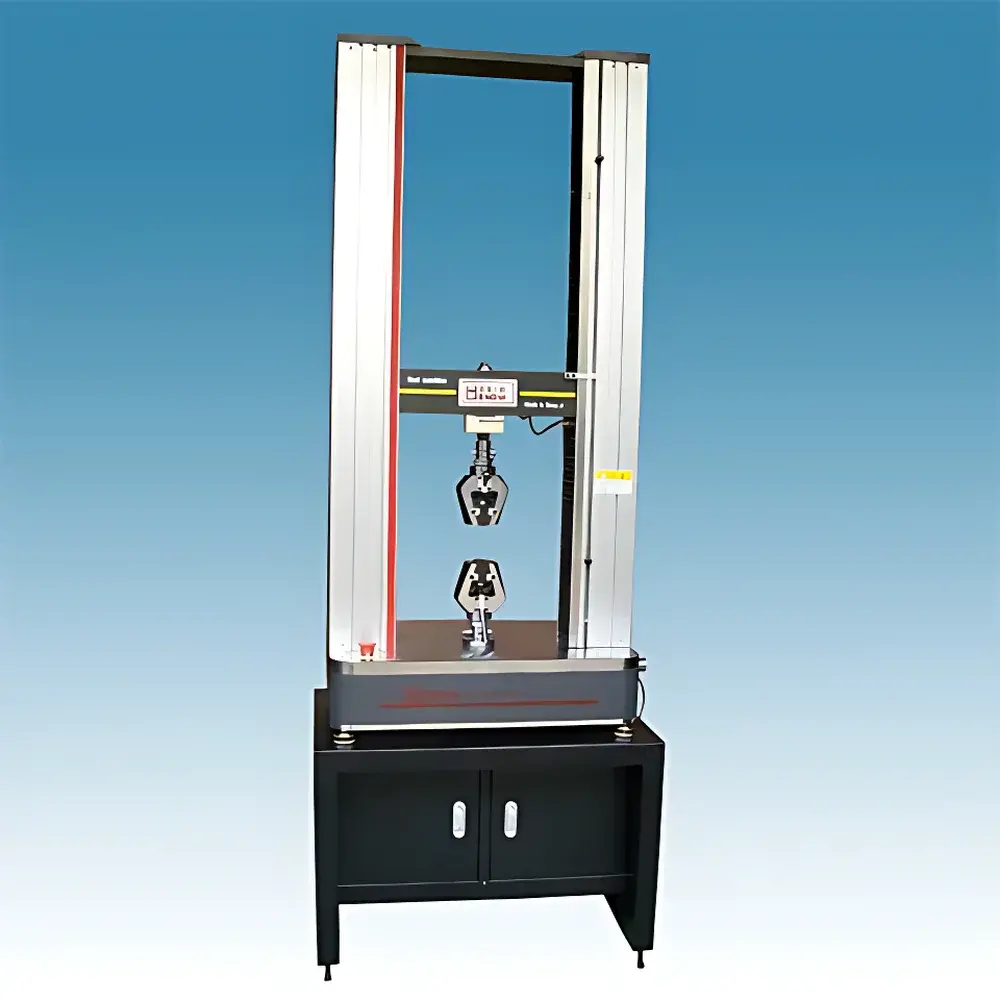
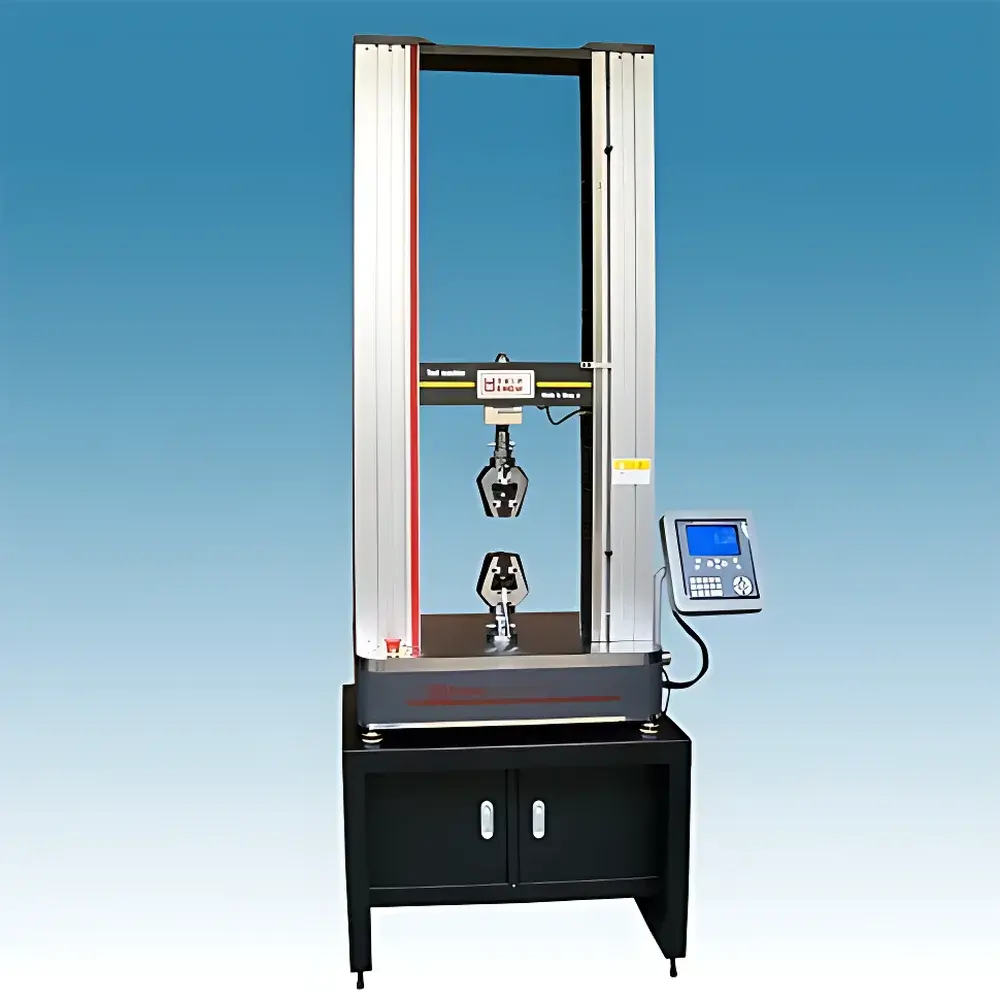
Hengyi HY(IC) UYUINGH Dual-Directional Dynamic Bending and Torsion Tester for Smart Cards
| Brand | Hengyi / Hengyitest |
|---|---|
| Origin | Shanghai, China |
| Manufacturer Type | Direct Manufacturer |
| Region of Origin | Domestic (China) |
| Model | HY(IC) UYUINGH |
| Pricing | Upon Request |
| Test Stations | 15 (5 long-edge bending, 5 short-edge bending, 5 torsion) |
| Cycle Count Range | 1–9999 cycles |
| Counting Method | Non-contact optical encoder (replacing mechanical switch-based counting) |
| Bending Displacement | Long-edge max 20 mm (0.00 / −1.00 mm), min 2 mm ±0.50 mm |
| Torsion Angle | ±15° ±1° (bidirectional, d = 86 mm |
| Test Speed | 30 rpm or 0.5 Hz (bending & torsion) |
| Dimensions (L×W×H) | 670 × 380 × 220 mm |
| Weight | 70 kg |
| Power Supply | AC 220 V ±5% |
| Power Consumption | 35 W |
| Compliance | GB/T 16649.1, GB/T 17554.1–2006, ISO/IEC 10373, ISO/IEC 7816–1998 |
Overview
The Hengyi HY(IC) UYUINGH Dual-Directional Dynamic Bending and Torsion Tester is an electromechanical test system engineered specifically for the mechanical durability evaluation of contact and contactless smart cards, including magnetic stripe cards, integrated circuit (IC) cards, and embedded microprocessor cards. It operates on a precisely synchronized servo-driven actuation principle, applying controlled cyclic bending and torsional loads to simulate real-world handling stresses—such as insertion into readers, wallet flexing, and pocket deformation—that contribute to card delamination, conductor fatigue, or chip detachment. The instrument implements a modular 15-station architecture: five stations dedicated to long-edge bending, five to short-edge bending, and five to bidirectional torsion—enabling parallel, statistically robust testing per ISO/IEC 10373-1 Annex D and GB/T 17554.1–2006 Clause 6. Its non-contact optical encoder-based cycle counting ensures metrological traceability and eliminates mechanical wear-induced drift, supporting high-reproducibility fatigue life assessment under GLP-aligned laboratory conditions.
Key Features
- Fifteen independent test stations configured for simultaneous long-edge bending, short-edge bending, and bidirectional torsion—maximizing throughput while preserving inter-station isolation.
- Optical encoder-based cycle counter with full 1–9999 programmable range and zero mechanical hysteresis—eliminating switch bounce errors and extending mean time between failures (MTBF) beyond 10,000 cycles.
- Precision-adjustable displacement control: long-edge bending stroke from 2.0 mm ±0.50 mm to 20.0 mm (−1.00 mm tolerance), short-edge from 1.0 mm ±0.50 mm to 10.0 mm (−1.00 mm tolerance).
- Bidirectional torsion capability with ±15° ±1° angular resolution (d = 86 mm mandrel diameter), delivering a cumulative 30° twist per full cycle—fully aligned with ISO/IEC 7816–1998 Clause 9.2 and GB/T 16649.1 Section 5.3.
- Touchscreen HMI with intuitive parameter mapping: user-defined cycle count, speed (0.5 Hz or 30 rpm), dwell time, and direction sequencing—stored in non-volatile memory with timestamped session logging.
- STK AC variable-frequency drive coupled with high-ratio planetary gear reduction ensures torque stability <±2% across full speed range and positional repeatability ≤±0.05 mm.
Sample Compatibility & Compliance
The HY(IC) UYUINGH accommodates standard ID-1 format cards (85.6 × 53.98 × 0.76 mm) per ISO/IEC 7810. Fixture geometry—including clamping force distribution, mandrel radius, and pivot axis alignment—is dimensionally certified against ISO/IEC 10373-1 Figure D.1 and GB/T 17554.1–2006 Figure 1. Test protocols executed on this platform satisfy mandatory conformance requirements for EMVCo Level 1 physical interoperability certification, national payment network approvals (e.g., China UnionPay), and EU CE marking under Directive 2014/30/EU (EMC) and 2014/35/EU (LVD). All mechanical outputs are traceable to NIM (National Institute of Metrology, China) calibration standards.
Software & Data Management
The embedded control firmware supports CSV export of raw cycle logs—including timestamp, station ID, completion status, and error flags—for post-test statistical analysis (e.g., Weibull failure modeling). Audit trails record operator login, parameter changes, and emergency stop events—meeting FDA 21 CFR Part 11 electronic record requirements when deployed in regulated QA/QC environments. Optional Ethernet interface enables integration with LIMS platforms via Modbus TCP, permitting centralized test scheduling and result archival without manual intervention.
Applications
- Qualification testing of PVC, PET, PETG, and polycarbonate card substrates for tensile modulus degradation after repeated flexure.
- Evaluation of antenna loop integrity in contactless (RFID/NFC) cards subjected to torsional strain at the hinge region.
- Validation of adhesive bond strength between laminated layers under combined bending-torsion stress states.
- Accelerated life-cycle testing for banking, transit, and government-issued eID cards prior to field deployment.
- Root cause analysis of field failures linked to mechanical fatigue—correlating lab-induced damage modes (e.g., trace cracking, solder joint fracture) with real-world incident reports.
FAQ
Does the tester support automated pass/fail judgment based on cycle count?
Yes—the system triggers a visual and audible alert upon reaching the preset cycle limit and records final status (pass/fail) per station in the session log.
Can test parameters be locked to prevent unauthorized modification?
Operator-level access control is enforced via password-protected configuration mode; administrator credentials are required to alter displacement limits or counting logic.
Is calibration documentation provided with shipment?
Each unit ships with a factory calibration certificate referencing NIM-traceable standards for displacement, angular position, and cycle timing—valid for 12 months.
What maintenance intervals are recommended?
Optical encoder alignment verification every 6 months; gear lubrication and belt tension check annually; no consumable parts require replacement within first 5,000 operational hours.
Are custom fixtures available for non-ID-1 card formats?
Yes—Hengyi offers OEM fixture design services compliant with ISO/IEC 10373-6 (mini-SIM, nano-SIM, wearable tokens) with lead time of 4–6 weeks post-drawing approval.



