
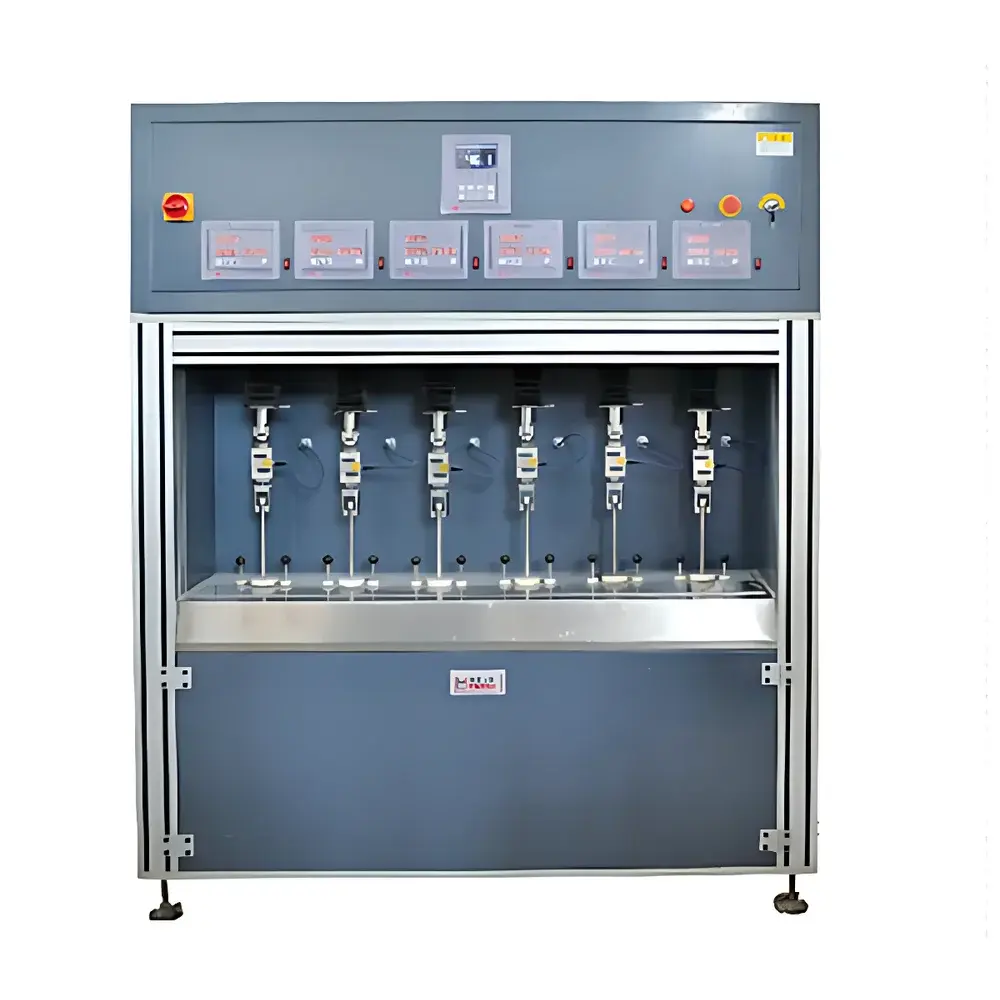
Hengyi HY-QKRB Full-Notch Creep Tester for Polymer Composites
| Brand | Hengyi |
|---|---|
| Origin | Shanghai, China |
| Manufacturer Type | Direct Manufacturer |
| Country of Origin | China |
| Model | HY-QKRB |
| Price | Upon Request |
| Load Capacity | 2000 N |
| Force Accuracy | Class 0.5 |
| Effective Force Range | 0.4–99.999% of full scale |
| Test Width | 120 mm |
| Test Height | 200 mm |
| Speed Range | 0.001–100 mm/min |
| Speed Accuracy | ±1% of indicated value |
| Displacement Accuracy | ±1% of indicated value |
| Strain/Deformation Accuracy | ±1% of indicated value |
| Test Stations | 12 |
| Temperature Bath Range | Ambient to 95 °C |
| Temperature Control Accuracy | ±0.5 °C |
| Control System | PC-based |
| Power Requirement | 10 kW |
| Voltage | 220 V AC |
| Weight | 850 kg |
| Dimensions (W×D×H) | 1620 × 850 × 1750 mm |
| Standards Compliance | GB/T 15820–1995, GB/T 11546, GB/T 32682–2016, ISO 899-1, ISO 16770, ISO 3501 |
Overview
The Hengyi HY-QKRB Full-Notch Creep Tester is an engineered platform designed specifically for standardized environmental stress cracking (ESC) and time-dependent mechanical failure evaluation of thermoplastic polymer composites—particularly polyethylene (PE) pipe materials, fittings, and extruded profiles. It implements the full-notch creep test (FNCT) methodology per ISO 16770 and GB/T 32682–2016, where a pre-notched specimen is subjected to constant tensile load while immersed in a defined chemical agent (e.g., surfactant solution) at controlled elevated temperature. This accelerates ESC initiation and propagation, enabling quantitative assessment of material resistance to slow crack growth under combined mechanical and chemical stress. Unlike conventional tensile creep testers, the HY-QKRB integrates multi-station parallel testing with precision thermal bath control, allowing statistically robust data generation across 12 independent test positions under identical environmental conditions. Its architecture supports both FNCT and standard uniaxial tensile creep per ISO 899-1, as well as pull-out strength testing for PE pipe joint integrity per GB/T 15820.
Key Features
- Twelve independently instrumented test stations enable high-throughput, statistically significant ESC lifetime determination—critical for quality assurance in pipe manufacturing and third-party certification labs.
- Class 0.5 force measurement accuracy with interchangeable load cells (up to 2000 N capacity), ensuring traceable compliance with ISO 7500-1 and GB/T 16825.
- Thermostatically controlled immersion bath with ±0.5 °C uniformity across the full 20–95 °C operating range; integrated circulation and level monitoring prevent thermal gradient-induced scatter.
- Precision electromechanical actuation with closed-loop speed control (0.001–100 mm/min), delivering stable load application over durations spanning hours to months.
- Rigid, 850 kg structural frame minimizes vibration coupling and thermal drift—essential for sub-micron displacement resolution during long-term creep monitoring.
- PC-based control system with real-time load/displacement/temperature logging, automated pass/fail flagging per threshold criteria, and export-ready data formatting (CSV, XML).
Sample Compatibility & Compliance
The HY-QKRB accommodates standard FNCT specimens per ISO 16770 (10 mm × 4 mm × 50 mm) and ASTM D1693 geometry variants, including notched pipe ring segments and machined bar coupons. It supports testing in aqueous surfactant solutions (e.g., Igepal CO-630), glycol/water mixtures, or other aggressive media specified in ISO 3501. All operational parameters—including load profile, bath temperature ramping, dwell timing, and termination logic—are programmable to align with GLP-compliant test protocols. The system meets mechanical and metrological requirements of GB/T 11546 (plastic creep), ISO 899-1 (tensile creep), and GB/T 15820 (pipe joint pull-out), and its documentation structure supports audit readiness for CNAS, ILAC-MRA, and FDA-regulated contract testing facilities.
Software & Data Management
The proprietary Hengyi TestMaster™ software provides ISO/IEC 17025-aligned test sequence definition, real-time multi-channel visualization (load vs. time, displacement vs. time, temperature stability plots), and automated calculation of time-to-failure (TTF), creep strain rate, and median failure time (t50). Audit trails record all user actions, parameter changes, and calibration events with timestamps and operator ID—fully compliant with FDA 21 CFR Part 11 electronic record requirements when deployed with validated Windows OS configuration. Raw data exports include metadata headers (standard ID, specimen ID, bath lot, sensor serial number) to ensure traceability across LIMS integration.
Applications
- Accelerated ESC screening of PE100 and PE100-RC resins for gas/water distribution pipe certification.
- Comparative lifetime modeling of pipe fusion joints per GB/T 15820 and ISO 13953.
- Raw material qualification for compounders supplying automotive interior trim or cable jacketing compounds.
- Root cause analysis of field failures involving slow crack growth in buried infrastructure.
- Regulatory submission support for CE marking (EN 1555, EN 12201) and NSF/ANSI 61 potable water system approvals.
FAQ
What standards does the HY-QKRB fully support for FNCT testing?
ISO 16770, GB/T 32682–2016, and ISO 3501—covering specimen geometry, loading protocol, bath composition, and data reporting requirements.
Can the system perform non-FNCT tests such as standard tensile creep?
Yes—it complies with ISO 899-1 for uniaxial tensile creep and GB/T 11546 for general plastic creep characterization using smooth-bar specimens.
Is multi-bath operation possible for comparative temperature studies?
No—the single integrated bath ensures inter-station thermal equivalence; separate baths would compromise comparability and violate ISO 16770 clause 6.2.
How is force calibration maintained across extended test durations?
Each load cell includes internal shunt calibration verification points; scheduled recalibration per ISO/IEC 17025 is recommended every 12 months or after 5000 test cycles.
Does the system support automated pass/fail evaluation against regulatory thresholds?
Yes—users define minimum acceptable t50 or individual specimen failure time limits; software flags deviations in real time and generates summary compliance reports.
Related Products



