
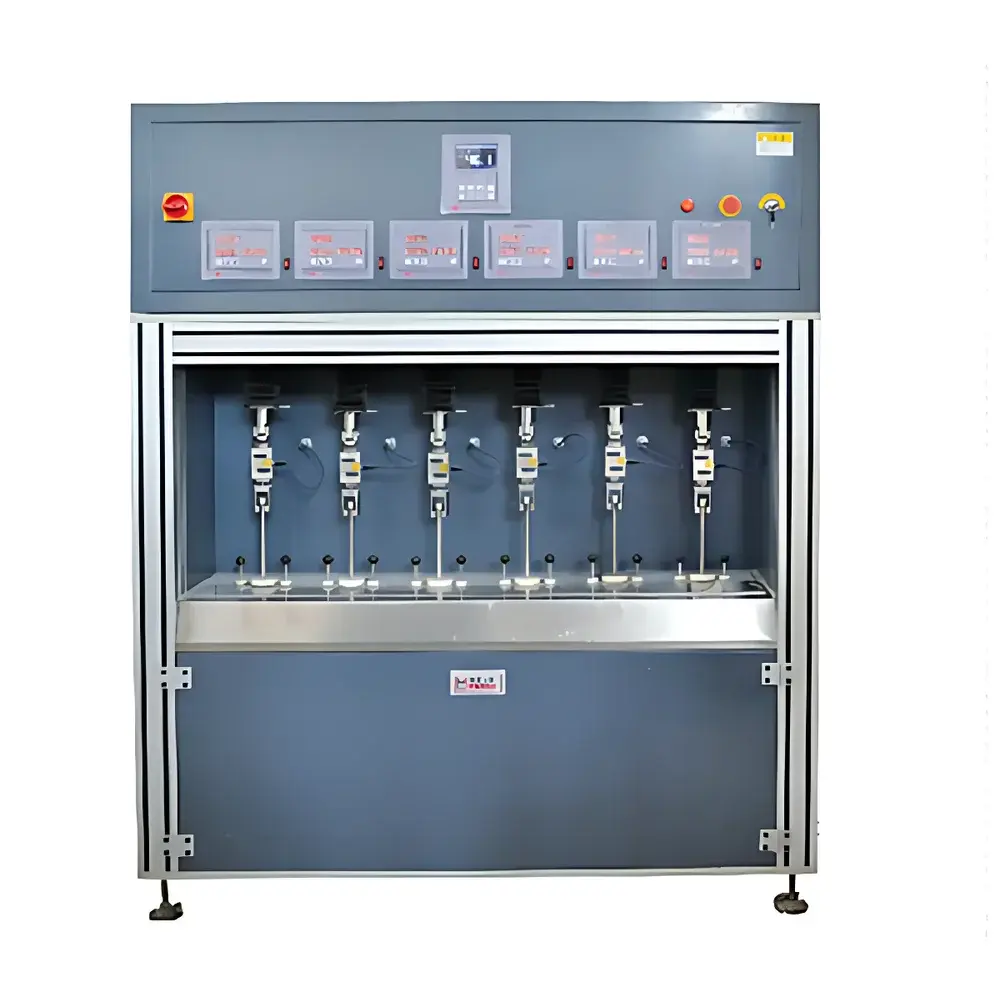
Hengyi HY-QKRB FNCT Creep Testing Machine
| Brand | Hengyi / Hengyitest |
|---|---|
| Origin | Shanghai, China |
| Manufacturer Type | Manufacturer |
| Region of Origin | Domestic (China) |
| Model | HY-QKRB |
| Quotation | Upon Request |
| Load Capacity | 2000 N |
| Force Accuracy | Class 0.5 |
| Effective Force Range | 0.4–99.999% of full scale |
| Test Width | 120 mm |
| Test Space | 200 mm |
| Speed Range | 0.001–100 mm/min (adjustable) |
| Speed Accuracy | ±1% of indicated value |
| Displacement & Strain Measurement Accuracy | ±1% of indicated value |
| Test Stations | 6 or 12 independent stations |
| Temperature Control Range | Ambient to 95 °C |
| Temperature Stability | ±0.5 °C |
| Control System | PC-based software |
| Power Requirement | 10 kW, 220 V AC |
| Unit Weight | 850 kg |
| Dimensions (W×D×H) | 1620 × 850 × 1750 mm |
| Compliance | GB/T 15820, GB/T 11546, GB/T 32682–2016, ISO 899-1, ISO 3501, ISO 16770 |
Overview
The Hengyi HY-QKRB FNCT (Full Notch Creep Testing) Machine is a precision-engineered, multi-station static tensile creep and environmental stress cracking (ESC) testing system designed for polyethylene (PE) and other thermoplastic polymer composites used in pressure piping systems. It operates on the principle of sustained uniaxial loading under controlled thermal and chemical environments—typically aqueous surfactant solutions at elevated temperatures—to quantify time-dependent deformation and failure behavior. The instrument implements standardized FNCT methodology per ISO 16770 and GB/T 32682–2016, where pre-notched specimens are subjected to constant tensile stress while immersed in a thermostatically regulated bath. Failure is defined as crack initiation and propagation leading to specimen rupture. This test method provides critical data for service life prediction, material ranking, and quality assurance in PE pipe manufacturing and third-party certification laboratories.
Key Features
- Six or twelve fully independent test stations, each equipped with electromechanical load application and real-time force feedback—enabling parallel testing without cross-interference.
- Modular elastic support architecture isolates mechanical vibration and thermal drift between stations, ensuring high reproducibility across long-duration tests (up to thousands of hours).
- Integrated high-stability temperature-controlled water bath (ambient to 95 °C, ±0.5 °C uniformity) with corrosion-resistant stainless-steel construction and precise fluid circulation.
- Class 0.5 load cell accuracy (per ISO 7500-1) with selectable transducers up to 2000 N; optional lower-capacity sensors available for enhanced resolution in low-stress regimes.
- Wide dynamic speed range (0.001–100 mm/min) with closed-loop control and ±1% speed fidelity—critical for achieving target stress levels via displacement-controlled loading protocols.
- Comprehensive hardware-level safety logic: over-temperature cutoff, overload protection, emergency stop interlock, and automatic fault diagnosis with event logging.
Sample Compatibility & Compliance
The HY-QKRB accommodates standard FNCT specimens per ISO 16770 (e.g., 80 × 10 × 4 mm PE bars with 2-mm full-depth notch) as well as ASTM D1598-compliant pipe pull-out configurations. It supports both dry and wet immersion testing modes, including aggressive detergent solutions (e.g., Igepal CO-630) commonly used in ESC evaluation. All mechanical and thermal subsystems comply with electromagnetic compatibility (EMC) and electrical safety standards applicable to laboratory instrumentation (IEC 61326-1, IEC 61010-1). The system satisfies metrological traceability requirements under ISO/IEC 17025 for accredited testing laboratories and supports audit-ready documentation for GLP/GMP environments.
Software & Data Management
The proprietary Windows-based control software provides full automation of test setup, execution, and post-processing. Users define stress levels, temperature profiles, and duration per station; the system autonomously applies and maintains load while recording force, displacement, and time-synchronized bath temperature at user-configurable intervals (down to 1-second resolution). Raw data are stored in vendor-neutral CSV format with embedded metadata (test ID, operator, calibration certificate ID, environmental conditions). Built-in analysis modules compute time-to-failure (TTF), generate master curves (log σ vs. log t), and plot displacement–time, force–time, and stress–failure time relationships. Audit trails—including user login history, parameter changes, and manual overrides—are retained per FDA 21 CFR Part 11 guidelines when configured with electronic signature modules.
Applications
- Environmental stress cracking (ESC) resistance evaluation of PE100 and PE100-RC resins for gas/water distribution pipes.
- Quality control of butt-fusion and electrofusion joint integrity per GB/T 15820 (pull-out strength under sustained load).
- Comparative ranking of polymer formulations during R&D, especially for additives affecting long-term ductility.
- Validation of accelerated aging models against field performance data in infrastructure asset management programs.
- Third-party certification testing for ISO 4427, EN 1555, and AS/NZS 4130 compliance.
FAQ
What test standards does the HY-QKRB support?
It fully implements ISO 16770 (FNCT), ISO 899-1 (tensile creep), ISO 3501 (ESC by bent strip), GB/T 32682–2016, GB/T 11546, and GB/T 15820 for pipe joint pull-out testing.
Can the system operate unattended for extended durations?
Yes—designed for continuous operation up to 10,000 hours with automated shutdown on failure detection, power-loss recovery, and remote monitoring capability via Ethernet.
Is calibration traceable to national standards?
All load cells and temperature sensors are supplied with UKAS-accredited calibration certificates (NIST-traceable where applicable); annual recalibration services are available.
How is data integrity ensured during long-term testing?
Real-time dual-storage (RAM + SSD), cyclic redundancy checksum validation, and automatic backup to network drives prevent data loss—even during unexpected interruptions.
Does the system support custom test protocols beyond standard methods?
Yes—the software SDK allows scripting of non-standard ramp-hold sequences, multi-step temperature profiles, and conditional termination logic based on real-time strain thresholds.



