
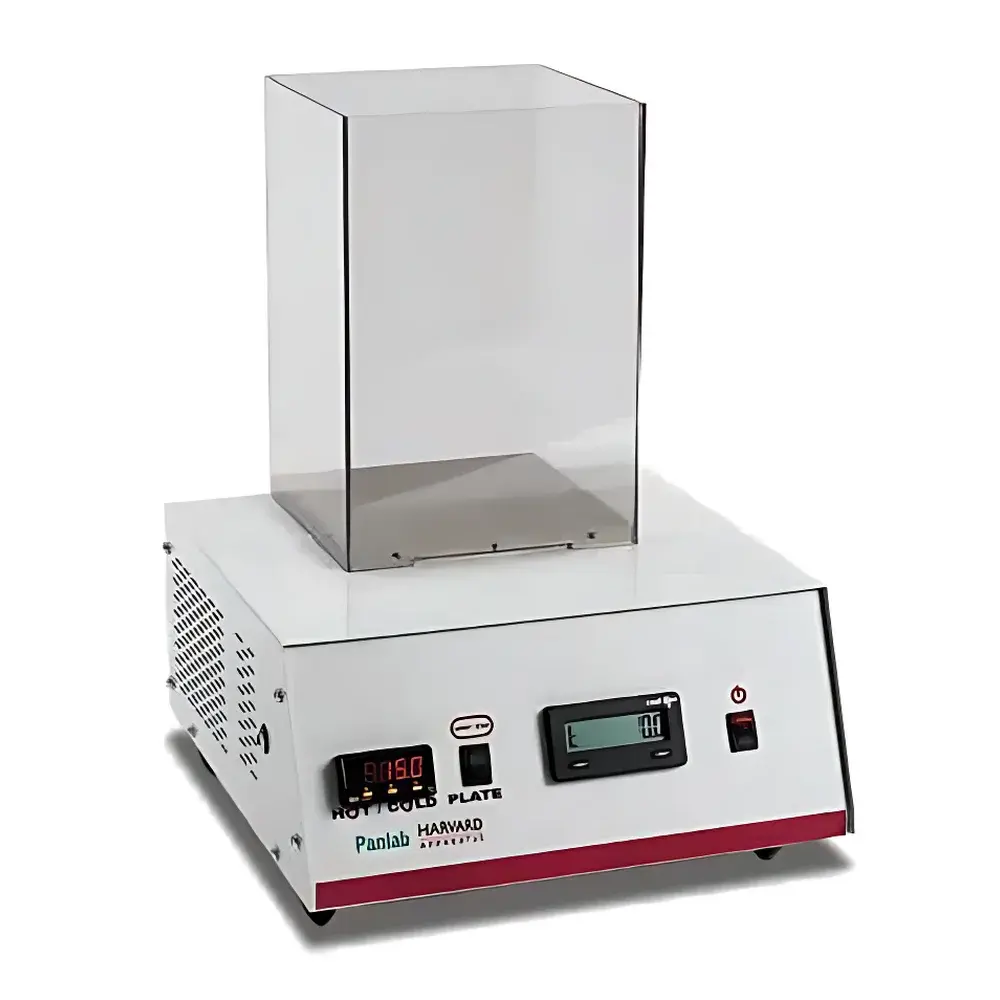
Panlab LE7420 Cold-Hot Plate Instrument
| Brand | Harvard Apparatus |
|---|---|
| Origin | Mexico |
| Model | LE7420 |
| Temperature Range | −3 °C to 65 °C (at ambient 20–25 °C, 50% RH) |
| Temperature Uniformity | < 0.5 °C across plate surface |
| Timing Resolution | 0.1 s |
| Plate Dimensions | 165 × 165 mm |
| Base Dimensions | 305 × 280 × 158 mm |
| Weight | 6.5 kg |
| Included Software | BSRamp Software |
| Optional Software | SeDaCom Data Acquisition Software |
Overview
The Panlab LE7420 Cold-Hot Plate Instrument is a precision-engineered thermal nociception testing platform designed for preclinical evaluation of analgesic efficacy in rodent models. Based on validated thermally evoked withdrawal paradigms, the system operates on the principle of measuring latency-to-response—specifically, the time elapsed between placement of an animal onto a thermally controlled metal plate and the first hindpaw lift or lick, indicative of acute thermal nociception. Unlike single-temperature assays, the LE7420 integrates both cold- and hot-plate modalities within a single, unified hardware architecture—enabling bidirectional assessment of thermal pain thresholds across a broad physiological spectrum (−3 °C to +65 °C). This dual-range capability supports comparative pharmacodynamic profiling of centrally and peripherally acting analgesics, including opioids, NSAIDs, TRP channel modulators, and novel neuropathic agents. The instrument employs solid-state Peltier elements coupled with high-stability electronic temperature regulation, ensuring rapid thermal transitions (e.g., ≤10 min from 22 °C to 4 °C; ≤5 min from 4 °C to 65 °C) and minimal spatial gradient (<0.5 °C deviation across the 165 × 165 mm active surface).
Key Features
- Simultaneous cold- and hot-plate functionality in a single, compact benchtop unit
- Precise Peltier-based temperature control with real-time digital display on front-panel LCD and synchronized PC interface
- High temporal resolution timing (0.1 s) via front-panel start/stop buttons or optional footswitch for hands-free operation
- Uniform thermal distribution verified across full plate area—critical for reproducible inter-trial and inter-laboratory data
- Modular software architecture: BSRamp enables programmable temperature ramps (linear, stepwise, or custom profiles) for dynamic thermal challenge protocols, including those compatible with telemetry-integrated studies
- Optional SeDaCom software provides synchronized acquisition of behavioral timestamps alongside external physiological signals (e.g., core body temperature, ECG, locomotor activity)
- Robust mechanical design with aluminum alloy heating/cooling plate and vibration-damped base (305 × 280 × 158 mm; 6.5 kg), optimized for stability during repeated animal handling
Sample Compatibility & Compliance
The LE7420 is validated for use with mice (C57BL/6, CD-1, BALB/c) and rats (Sprague-Dawley, Wistar) weighing 15–300 g. Plate dimensions and edge geometry accommodate standard caging-derived acclimation protocols while minimizing escape behavior. All thermal protocols comply with internationally recognized guidelines for ethical pain research, including the IASP’s “Ethical Standards for Investigations of Experimental Pain in Animals” and the EU Directive 2010/63/EU. Temperature calibration is traceable to NIST-certified reference standards, and system performance documentation supports GLP-compliant study reporting. While not FDA-cleared as a medical device, the instrument meets essential electrical safety requirements per IEC 61010-1 and electromagnetic compatibility per IEC 61326-1.
Software & Data Management
BSRamp Software serves as the primary control and protocol definition interface. It allows users to define multi-phase temperature profiles—including ramp rate (°C/min), dwell times, upper/lower limits, and auto-termination conditions—ensuring strict adherence to standardized test sequences. All timing events (onset, response, timeout) are timestamped with millisecond accuracy and exported in CSV or Excel-compatible formats. Audit trails record user actions, parameter changes, and calibration logs—supporting 21 CFR Part 11 readiness when deployed with appropriate IT infrastructure and administrative controls. SeDaCom (optional) extends functionality by enabling synchronized acquisition from third-party analog/digital inputs (e.g., implanted telemeters, force plates, video tracking systems), facilitating multimodal correlation of thermal sensitivity with autonomic or motor outputs.
Applications
- Quantitative assessment of antinociceptive potency and duration of action for novel analgesic compounds
- Differentiation of central vs. peripheral mechanisms using selective thermal challenges (e.g., cold allodynia in neuropathic models vs. heat hyperalgesia in inflammatory models)
- Pharmacokinetic–pharmacodynamic (PK–PD) modeling of dose–response relationships under dynamic thermal stress
- Evaluation of sex-, age-, or strain-dependent variations in thermal nociceptive thresholds
- Validation of genetically modified animal models exhibiting altered TRPM8, TRPV1, or TRPA1 channel function
- Support for regulatory submission packages requiring ISO/IEC 17025-aligned instrumentation verification records
FAQ
What is the recommended acclimation protocol prior to testing?
Animals should be habituated to the testing room (22 ± 2 °C, 50 ± 10% RH) for ≥30 min and placed on a neutral-temperature plate (30 °C) for 2–3 min to minimize non-specific stress responses.
Can the LE7420 be integrated with existing video-tracking systems?
Yes—via TTL pulse synchronization output and SeDaCom’s API interface, enabling frame-accurate alignment of thermal onset with behavioral event detection.
Is routine calibration required, and how is it performed?
Annual calibration using certified RTD probes is recommended; procedure is documented in the Instrument Qualification Package and supported by Panlab-certified service engineers.
Does the system support automated animal detection to trigger timing?
No—timing initiation remains manual (panel button or footswitch) to maintain experimental control and avoid false triggers from exploratory behavior.
What environmental conditions must be maintained during operation?
Ambient temperature 20–25 °C and relative humidity 30–70% are required to guarantee specified temperature range and uniformity performance.





