
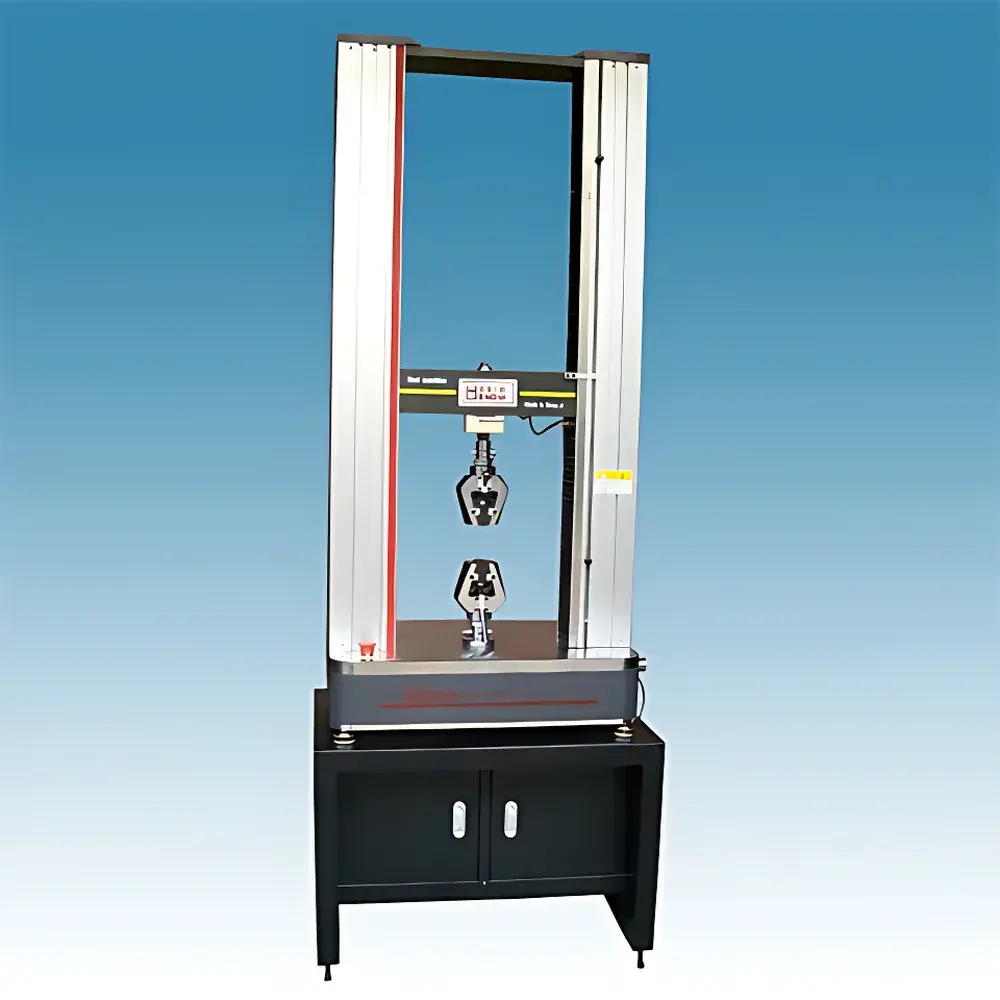
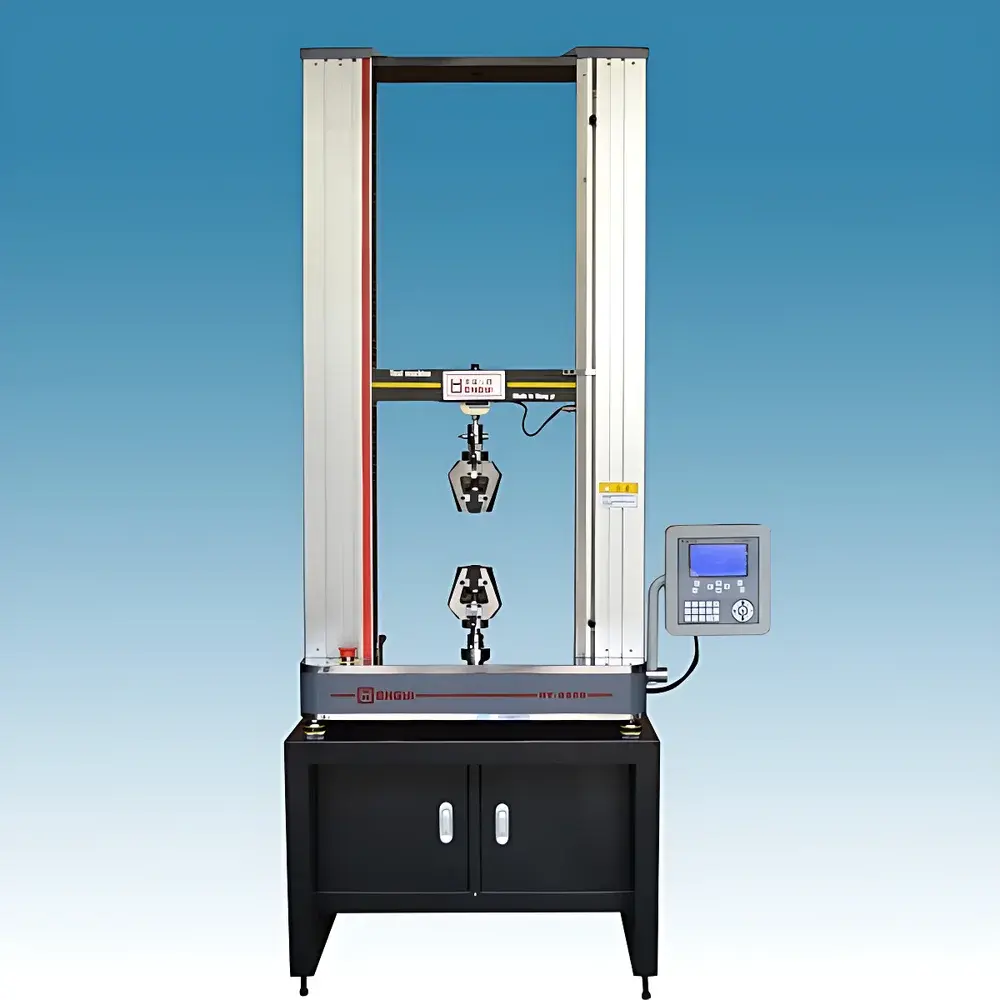
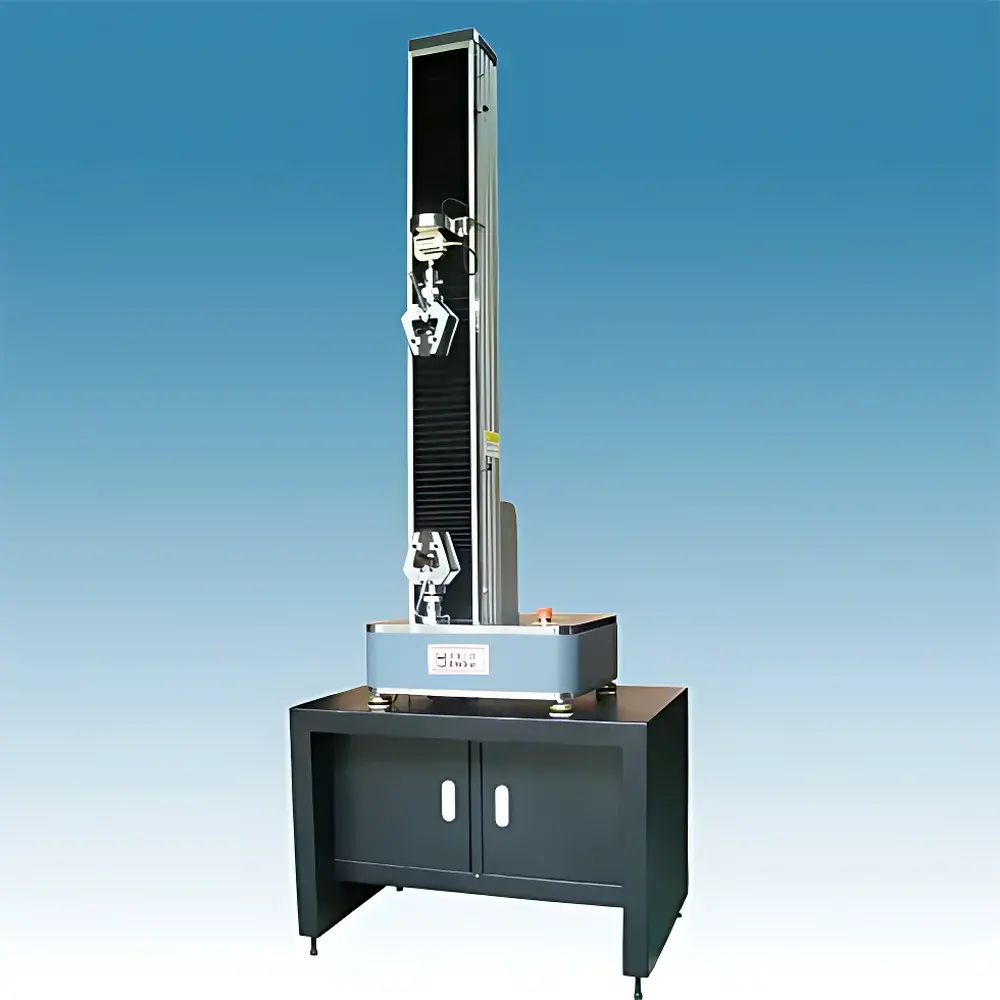
Hengyi HY-0580LKUI Single-Column Universal Testing Machine for Three-Point Bending Strength Testing of Al-Ti Composite Plates
| Brand | Hengyi |
|---|---|
| Origin | Shanghai, China |
| Manufacturer Type | Direct Manufacturer |
| Product Category | Domestic |
| Model | HY-0580LKUI |
| Instrument Type | Electromechanical Universal Testing Machine |
| Load Capacity Options | 1 N to 5000 N (interchangeable load cells) |
| Force Accuracy | ≤ ±0.5% of reading |
| Effective Test Width | 120 mm |
| Effective Vertical Travel | 800 mm |
| Speed Range | 0.001–500 mm/min (adjustable) |
| Speed Accuracy | ±0.5% of set value |
| Displacement Accuracy | ±0.5% of reading |
| Strain Measurement Accuracy | ±0.5% of reading |
| Force Resolution | ±500,000 counts (full-scale, no range switching) |
| Stress/Strain Control Range | 0.005–6% FS/s |
| Constant-Load/Displacement/Strain Control Accuracy | ±0.1% FS (≥10% FS), ±1% FS (<10% FS) |
| Safety Features | Electronic limit protection, overload protection (110% FS), auto-diagnostic system |
| Power Supply | 220 V AC, 750 W |
| Dimensions (W×D×H) | 470 × 400 × 1510 mm |
| Weight | 120 kg |
Overview
The Hengyi HY-0580LKUI is a single-column electromechanical universal testing machine engineered for high-reproducibility mechanical characterization of advanced laminated and composite materials—specifically optimized for three-point bending strength evaluation of aluminum-titanium (Al-Ti) clad plates. It operates on the principle of controlled displacement actuation via a precision ball-screw-driven crosshead, with force feedback acquired through calibrated S-type or cantilever load cells. The system conforms to static uniaxial testing fundamentals defined in ISO 7500-1, ASTM E4, and GB/T 16491-2008, delivering traceable, standards-compliant data for R&D, quality assurance, and regulatory submission workflows. Its rigid monolithic frame, low-inertia drive architecture, and real-time closed-loop control ensure minimal compliance error and consistent load train alignment—critical for brittle or anisotropic composites where localized stress concentrations govern failure mode.
Key Features
- Modular load cell configuration supporting 1 N to 5000 N capacities, enabling seamless transition between micro-scale interfacial shear testing and macro-scale structural bending evaluation.
- Full-scale force resolution of ±500,000 digital counts without range switching—maintaining constant resolution across the entire measurement span per ISO 376 Annex C requirements.
- Adjustable crosshead speed from 0.001 mm/min (for creep or relaxation studies) to 500 mm/min (for high-rate quasi-static loading), with velocity accuracy maintained within ±0.5% of setpoint per ASTM E2309.
- Dual-mode motion control: manual jog operation for precise specimen alignment and automated programmable sequences for standardized test protocols (e.g., ISO 14125 for flexural properties of fiber-reinforced plastics).
- Integrated electronic limit switches and hardware-based overload cutoff (110% FS threshold) prevent mechanical damage during unexpected specimen rupture or fixture misalignment.
- Self-diagnostic subsystem continuously monitors drive current, encoder feedback, and amplifier voltage—triggering immediate shutdown upon detection of overpressure, overcurrent, or position deviation exceeding 0.1 mm.
Sample Compatibility & Compliance
The HY-0580LKUI accommodates flat-sheet specimens up to 120 mm wide and 800 mm tall, making it suitable for standardized three-point bending configurations per ASTM D790, ISO 178, and GB/T 3354. Its open-front design allows rapid fixture exchange—including custom-designed three-point bend supports with radiused rollers (R ≥ 5 mm) and hardened steel anvils meeting ISO 2041 specifications. The machine satisfies metrological requirements of GB/T 2611-2007 (General Technical Requirements for Testing Machines), GB/T 16852.1-2008 (Verification of Static Uniaxial Testing Machines), and ISO 7500-1:2018 (Calibration of Force-Proving Instruments). All force and displacement outputs are traceable to national standards via factory calibration certificates compliant with ISO/IEC 17025 procedures.
Software & Data Management
Control and analysis are executed via Hengyi’s proprietary PC-based software suite, supporting Windows 10/11 environments and compliant with FDA 21 CFR Part 11 for audit-trail-enabled data integrity. The interface enables creation of multi-step test profiles (e.g., preload → ramp → hold → unload), automatic calculation of flexural modulus, yield strength, and fracture toughness (KIC-equivalent for thin plates), and export of raw time-stamped data in CSV or XML formats. Software modules include GLP-compliant user access levels, electronic signature capability, and configurable report templates aligned with ISO/IEC 17025 documentation requirements. Raw sensor data is stored locally with SHA-256 hash verification to prevent post-acquisition tampering.
Applications
- Three-point bending strength and stiffness quantification of Al-Ti bimetallic plates used in aerospace heat exchangers and marine propulsion components.
- Mechanical screening of diffusion-bonded interfaces under controlled strain rates to assess interlayer adhesion integrity.
- Quality conformance testing per GB/T 3923 (woven fabric tensile), GB/T 1040 (plastics tensile), and ISO 527 series for polymer matrix composites.
- Development validation of novel clad architectures—e.g., Ti-6Al-4V/AA2024 stacks—where asymmetric yield behavior necessitates precise moment-arm calibration.
- Educational use in university materials science labs for hands-on instruction in ASTM E8/E8M principles and fracture mechanics fundamentals.
FAQ
What standards does the HY-0580LKUI support for three-point bending tests?
It complies with ASTM D790, ISO 178, GB/T 3354, and GB/T 1449—covering flexural property determination for metals, polymers, and hybrid laminates.
Can the system perform both tension and compression testing?
Yes—equipped with reversible load train geometry and dual-directional load cells, it supports axial tension, compression, bending, peel, and shear per ISO 376 and ASTM E4.
Is the software validated for regulated environments (e.g., ISO 13485 or GMP)?
The software includes 21 CFR Part 11-compliant audit trails, role-based permissions, and electronic signature functionality—validated for use in medical device and pharmaceutical QA/QC labs.
How is force calibration maintained over time?
Each load cell ships with a NIST-traceable calibration certificate; field recalibration is supported using certified deadweight standards per ISO 376 Annex D.
What safety certifications apply to the electrical architecture?
The unit meets IEC 61000-6-2 (immunity) and IEC 61000-6-4 (emissions), with CE marking for EMC Directive 2014/30/EU and Low Voltage Directive 2014/35/EU.



