
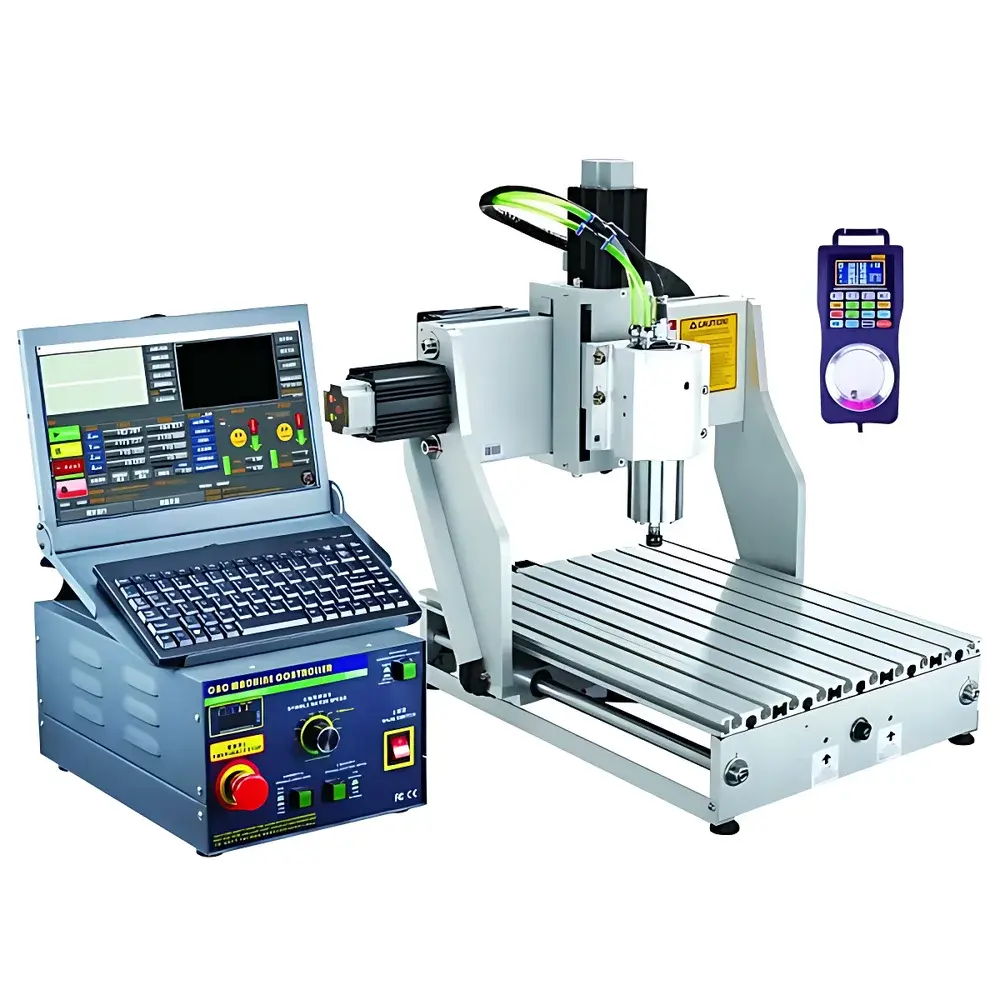
Hengyi HY(DK)ERTT Computer-Controlled Composite Material Specimen Preparation Machine
| Brand | Hengyi / Hengyitest |
|---|---|
| Origin | Shanghai, China |
| Manufacturer Type | Direct Manufacturer |
| Regional Category | Domestic (China) |
| Model | HY(DK)ERTT |
| Quotation | Upon Request |
| Spindle Speed | 24,000 rpm |
| Feed Rate | 0–500 mm/min |
| Cutting Depth | 2–20 mm |
| Applicable Pipe Diameter | 50–250 mm |
| Max. Workpiece Length (Pipe/Sheet) | 260 mm |
| X-axis Travel | 280 mm |
| Y-axis Travel | 310 mm |
| Z-axis Travel | 70 mm |
| Frame Material | Aluminum Alloy |
| Stepper Motor & Driver Sets | 3 |
| High-Speed Variable-Frequency Spindle Motor | 1 |
| Precision Linear Guide Rods | 6 |
| Precision Ball Screws | 3 |
| Standard Vise | 1 set |
| Specimen Dimensional Accuracy | Compliant with GB/T 1043, GB/T 1843, GB/T 1040, GB/T 8804.2, ISO 8004.2, and ISO 179 |
| Tooling Options | Cylindrical End Mill, 20° Flat-End Cutter, Slitting Blade, 45° Chamfering Cutter |
| Tool Diameters | Φ3 mm, Φ4 mm, Φ6 mm |
| Max. Machining Envelope | 300 × 150 × 100 mm |
| Power Supply | AC 220 V |
| Total Power Consumption | 1500 W |
| Net Weight | 45 kg |
Overview
The Hengyi HY(DK)ERTT Computer-Controlled Composite Material Specimen Preparation Machine is a precision CNC-based machining system engineered for the reproducible fabrication of standardized test specimens from thermoplastic, thermoset, fiber-reinforced polymer (FRP), glass-reinforced plastic (GRP), acrylic, and other non-metallic structural materials. Unlike manual or semi-automatic sample cutters, this machine employs closed-loop motion control architecture—integrating high-torque stepper motors, preloaded ball screws, and hardened linear guide rods—to ensure micron-level repeatability in specimen geometry across sequential production runs. Its core operational principle relies on programmable toolpath execution (G-code compatible) to perform milling, slotting, notching, chamfering, and dumbbell-profile cutting under consistent spindle dynamics (24,000 rpm constant-speed operation). Designed specifically to meet the dimensional tolerancing requirements of mechanical property testing standards—including tensile (GB/T 1040, ISO 527), impact (GB/T 1043, ISO 179, GB/T 1843), flexural (GB/T 9341, ISO 178), and pipe-specific evaluation protocols (GB/T 8804.2, ISO 8004.2)—the HY(DK)ERTT eliminates operator-induced variability inherent in hand-sawing or template-guided methods.
Key Features
- Integrated CNC control system with intuitive GUI interface supporting ISO-standard G-code input and parametric macro programming for batch specimen generation
- High-rigidity aluminum alloy frame with vibration-damping structural design, minimizing thermal drift and dynamic deflection during extended machining cycles
- Dual-mode spindle drive: variable-frequency inverter enables stable high-speed rotation (24,000 rpm ±1%) with torque compensation across load fluctuations
- Three-axis orthogonal motion system (X: 280 mm, Y: 310 mm, Z: 70 mm) featuring preloaded ground ball screws (C5 grade) and hardened linear guide rods (6 sets) for positional accuracy ≤ ±0.02 mm
- Modular tooling station accommodating interchangeable cutters: cylindrical end mills (Φ3/Φ4/Φ6 mm), 20° flat-bottom notch cutters, slitting blades, and 45° chamfer tools—each optimized for specific ASTM/ISO specimen geometries
- Standard vise with T-slot base and adjustable clamping force ensures secure workholding for pipes (Ø50–250 mm) and flat sheets up to 260 mm in length
- Comprehensive safety architecture including emergency stop circuitry, interlocked enclosure doors, and real-time spindle overload monitoring
Sample Compatibility & Compliance
The HY(DK)ERTT accommodates a broad spectrum of polymeric and composite substrates—including PVC, PP, PE, ABS, PC, PMMA, carbon-fiber laminates, and fiberglass-reinforced resins—without requiring material-specific tool recalibration. It produces specimens conforming to mandatory dimensional specifications outlined in GB/T 1040.2 (tensile dumbbells, Type I/II), GB/T 1043.1 (Charpy/Izod impact bars with 2-mm or 4-mm notches), GB/T 1843 (notched cantilever beam specimens), GB/T 8804.2 (polyethylene pipe tensile test pieces), and corresponding ISO equivalents (ISO 527-2, ISO 179-1, ISO 1843-1, ISO 8004-2). All machined edges exhibit surface roughness Ra ≤ 1.6 µm—verified via tactile profilometry—ensuring minimal stress-concentration artifacts during subsequent mechanical testing. The system supports GLP-compliant documentation workflows when integrated with external LIMS platforms.
Software & Data Management
The embedded control software provides native support for ISO 6983 (G-code) and includes built-in libraries for standard specimen profiles per GB, ISO, and ASTM standards. Users may import DXF files for custom geometries or define parametric variables (e.g., notch depth, radius, gauge length) via editable templates. Audit-trail functionality logs all machining parameters—including tool offset values, feed rate profiles, spindle RPM history, and timestamped job completion records—for traceability in regulated environments. Export options include CSV-formatted machining logs and PDF reports containing specimen ID, material lot number, operator ID, and compliance verification statements aligned with ISO/IEC 17025 documentation requirements.
Applications
- Routine preparation of ISO/GB-compliant tensile dumbbell specimens from extruded polymer pipes and injection-molded plaques
- High-throughput generation of notched impact bars for quality control in PVC window profile manufacturing
- Production of standardized flexural test beams for structural composites used in wind turbine blade R&D
- Specimen conditioning prior to accelerated aging studies (UV, thermal cycling, humidity exposure)
- Reference specimen fabrication for inter-laboratory round-robin testing programs accredited under CNAS (China National Accreditation Service)
- Supporting ISO 17025-accredited testing laboratories in fulfilling clause 7.2.2 (sampling and specimen preparation) requirements
FAQ
What standards does the HY(DK)ERTT explicitly support for specimen geometry?
It meets dimensional tolerances defined in GB/T 1040.2, GB/T 1043.1, GB/T 1843, GB/T 8804.2, ISO 527-2, ISO 179-1, ISO 1843-1, and ISO 8004.2 for tensile, impact, and pipe-specific test specimens.
Can the machine process carbon fiber laminates without delamination?
Yes—when using optimized feed rates (≤300 mm/min) and diamond-coated Φ4 mm end mills, the system maintains interlaminar shear stress below critical thresholds, as validated by SEM cross-section analysis per ASTM D7264.
Is the control software compatible with Windows-based laboratory information management systems (LIMS)?
The machine exports CSV and PDF reports with structured metadata fields (specimen ID, date/time stamp, operator code, standard reference), enabling direct ingestion into common LIMS platforms via API or folder-watch integration.
What maintenance intervals are recommended for the spindle and motion system?
Spindle bearings require re-greasing every 2,000 operational hours; ball screws and linear guides should be inspected and lubricated quarterly per ISO 13374 condition monitoring guidelines.
Does the system support FDA 21 CFR Part 11 compliance for electronic records?
While the base controller does not include digital signature or role-based access modules, its audit-trail export capability allows integration with third-party e-signature middleware to satisfy Part 11 requirements in pharmaceutical packaging validation labs.
Related Products



