
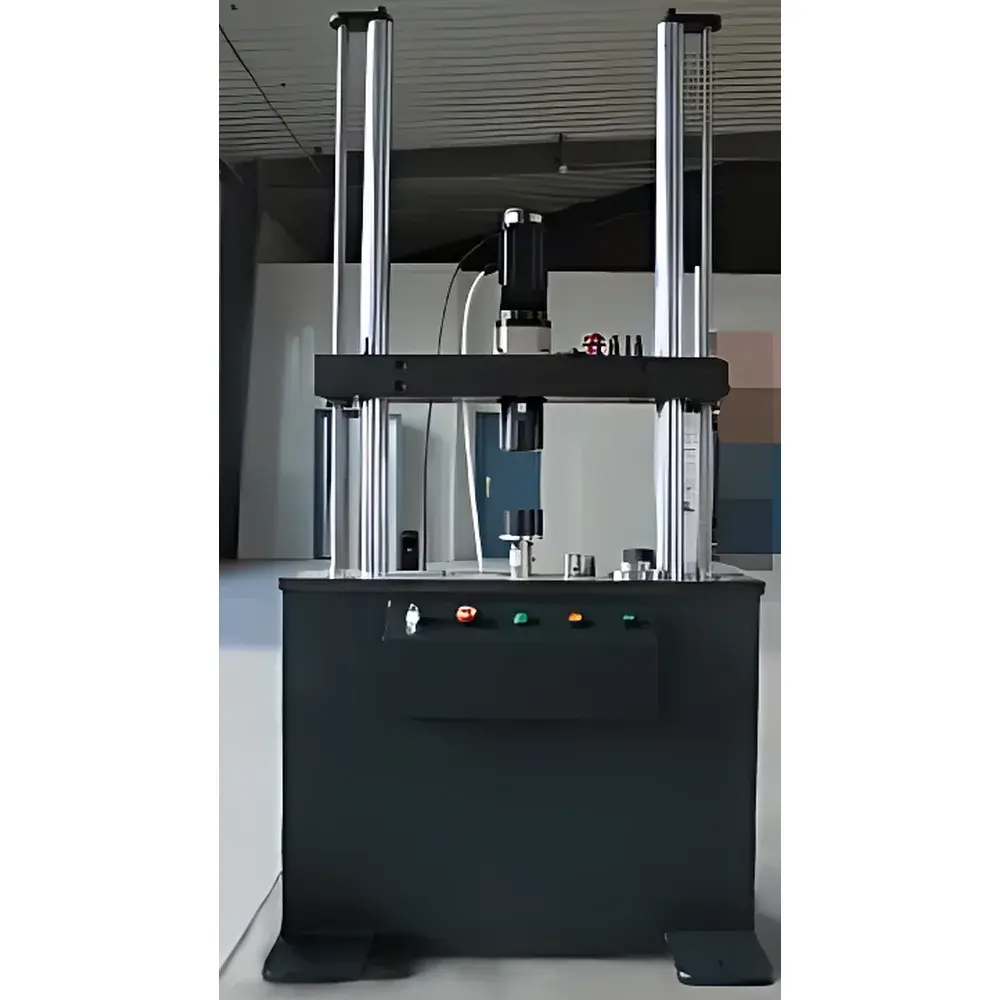
Hengyi HY(DZPL)-5KN Electromechanical Fatigue Testing Machine
| Brand | Hengyi |
|---|---|
| Origin | Shanghai, China |
| Manufacturer Type | Direct Manufacturer |
| Product Category | Domestic |
| Model | HY(DZPL) |
| Max Test Force | ±5000 N |
| Frequency Range | 10 Hz |
| Actuator Stroke | 100 mm |
| Adjustable Test Space | 500 mm |
| Dimensions (L×W×H) | 930 × 610 × 2000 mm |
| Weight | 60 kg |
| Force Measurement Accuracy | ±1% |
| Control Accuracy | ±1% |
Overview
The Hengyi HY(DZPL)-5KN Electromechanical Fatigue Testing Machine is a precision-engineered, servo-controlled fatigue testing system designed for low-load, low-to-moderate frequency cyclic loading applications. It operates on the principle of electromechanical actuation—utilizing a high-fidelity AC servo motor coupled with a precision ball-screw transmission mechanism to deliver controlled sinusoidal, triangular, or trapezoidal load waveforms. Unlike hydraulic systems, this machine eliminates fluid maintenance, leakage risks, and thermal drift, offering enhanced long-term stability and repeatability in ambient laboratory environments. Its ±5000 N dynamic force capacity and 10 Hz maximum test frequency make it especially suitable for evaluating the fatigue behavior of small-scale metallic specimens, polymer components, biomedical implants, thin films, and micro-mechanical structures under uniaxial tension-compression or bending conditions.
Key Features
- Servo-driven electromechanical actuation ensures precise, programmable control over load amplitude, frequency, waveform shape, and cycle count without hydraulic infrastructure.
- Integrated high-resolution load cell with ±1% full-scale accuracy and real-time digital signal conditioning for reliable force feedback and closed-loop control.
- 100 mm stroke actuator enables flexible specimen accommodation while maintaining mechanical rigidity and minimal axial deflection during cyclic loading.
- Adjustable vertical test space (500 mm) accommodates diverse specimen geometries and custom fixture configurations—including tensile, compression, and three-point bending setups.
- Robust structural frame (60 kg total mass) minimizes resonance interference and supports stable operation up to 10 Hz without external anchoring or vibration isolation tables.
- Modular hardware architecture allows seamless integration with optional extensometers, environmental chambers, or acoustic emission sensors for multi-parameter fatigue characterization.
Sample Compatibility & Compliance
The HY(DZPL)-5KN supports standardized and non-standard specimens conforming to ASTM E466, ISO 1099, and GB/T 26077–2010 (Metallic Materials — Fatigue Testing — Axial Strain-Controlled Method). Typical sample types include dog-bone tensile bars (ASTM E8/E9), notched specimens (ASTM E606), miniature cantilevers, solder joints, MEMS devices, and elastomeric connectors. The system complies with general safety requirements per IEC 61000-6-2 (EMC immunity) and IEC 61000-6-4 (EMC emissions). While not pre-certified for FDA 21 CFR Part 11 or GLP/GMP audit trails out-of-the-box, its software architecture supports traceable data logging and user-access controls when deployed with validated third-party compliance modules.
Software & Data Management
The machine is operated via Hengyi’s proprietary Windows-based control and analysis software, supporting both manual setup and automated test sequences. Users define test parameters—including target stress/strain amplitude, mean load, frequency, and termination criteria (cycle count, stiffness degradation, or fracture detection)—through an intuitive graphical interface. Real-time plotting of force vs. displacement, hysteresis loops, and S-N curve generation is available. Raw data is exported in CSV or Excel-compatible formats with timestamps, channel metadata, and calibration identifiers. The software maintains local audit logs of operator actions, parameter changes, and test execution history—enabling basic traceability required for internal QA documentation and academic reproducibility.
Applications
- High-cycle fatigue (HCF) evaluation of aerospace fasteners and miniature structural components.
- Low-cycle fatigue (LCF) and ratcheting behavior assessment in thermoplastic elastomers and shape-memory alloys.
- Reliability screening of electronic interconnects, solder bumps, and flexible printed circuits (IPC-J-STD-001, IPC-9701).
- Fatigue life prediction modeling using strain-life (ε–N) and stress-life (S–N) approaches.
- Material qualification per automotive OEM specifications (e.g., GMW14872, Ford WSS-M99P1111-A).
- Research-grade fatigue crack initiation and propagation studies in university mechanics labs.
FAQ
What types of waveforms can be generated?
Sinusoidal, triangular, square, and trapezoidal waveforms are supported, all fully programmable in amplitude, offset, frequency, and duty cycle.
Is the system compatible with extensometers?
Yes—the control system provides analog input channels and digital trigger interfaces for commercially available clip-on or non-contact extensometers.
Can the machine perform strain-controlled fatigue tests?
Yes, when paired with a calibrated extensometer and configured in closed-loop strain control mode.
What is the recommended maintenance schedule?
Biannual inspection of ball-screw lubrication, load cell zero verification, and servo tuning validation is advised; no hydraulic fluid servicing required.
Does the software support automated reporting?
Basic report templates (PDF/HTML) with test summary, curves, and statistics are included; custom reporting requires export to external analysis tools like MATLAB or Python.



